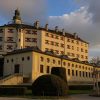
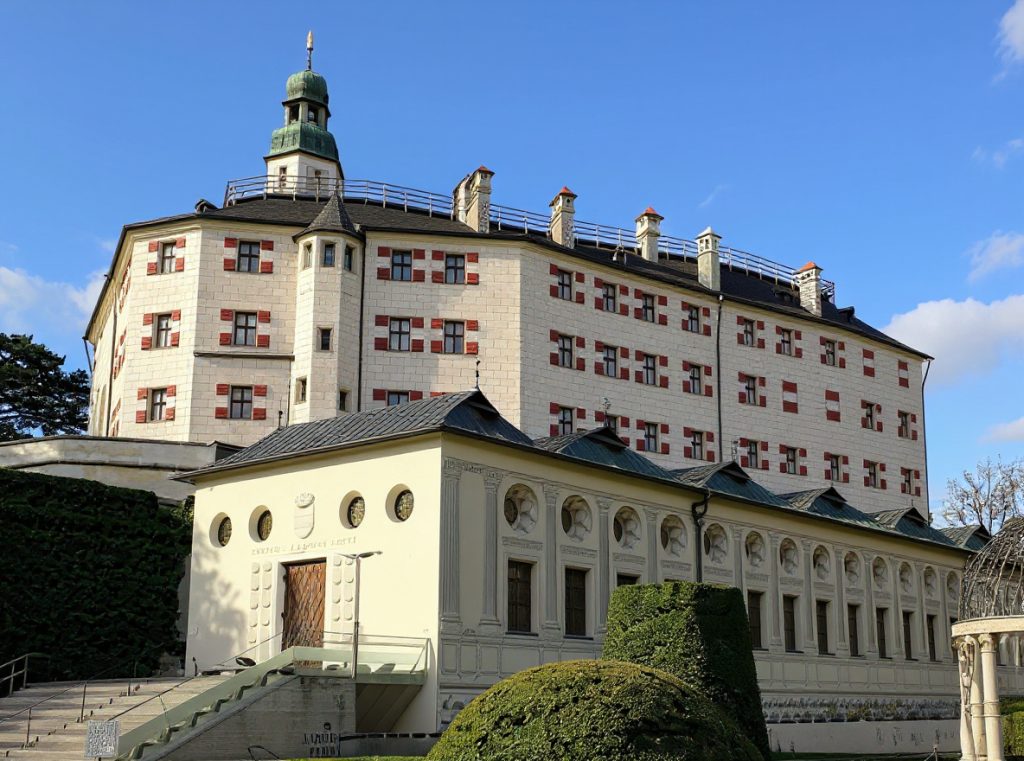
Rising from a wooded hill above Innsbruck, Ambras Castle commands sweeping views across the Tyrolean capital and the surrounding Alps. Archduke Ferdinand II founded this Renaissance castle in the 16th century when he transformed a medieval fortress into an elegant palace. The collections in the Lower Castle, which builders constructed specifically for museum purposes, make Ambras Castle one of the oldest museums in the world. The Chamber of Art and Curiosities still occupies its original location. The archduke ordered the medieval fortress turned into a Renaissance castle as a gift for his wife Philippine Welser.
Plan your visit to Ambras Castle
Location of Ambras Castle
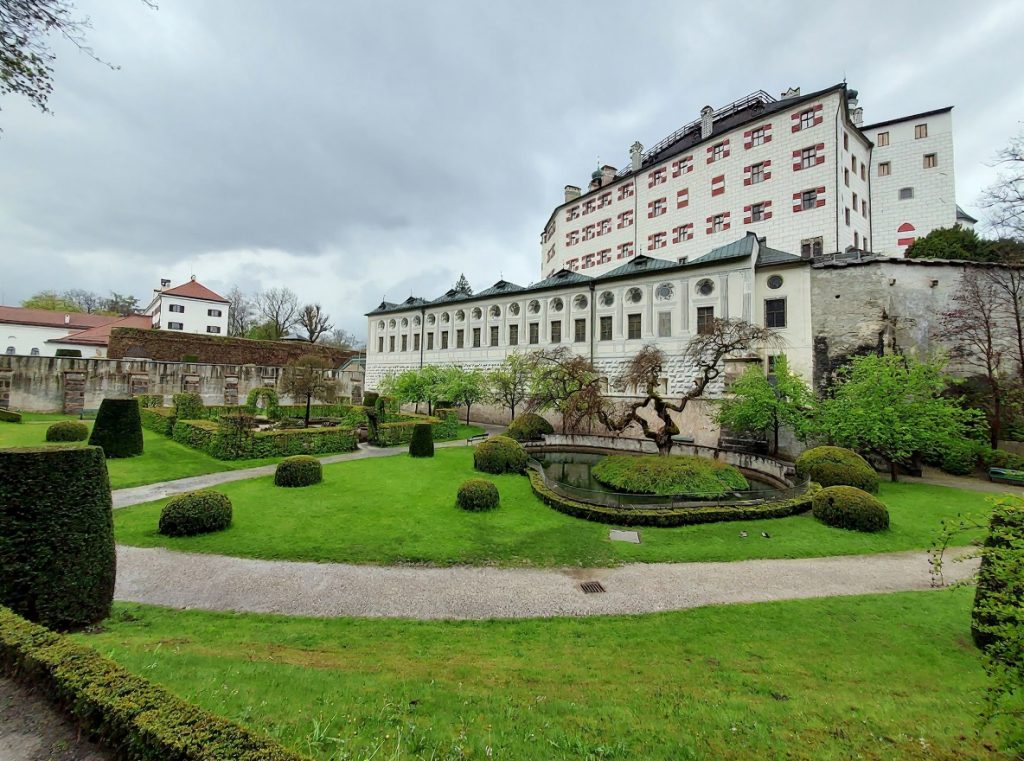
Ambras Castle sits conspicuously on a cliff at the outskirts of Innsbruck in the middle of extensive castle grounds. It stands 632 metres above sea level. The address is Schlossstraße 20, 6020 Innsbruck. Visitors can take post bus line 540 from the main train station. Alternatively, they can take bus line M from the city centre. Bus line C and tram lines 3 or 6 also serve the area, though these require a 10-minute walk. The castle grounds feature gardens, walking paths, and water features that Ferdinand II designed himself. Parking is available near the entrance, though space is limited.
History of Ambras Castle
Records about Ambras date from the tenth century, with the spelling ‘Amras’ or ‘Omras’. Builders raised the castle in the sixteenth century on the spot of an earlier tenth-century castle. That earlier fortress became the seat of power for the Counts of Andechs. In 1248, the castle ruins and property passed by inheritance from the Counts of Andechs to Count Albert IV of Tyrol. In 1563, Archduke Ferdinand II became Tyrol’s provincial governor and chose Ambras Castle as his summer residence. He then transformed it into the seat of Tyrol’s royal court. When he became provincial sovereign of Tyrol in 1564, Ferdinand II ordered two Italian architects to turn the existing medieval fortress into a Renaissance castle for his wife Philippine Welser, whom he had married in secret.
Ferdinand II built the museum castle starting in 1572 and ending in 1583. Architects adapted the castle building to reflect the Renaissance style by integrating older buildings into the palace. They remodelled the southern wing, added a third floor and expanded the medieval outer bailey. New construction included the Spanish Hall, which builders erected between 1569 and 1571. Workers also remodelled the pleasure garden from 1565 to 1568. The Spanish Hall is a notable example of German Renaissance architecture. It contains an intricate wood-inlay ceiling and walls adorned with 27 full-length portraits of the rulers of Tyrol. After Ferdinand’s death in 1595, his second son Charles, Margrave of Burgau, inherited Ambras Castle. Charles had little interest in the castle and never used it as a residence, so he sold it in 1606 to Emperor Rudolf II.
From 1855 to 1858, Archduke Karl Ludwig made it his summer residence where he employed neo-Gothic designs. In 1881, officials reinstated Ambras Castle as a public place, allowing visitors to see the collections.
Current status
Ambras Castle is a federal museum of the Republic of Austria. The castle ranks among the most important sights in Austria. In fact, it is the only site within the KHM Museum Association that sits outside Vienna. The castle opens daily from 10 a.m. to 5 p.m., but closes in November. The exhibition in the Lower Castle reconstructs the archduke’s museum: the Cabinet of Art and Wonders, the Armouries, and the Antiquarium. The Upper Castle houses the extraordinary Habsburg Portrait Gallery, featuring over 200 portraits. These include works by artists such as Lucas Cranach, Titian, van Dyck, and Velázquez. The Spanish Hall is among the most splendid Renaissance halls. In summer it serves as venue for a range of concerts, including the Ambras Castle Concerts.
Ambras Castle functions as a museum nowadays, while Bundesgärten Österreich manages the garden. Special exhibitions draw on Ferdinand’s remarkable collections of arms, natural curiosities, scientific instruments, and exotic treasures. The Strasser glass collection displays precious Renaissance and Baroque glassware. Visitors wander through vaulted armouries where tournament suits stand beside weapons that once belonged to European rulers. The castle grounds invite exploration along tree-lined paths, past fountains and through the English landscape garden. Above it all, the Spanish Hall glows with its ornate ceiling and Tyrolean portraits, an enduring example of Renaissance splendour in the Alps.
Castles near Ambras Castle
Frequently asked questions
Do I need to book tickets in advance for Ambras Castle?
No advance booking is required for regular admission to Ambras Castle. However, booking online saves you €2 per adult ticket (€16 instead of €18 April–October).
What can I see inside Ambras Castle?
Ambras Castle houses the famous Chamber of Art and Wonders, three armouries, the Habsburg Portrait Gallery (April–October only), and the Spanish Hall. The castle is considered the world's first museum still in its original location.
Is Ambras Castle suitable for families with children?
Yes, children and young adults under 19 receive free admission. The castle grounds include extensive gardens and parkland to explore, though some of the museum collections may appeal more to older children interested in history and art.
Can I visit the grounds of Ambras Castle without a museum ticket?
Yes, the castle grounds and gardens are open to the public without a museum ticket. The grounds offer pleasant walks and views, though opening hours differ from the museum (check Österreichische Bundesgärten website).
Is parking available at Ambras Castle?
Limited paid street parking is available near Ambras Castle on Schlossstraße. Spaces can be scarce during busy periods, so arriving by public transport (bus 4134 from Innsbruck Hauptbahnhof) is often more convenient.
Featured listings