
Rising from Herreninsel island in Bavaria’s largest lake, Herrenchiemsee Palace commands attention as King Ludwig II’s most ambitious creation. The monarch commissioned this grand complex in 1878 as a tribute to France’s Louis XIV. Though construction never reached completion after Ludwig’s death in 1886, the palace stands today as a powerful symbol of 19th-century royal aspiration. The Bavarian Administration of State-Owned Palaces, Gardens and Lakes preserves it as a major cultural landmark.
Plan your visit to Herrenchiemsee Palace
Location of Herrenchiemsee Palace
Herrenchiemsee Palace occupies Herreninsel, the largest island in Lake Chiemsee in southern Bavaria. The site sits approximately 60 kilometres southeast of Munich in the Rosenheim district. Visitors reach the car-free island year-round by ferry from Prien am Chiemsee or Gstadt. In summer months, horse-drawn carriages transport guests between the jetty and the palace. Prien am Chiemsee sits about an hour’s drive from either Munich or Salzburg via the A8 motorway. Trains also run regularly from Munich’s central station. The journey across the lake offers views of the Alpine landscape that frames this extraordinary setting.
History of Herrenchiemsee Palace
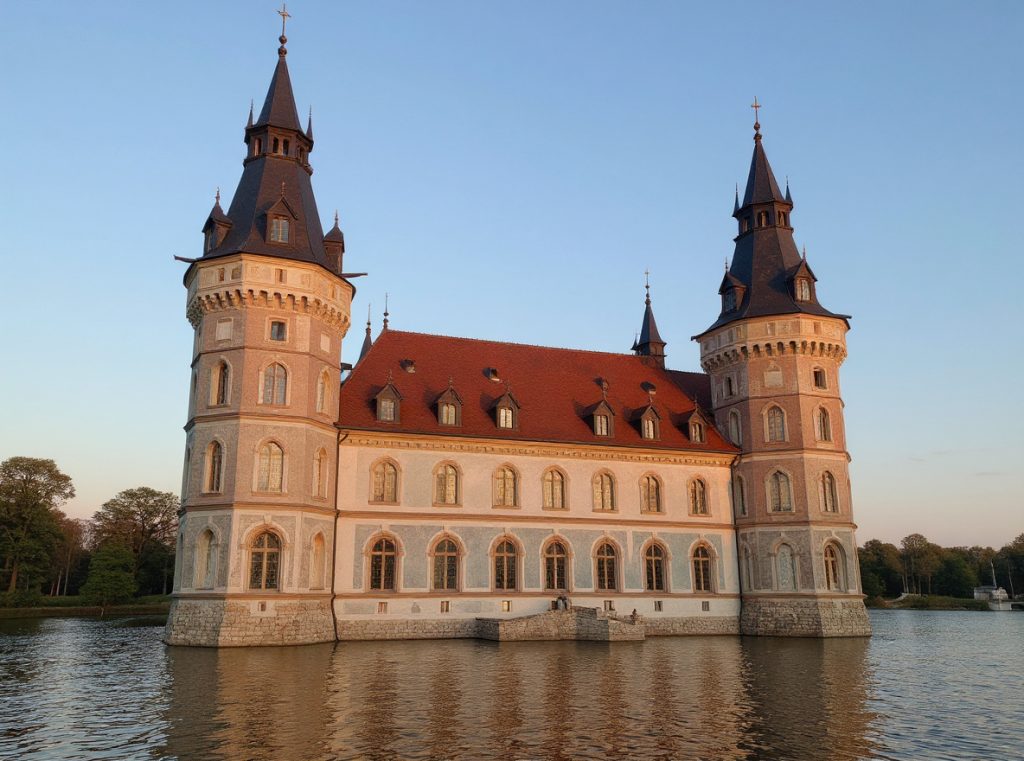
King Ludwig II of Bavaria purchased the island in 1873, when it housed a former Augustinian monastery. He converted these existing buildings into a residence known as the Old Palace. Ludwig stayed there while supervising construction of the new project. The king visited Versailles in summer 1874 and received honours from the French government on his birthday, August 25. This experience crystallised his vision for a Bavarian palace honouring the Sun King.
Construction began on 21 May 1878. Architects Georg von Dollmann, Christian Jank and Franz von Seitz designed the palace. The project eventually employed more than 4,000 workers at its peak. Ludwig conceived Herrenchiemsee as a private yet vast residence that resembled Versailles. However, he never intended it to host a large royal household. Unlike the medieval-themed Neuschwanstein Castle, the Neo-Baroque palace demonstrates Ludwig’s admiration of King Louis XIV. The Hall of Mirrors ceiling features 25 painted scenes depicting the French monarch.
Designers shaped the palace in a ‘W’ with wings flanking a central building, though only the central portion rose from the ground. Of the planned 70 rooms, workers completed only 16 on the ground floor. Another 50 rooms remained unfinished. Ludwig stayed at the palace for just a few days in September 1885. At that time, workers had richly decorated only a handful of rooms, and coloured canvasses covered the unfinished sections. After the king’s death the following year, all construction work stopped. Between 1863 and 1886, the project consumed 16,579,674 Marks.
Current status
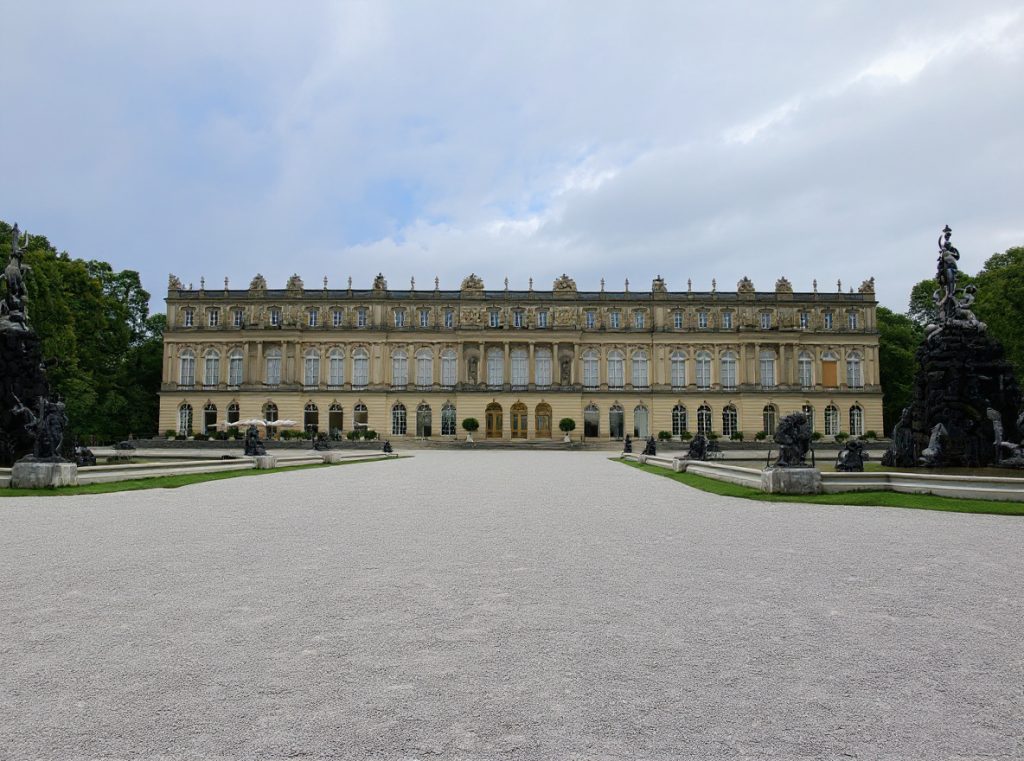
The Bavarian Administration of State-Owned Palaces, Gardens and Lakes maintains Herrenchiemsee today. It draws visitors as a major tourist attraction. Guided tours run regularly through the state rooms. These tours take approximately one hour including the boat journey. The King Ludwig II Museum opened in 1987 in the south wing ground floor. It chronicles the monarch’s life through portraits, busts, photographs and original state robes. The palace opened to the public as a museum in 1887, just one year after Ludwig’s death.
Many completed rooms remain open for viewing and offer fabulous examples of 19th-century interior design. In fact, some count among the finest in existence. The palace features impressive gardens including a fountain modelled on the Bassin de Latone. It also contains a Hall of Mirrors 98 metres long—a third longer than Versailles’ original. Court garden director Carl von Effner designed the outdoor area between 1882 and 1886. Fountains, water features and manicured lawns offer views across Lake Chiemsee. The Hall of Mirrors transforms into a concert hall during the annual Herrenchiemsee Festival. Other highlights include the splendid parade bedroom and the dining room with its famous automated dining table.
UNESCO designated the palace as a World Heritage Site since 2025. The organisation recognised it alongside Ludwig’s other palaces as an exceptional 19th-century architectural achievement. Water and mountain landscape embrace this unfinished dream, where vision and reality met only briefly before time preserved them both in stone and story.
Castles near Herrenchiemsee Palace
Frequently asked questions
Can I visit Herrenchiemsee Palace without a tour?
No, the palace state rooms can only be visited with a guided tour, which lasts approximately 40 minutes. The palace gardens and park grounds are freely accessible.
How do I get to Herrenchiemsee Palace from the mainland?
The palace is on Herreninsel island. Take a ferry from Prien harbour; the round-trip costs €11.50 for adults and €5.70 for children aged 6–15. Ferries depart hourly, and the crossing takes 15 minutes.
What does the Herrenchiemsee combination ticket include?
The €14 ticket includes a guided tour of the New Palace, entry to the King Ludwig II Museum, and the Augustinian Monastery with its galleries. The ferry ticket is purchased separately.
Is Herrenchiemsee Palace open all year?
Yes, the palace is open daily except 1 January, Shrove Tuesday, and 24, 25 and 31 December. Opening hours are 9:00–18:00 (April–24 October) and 10:00–16:45 (25 October–March).
How long should I plan for a visit to Herrenchiemsee Palace?
Allow 2.5 to 3 hours on the island. This includes the 15-minute walk from the jetty to the palace, the 40-minute guided tour, and time to explore the King Ludwig II Museum and gardens.
Featured listings