
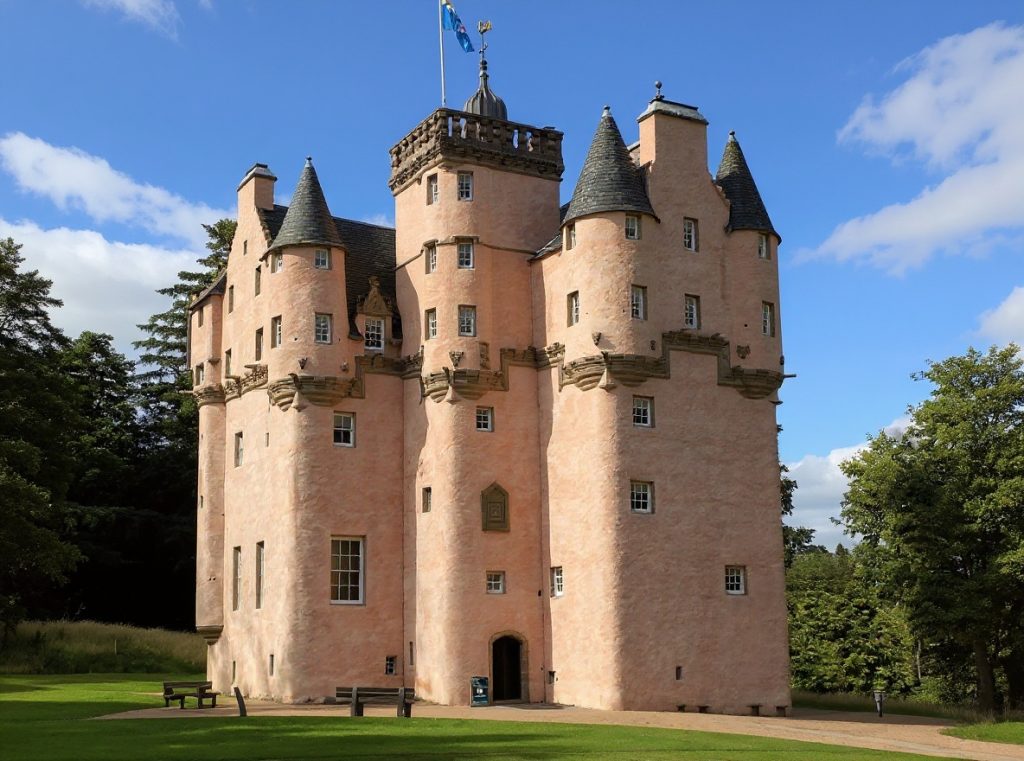
Nestled in the rolling hills of Aberdeenshire, Craigievar Castle rises like a vision from a storybook, its pink-harled walls crowned by an array of turrets, corbels and conical roofs. This seven-storey tower house stands virtually unchanged since its completion in 1626, embodying the pinnacle of Scottish Baronial architecture. Reputed to have inspired Walt Disney’s castle imagery, Craigievar enchants visitors with its fairytale silhouette and remarkably preserved interiors. The castle remained a beloved family home for over three centuries before passing into the care of the National Trust for Scotland.
Plan your visit to Craigievar Castle
Sat–Sun 11:00–15:00
Location of Craigievar Castle
Craigievar Castle sits on the western slope of a valley approximately six miles south of Alford in Aberdeenshire. The castle occupies a commanding position in the eastern foothills of the Cairngorm Mountains, with sweeping views across the Corrennie Moor and the pastoral landscape of Leochel Burn valley. Visitors reach the property via a well-signposted single-track road that branches west from the A980, climbing gently for half a mile to a car park set within wooded grounds. The estate lies roughly 26 miles west of Aberdeen, making it an accessible destination from Scotland’s third-largest city.
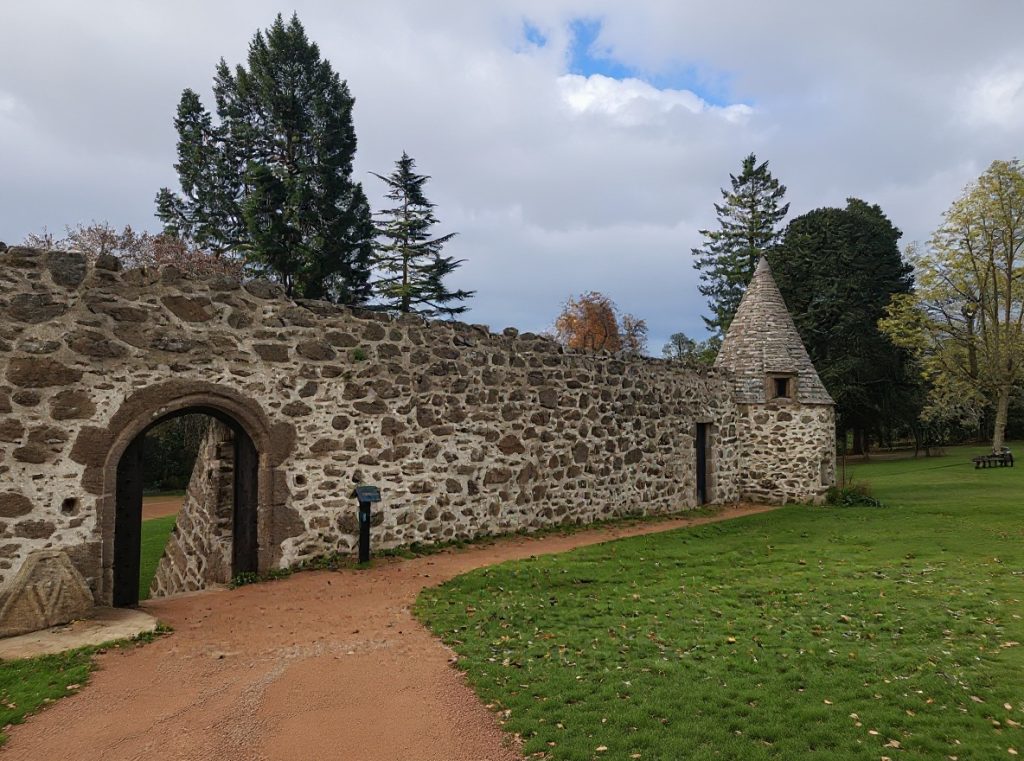
No direct public transport serves the castle itself. However, bus services run from Aberdeen to Alford, Lumphanan and Aboyne, from where visitors can arrange taxis. The castle stands amid over 200 acres of farmland, woodland and parkland, with two waymarked walking trails winding through the estate. Ancient beech trees and ornamental conifers frame the approach, while the remains of a walled courtyard and one surviving round tower hint at the castle’s original defensive configuration. The surrounding countryside remains agricultural, with livestock grazing the valleys and moorland capping the hilltops.
History of Craigievar Castle
The Mortimer family held the Craigievar estate from at least 1376 and began constructing the tower house between 1575 and 1595. Financial difficulties, possibly stemming from the religious upheavals of the Reformation, forced the Mortimers to abandon their building project. In 1610, wealthy Aberdeen merchant William Forbes of Menie purchased the partially completed structure. Forbes had amassed his fortune through Baltic timber trading, earning the nickname “Danzig Willie” for his frequent voyages to the port of Danzig.
William Forbes transformed the plain four-storey tower into a spectacular architectural statement. He retained the lower storeys but replaced the upper levels with an elaborate crown of corbelled turrets, gables and a balustraded viewing platform. The work married Scottish tradition with Renaissance flourishes. Skilled plasterers from Bromley-by-Bow, near London, created intricate moulded ceilings featuring biblical scenes, classical mythology, heraldic devices and geometric patterns. These plasterwork ceilings, installed around 1624, rank among Scotland’s finest and were revolutionary for their time. The castle reached completion in 1625 or 1626, and William Forbes died in 1648.
His son received a baronetcy of Nova Scotia from Charles I in 1630. The Forbes family resided at Craigievar for 350 years, accumulating collections of family portraits, 17th- and 18th-century furnishings, and historical artefacts. The second baronet, known as “Red Sir John,” became associated with ghostly legends after allegedly forcing a young Gordon suitor to leap from a window. In 1776, the family blocked 24 windows to reduce window tax payments. By the early 19th century, the castle had fallen into disrepair. In 1824, Sir John Forbes commissioned Aberdeen architect John Smith to assess the building. Smith recommended preservation rather than demolition, and Sir John funded comprehensive repairs including a new roof and fresh harling.
Current status
The National Trust for Scotland acquired Craigievar Castle in 1963 from William Forbes-Sempill, 19th Lord Sempill. The sale helped settle estate debts and death duties. The family stipulated that the interiors remain unchanged, including the absence of electricity above the ground floor. This preservation ensures visitors experience the castle by natural light alone, exactly as eight generations of the Forbes family did. The castle became a listed building in 1990. Between 2007 and 2009, and again in 2022 to 2024, the National Trust undertook major conservation projects, applying traditional lime-based harling to restore the authentic pink finish.
Today, the castle opens to the public seasonally, typically from April through October, with guided tours offered on a first-come, first-served basis. No advance booking is possible, and tours accommodate a maximum of ten people. The 45-minute tours guide visitors through the Great Hall, with its Stuart royal arms above the fireplace and musicians’ gallery; the Queen’s Bedroom with its “angel bed”; the Blue Room; and servants’ quarters. Original family portraits by artists including Raeburn grace the walls, while period furnishings evoke domestic life across the centuries. A secret staircase connects the high tower to the Great Hall. The grounds remain open year-round, with woodland trails showcasing the estate’s natural beauty, particularly striking when bluebells bloom in early summer.
The castle received approximately 24,000 visitors in 2019, drawn by its exceptional preservation and enchanting appearance. The structure stands as one of Scotland’s best-preserved tower houses, its L-plan form and soaring silhouette unchanged since William Forbes crowned it nearly four centuries ago. Visitors continue to marvel at Craigievar’s fairytale beauty, its pink walls glowing warmly against the green Aberdeenshire landscape, a testament to architectural ambition and centuries of careful stewardship.
Castles near Craigievar Castle
Frequently asked questions
Can I book a tour of Craigievar Castle in advance?
No, advance booking is not possible. Tours operate on a first-come, first-served basis with a maximum of 10 people per tour, running at approximately 30-minute intervals during opening hours.
Why is Craigievar Castle only open seasonally?
The castle has no artificial lighting to preserve its authenticity as a 17th-century building. Tours are only possible during months with sufficient natural daylight, typically April through October.
Is Craigievar Castle accessible for visitors with mobility issues?
The grounds are accessible, but the castle interior has stone steps at the entrance and steep spiral stone stairs to upper floors. Access to all seven floors is via these narrow historical staircases.
What makes Craigievar Castle architecturally significant?
It is one of Scotland's finest and best-preserved examples of Scottish Baronial architecture. Completed around 1626, the exterior remains virtually unchanged, with a massive lower structure topped by ornate turrets and corbelling.
Are there facilities at Craigievar Castle?
There is a small shop and seasonal kiosk, but no café or dining facilities inside the castle. Picnicking is allowed in the grounds, which include two waymarked woodland trails and Victorian gardens.
Featured listings