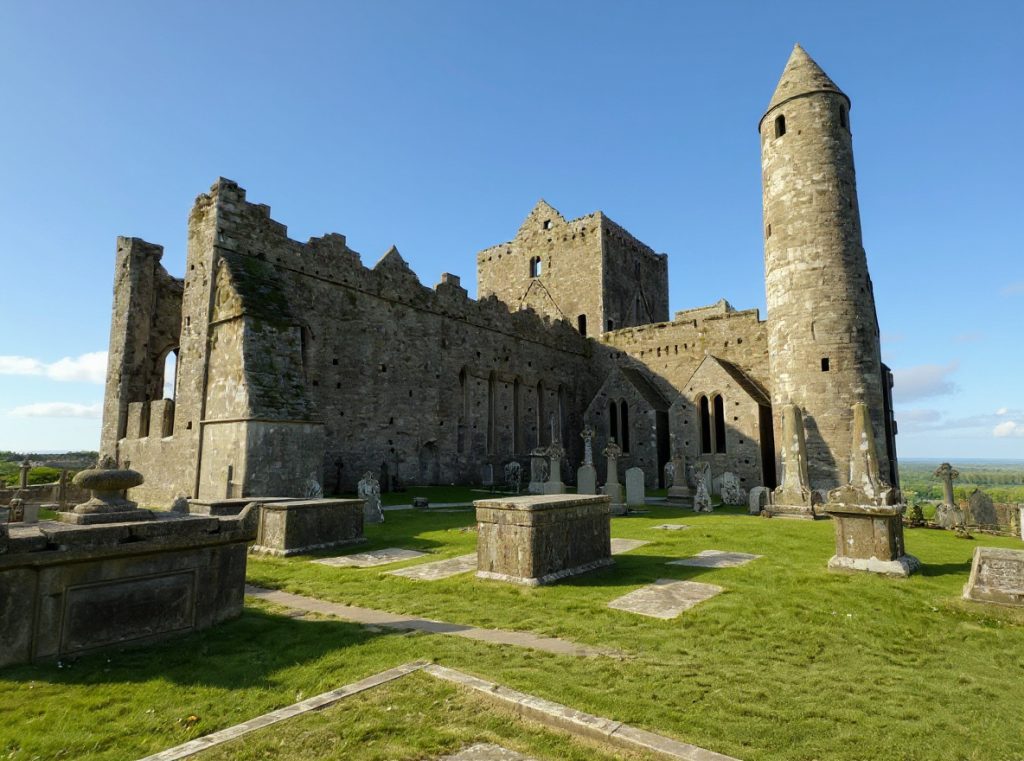
Rising from the Golden Vale on a dramatic limestone outcrop, Rock of Cashel commands the landscape of County Tipperary with its cluster of medieval monuments. For over a thousand years this windswept summit held the seat of Munster’s kings before becoming one of Ireland’s most significant ecclesiastical sites. The ruins that crown the Rock today—a round tower, Gothic cathedral, and Romanesque chapel—speak to centuries of power, faith, and architectural brilliance.
Plan your visit to Rock of Cashel
Location of Rock of Cashel
The Rock sits on a limestone outcrop just above the town of Cashel in County Tipperary’s Golden Vale, around 500 metres from the town centre. It lies just off the M8 motorway and stands about a two-hour drive southwest of Dublin. Cashel itself sits about 30 miles east-southeast of Limerick. The outcrop rises 358 feet tall. Visitors approaching from any direction will see the complex long before arrival, as its towers and walls dominate the horizon across the surrounding plain. A dedicated car park at the base of the Rock provides easy access. A short uphill walk then leads to the entrance. The site’s exposed position means weather conditions can change rapidly, so advance planning proves wise.
History of Rock of Cashel
The Rock served as the stronghold of the kings of Munster from the 4th century. St. Patrick visited Cashel around 450 CE and baptized King Aenghus, establishing Cashel as a bishopric. Brian Boru, the only Irish king to unite the entire island for any length of time, received his crown at the Rock in 990. He fortified Cashel around 990 AD. In 1101, a convocation took place where King Murtough O’Brien granted the Rock to the church for the use of the religious in Ireland. He dedicated it to God and St Patrick, and Maelmuire O’Dunan became the first Archbishop of Cashel.
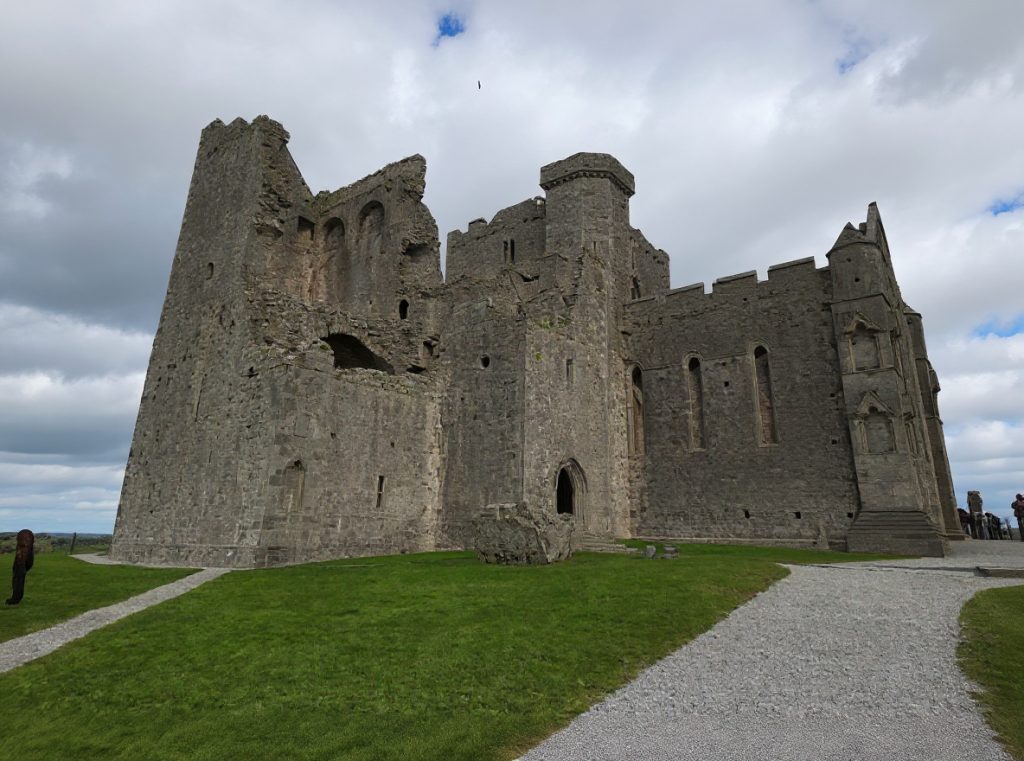
Builders constructed Cormac’s Chapel between 1127 and 1134. It contains the only surviving Romanesque frescoes in Ireland. The Round Tower, the oldest building on the Rock, dates from the early 12th century. Masons built St. Patrick’s Cathedral, the largest remaining structure, between 1235 and 1270. In 1647, Lord Inchiquin led Cromwellian forces in an attack upon the town. Workers then stripped the cathedral’s roof for its lead, leaving the building to fall into ruin. In 1749, Archbishop Arthur Price made the controversial decision to remove the cathedral’s roof.
Current status
In 1869, the state took the Cathedral and the other four buildings at the Rock into care. They became Ireland’s first national monument. Today, the Office of Public Works manages the Rock of Cashel. The site has an official Facebook page for the Rock of Cashel, an OPW managed site. Visitors need to buy a ticket to visit the Rock of Cashel. They can purchase tickets at the site or online. A separate ticket grants access to Cormac’s Chapel, and visits to the chapel run by guided tour only. Visitors can get chapel tickets only at the site. The site includes an audio-visual show and exhibitions.
The monuments include a round tower, a high cross, a Romanesque chapel, a Gothic cathedral, an abbey, the Hall of the Vicars Choral and a fifteenth-century Tower House. Queen Elizabeth II visited the Rock during her 2011 visit to Ireland. From the summit, visitors gain sweeping views across Tipperary and can spot nearby Hore Abbey in the fields below. The windswept ruins, open to the sky where roofs once stood, create an atmosphere that blends spiritual contemplation with historical wonder. Each stone tells stories of kings and clerics, of conquest and devotion, preserved on this ancient outcrop for future generations.
Castles near Rock of Cashel
Frequently asked questions
Do I need to book Rock of Cashel tickets in advance?
General admission can be booked online or purchased on site. However, tickets for the interior tour of Cormac's Chapel are limited and can only be purchased on site, so arrive early if you want to visit it.
What are the opening hours for the Rock of Cashel?
From mid-March to mid-October, it opens daily 09:00–17:30 (last admission 16:45). From mid-October to mid-March, it opens 09:00–16:30 (last admission 15:45). Closed 24–26 December.
Is the Rock of Cashel suitable for children?
Yes, it's good for families, especially older children interested in medieval ruins and towers. Children under 12 enter free. Close supervision is needed on stone steps and near edges.
Can you visit Cormac's Chapel at the Rock of Cashel?
Yes, but access is by guided tour only with limited tickets sold on site. The last tour is at 14:30 daily. Arrive early to secure a spot as tickets cannot be booked in advance.
How exposed is the Rock of Cashel to weather?
The site is very exposed on a limestone outcrop and can close at short notice during high winds or severe weather. Bring a rain jacket and check ahead in poor conditions.
Featured listings