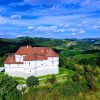

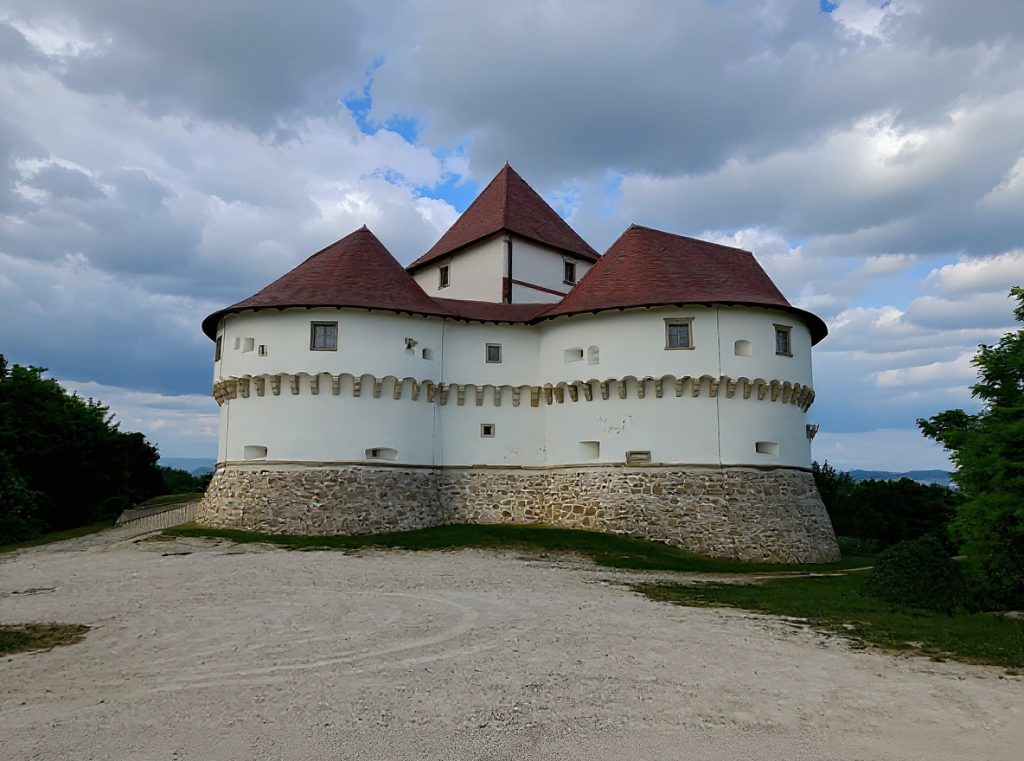
Crowning a hill in northwestern Croatia’s Zagorje region, Veliki Tabor Castle rises 333 metres above the surrounding valleys with its distinctive pentagonal tower and four semicircular bastions. The name derives from “tabor,” meaning a fortified military camp that defended against Ottoman incursions. This late medieval fortress ranks among continental Croatia’s most important secular monuments, and its fairytale silhouette has dominated the landscape for more than five centuries.
Plan your visit to Veliki Tabor Castle
Tue–Sun 09:00–16:00
Location of Veliki Tabor Castle
The castle sits in the village of Hum Košnički near Desinić, in Krapina-Zagorje County. Zagreb lies just over an hour’s drive southeast, while the Slovenian border runs only a few kilometres to the north. Visitors travelling from the capital take the road through Zabok toward Pregrada, then follow signs to Desinić. From the castle’s ramparts, panoramic views sweep across the entire Hrvatsko Zagorje region and into neighbouring Slovenia. The hill’s elevation provides full sunlight year-round, though winter snow often blankets the fortifications. Vineyards and farmland surround the base of the hill. The Horvatska rivulet valley below frames the castle as a landmark visible from great distances.
History of Veliki Tabor Castle
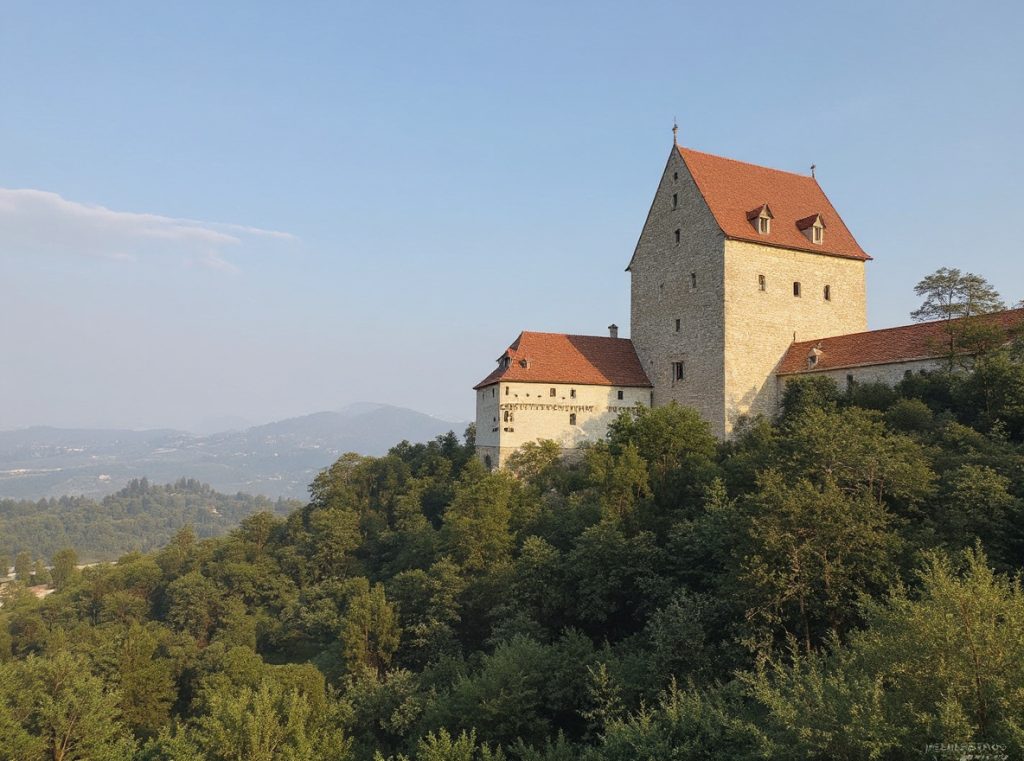
Archaeological research confirms that builders raised the oldest sections in the mid-15th century, though some theories suggest earlier 12th-century foundations. The aristocratic Celje family likely initiated construction of the late Gothic pentagonal tower. The first documented mention appears in 1502, when Ivaniš Korvin granted “castellum nostrum Thabor” to Pavao Ratkaj for his service in battles against Ottoman forces. The Rattkay family then expanded the fortress, adding four semicircular defensive towers after 1526 during a second major construction phase. These Hungarian nobles transformed the castle into their primary seat and ruled it for nearly three centuries.
The Rattkays shaped much of the castle’s Renaissance character. Juraj Rattkay Velikotaborski, a prominent 17th-century historian and chronicler, lived within these walls. The family built additional residences nearby, including Mali Tabor and Miljana, though Veliki Tabor remained their principal stronghold. When the last male heir, Josip Ivan Rattkay, died in 1793, the Hungarian Chamber assumed management. Multiple owners acquired the castle over the 19th and 20th centuries. The renowned Croatian painter Oton Iveković bought the property during this period and spent years depicting its towers and landscape in his canvases.
The castle fell into disrepair by the mid-20th century. Emergency repairs addressed the most damaged sections between 1945 and 1995, though comprehensive restoration remained years away. The late 1980s brought renewed attention when Josip Štimac launched cultural activities including knight tournaments, art colonies and falconry displays. Conservation research began in earnest in the mid-1990s under the Croatian Conservation Institute. Major reconstruction between 2004 and 2011 restored the pentagonal keep, courtyard galleries, walls and roof structures. The work revealed details about the original layout and subsequent modifications across five centuries.
Current status
The Government of the Republic of Croatia entrusted Veliki Tabor to the Museums of the Croatian Zagorje (Muzeji Hrvatskog Zagorja) in the early 1990s. The museum opened to visitors in autumn 2011 after the completion of the second restoration phase. Croatia designates the castle as a monument of the highest category, and it appears on the UNESCO Tentative World Heritage List. Exhibitions now occupy most floors, displaying ethnographic collections, archaeological finds, period weapons, armour, pottery and ceramic tiles from historical stoves. The castle’s chapel holds a particularly unusual exhibit: the skull of Veronika Desinić, whose tragic love story with a young nobleman has become the castle’s most famous legend.
Visitors can explore the great hall, residential chambers and colonnaded galleries overlooking the central courtyard. Educational workshops run throughout the year, and the castle hosts regular medieval festivals and costumed performances. Since 2002, Veliki Tabor has served as the venue for the Tabor Film Festival, an international celebration of short films. The site forms part of the Castle Road cultural route that links fortresses across Austria, Slovenia and Croatia. Admission fees support ongoing conservation, and guided tours explain the fortress’s strategic importance and architectural evolution.
Three floors of galleries circle the courtyard, their thick walls storing coolness during summer months. The tower commands views that once warned of approaching armies and now draw photographers at sunset. Local wine tastings sometimes conclude tours in the centuries-old cellars. Legend whispers that Veronika’s weeping still echoes through the stones on winter nights, though daylight reveals only the quiet dignity of a castle that has weathered Ottoman threat, noble intrigue and the passage of half a millennium.
Castles near Veliki Tabor Castle
Frequently asked questions
What is the legend of Veronika at Veliki Tabor Castle?
Veronika of Desinić was a commoner who fell in love with the count's son and was allegedly drowned for it. According to local legend, her body was walled up somewhere in the castle, and she is said to haunt Veliki Tabor to this day.
Can I visit Veliki Tabor Castle year-round?
Yes, Veliki Tabor is open year-round, Tuesday to Sunday. Opening hours are 9:00–16:00 from November to February, 9:00–17:00 in March, and 9:00–17:00 (weekdays) or 10:00–18:00 (weekends) from April to October.
Is Veliki Tabor Castle accessible by public transport?
Direct buses run from Zagreb central bus station to Desinić village (about 2 hours). From Desinić, the castle is approximately 3 km uphill, reachable on foot or by taxi; there is no public transport directly to the castle entrance.
Are guided tours available at Veliki Tabor Castle?
Yes, guided tours must be booked at least one week in advance. Standard tours in Croatian cost €25, tours in English €30, and costumed thematic tours range from €30 to €50 depending on language.
How far is Veliki Tabor Castle from Zagreb?
Veliki Tabor is approximately 69 km northwest of Zagreb, about one hour by car via the D206 road. It makes an easy day trip and can be combined with nearby Kumrovec open-air museum.
Top Rated Castle 2026
Veliki Tabor Castle is one of the best rated castles in Europe: 4.7 stars from 2,825 visitors on Google. See all winners.
Is this your castle? Show the award on your website
Copy this code into your website:
Popular right now
Featured listings