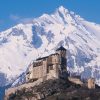

Crowning a steep hill above the town of Sion, Valère Castle rises 615 metres above sea level as one of Switzerland’s most striking fortified church complexes. The Valère Basilica, also called Valère castle, sits as a fortified church in Sion in the canton of Valais in Switzerland. It occupies a hill and faces the Château de Tourbillon, located on the opposite hill. This remarkable ensemble combines military, religious and residential architecture within a compact medieval borough. The site also protects one of the world’s oldest playable organs.
Plan your visit to Valère Castle
Tue–Sat 11:00–17:00
Sun 12:00–17:00Jun–Sep daily 11:00–18:00 (Sun from 12:00); Oct–May Tue–Sat 11:00–17:00, Sun 12:00–17:00
Location of Valère Castle
The castle of Valère stands on the Valère hill at 615 meters (2,018 ft) above sea level. It dominates the town of Sion in the canton of Valais, Switzerland. The relief of the Valère hill creates very uneven terrain, so access to the castle comes only from the north-east. Visitors reach the complex via a well-maintained path that winds upward through medieval streets from the centre of Sion. The climb rewards walkers with sweeping views across the Rhône Valley toward the surrounding Alps. The train station sits within easy walking distance of the approach path. As a result, travellers arriving by rail can access the site directly. Parking facilities appear near the base of the hill for those arriving by car.
History of Valère Castle
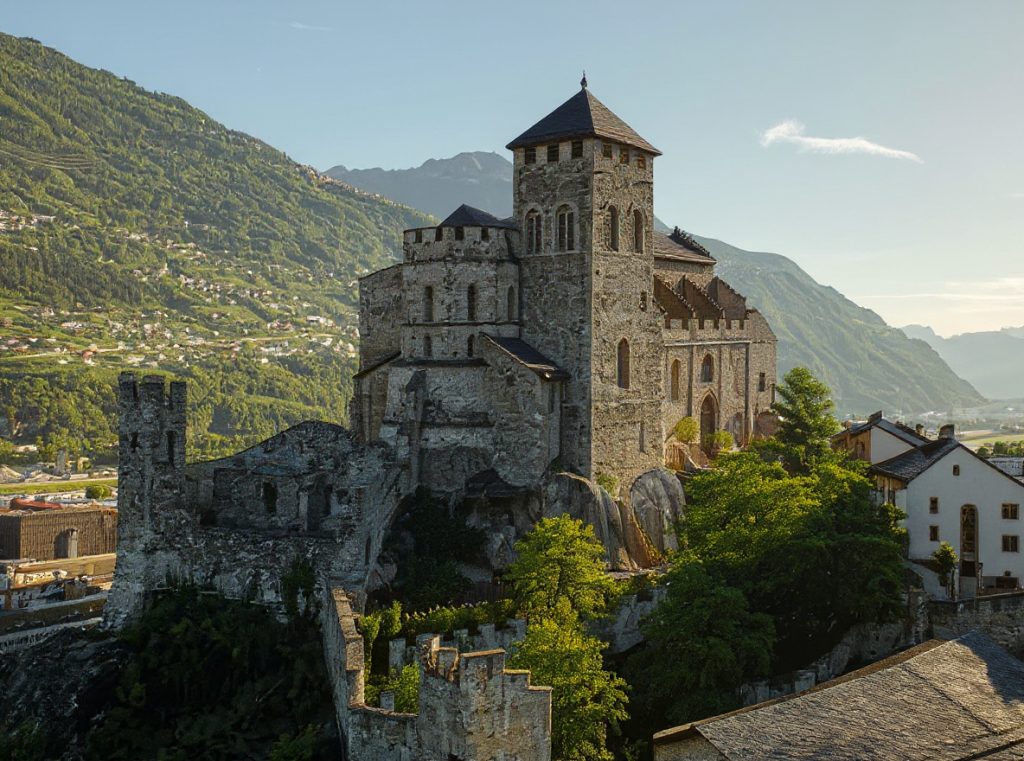
The name Valère first appears in 1049 as the site of the cathedral chapter in Sion. The bishop ceded Valère hill to his canons (cathedral chapter) in 1049, and it became their residence. Valère, as the residence of the cathedral chapter in Sion, formed one-third of the administrative center of the powerful Diocese of Sion. The canons built their fortified complex on this naturally defensive position during a time when the region required protection from military threats.
Builders raised the first parts of the church between 1100 and 1130 in the Romanesque style. The next construction phase began after 1130 and included the semi-circular apse, the walls and windows and a roof. The third phase saw the church expand and the style changed to the new Gothic style. Between 1235 and 1267 the nave expanded and gained two flanking aisles. During the 13th century, builders covered the choir with a Gothic ribbed vault. They also installed a rood screen to separate the chancel from the nave. The fortifications took shape around the same period, as thick stone walls and four towers formed an enclosure.
In the 12th century builders raised the Cathedral Notre Dame de Sion (du Glarier) in the town below Valère hill. Glarier Cathedral became the seat of the Diocese of Sion, while the Prince-Bishop of Sion lived in Tourbillon Castle. This division created a tripartite power structure in medieval Sion. Valère Castle’s primary structure, the Basilica of Our Lady of Valère, served as the residence for the canons of the cathedral chapter. They lived there until the upheaval of the French Revolution.
Current status
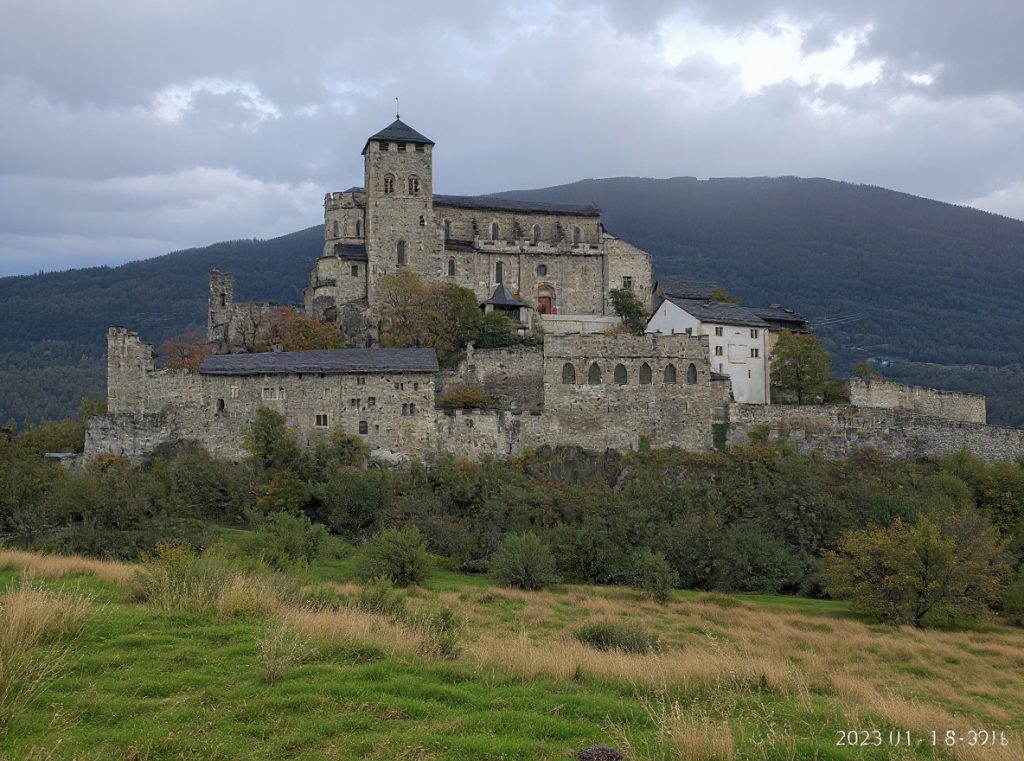
Valère Castle holds recognition as a Swiss heritage site of national significance. Pope John Paul II designated it a minor basilica in 1987. Workers restored and converted some of the buildings into a museum at the end of the 19th century. The museum now occupies the former canonical houses within the fortified complex, while the basilica remains a consecrated place of worship. This museum currently operates as the Valais History Museum.
The Valais History Museum displays over a thousand artifacts chronicling the region from prehistoric times through the Middle Ages. Visitors explore twenty-seven rooms that trace the cultural evolution of the canton through original objects, models and multimedia presentations. The organ, restored in 2005, is the oldest playable organ in the world (dated 1431-1437). The instrument still sounds during special concerts and occasions, drawing music lovers from across Europe. The basilica treasury, housed in the former archive chamber, preserves rare liturgical treasures that reflect a millennium of unbroken religious presence.
The fortified complex remains open to the public throughout most of the year, though hours vary between summer and winter seasons. Admission fees support the preservation and ongoing study of the collections. Since 1977, authorities have included the site in the Federal Inventory of Sites and Monuments of National Importance. They did so because a large number of protected species live on Valère Hill. The hilltop itself functions as a protected natural area where Mediterranean flora thrives in the alpine climate. Stone ramparts, a soaring bell tower, and the compact medieval borough create an evocative silhouette above Sion. They anchor the town’s identity and offer a window into the layered history of the Valais region.
Castles near Valère Castle
Frequently asked questions
What can I see inside Valère Castle?
The castle houses the Valais History Museum with 27 rooms and over 1,000 objects spanning 50,000 years, from the Stone Age to the 20th century. The Basilica of Notre-Dame de Valère contains the world's oldest playable organ, dating from the 15th century.
Is Valère Castle accessible by car?
No, the castle is accessible on foot only via Rue des Châteaux. There is no vehicle access to the hilltop site. Parking is available in central Sion, about 10–15 minutes' walk away.
Can I visit the basilica at Valère Castle separately from the museum?
Yes, the nave of the Basilica of Valère is free to access during opening hours (outside of mass times). The museum ticket (CHF 8 adults) gives access to the former canons' houses and exhibitions.
How do I get to Valère Castle from Sion railway station?
Walk approximately 1 km (10–15 minutes) from the station through the old town, following signs to Rue des Châteaux. The final approach involves an uphill path and stairs to reach the castle on its hilltop.
Are there guided tours available at Valère Castle?
Yes, free guided tours of the basilica are offered on the first Sunday of each month at 14:00 and 15:30 in French and German. Private group tours can be booked in advance for CHF 150 (including admission).
Popular right now
Featured listings