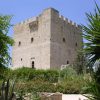

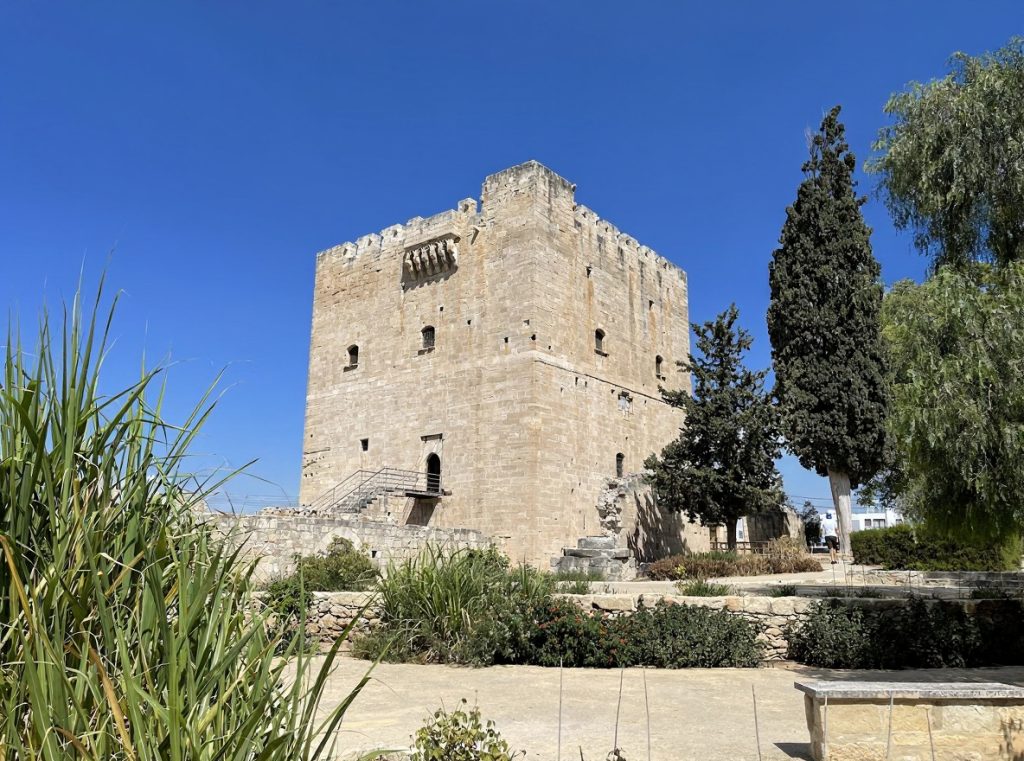
Rising from the coastal plains west of Limassol, Kolossi Castle commands attention with its imposing three-storey keep, a monument to medieval military might. The Hospitallers built the present castle in 1454 under the Commander of Kolossi, Louis de Magnac, whose coat-of-arms they carved into the castle’s walls. It held great strategic importance in the Middle Ages because it contained large facilities for producing sugar from local sugarcane, one of Cyprus’s main exports at the time. This Crusader stronghold ranks among Cyprus’s finest examples of Frankish military architecture. Its stone walls still bear witness to centuries of power struggles and economic enterprise.
Plan your visit to Kolossi Castle
Location of Kolossi Castle
Kolossi Castle was once a Crusader stronghold on the island of Cyprus. It sits at the southwest edge of the village of Kolossi, 14 kilometres west of the city of Limassol. The castle occupies the south edge of Kolossi village, which spreads across a coastal plain about 11 kilometres west of Limassol. Travellers can reach the fortress easily by car from Limassol when they follow the road towards Paphos. The castle sits at an elevation of roughly 45 metres above sea level. It offers views over the surrounding countryside. Ample parking facilities serve visitors who come to explore this medieval monument. The site lies 14km west of Lemesos on the road towards Pafos. The village of Kolossi itself provides restaurants and cafés for those wishing to extend their visit to the area.
History of Kolossi Castle
The Knights of the Order of Saint John of Jerusalem (Hospitallers) built the original castle in 1210 when King Hugh I gave them the land around Kolossi. This first structure served the Hospitallers as an administrative seat until 1310. The Knights Templar took possession of it in 1306. After Pope Clement abolished the Order of the Templars in 1313, the castle reverted to the Hospitallers. The fortress changed hands because of rivalry within the Crusader Kingdom of Cyprus. This reflected the complex politics of medieval Mediterranean power.
After the fall of Acre in 1291, the Knights Hospitaller relocated their headquarters to Cyprus. They used Kolossi as a regional commandery. Kolossi became their headquarters from 1301 to 1306 after the Hospitallers lost Acre. Their headquarters moved to Rhodes in 1310, while Kolossi retained a strong garrison and continued as a commandery. A commandery functioned as an administrative estate or district of a military-religious order. The territory controlled by Kolossi encompassed around 60 villages, which made it a significant feudal domain. From 1373 to 1426 it suffered substantial damage from raids. Yet the Hospitallers rebuilt it in 1454. The tower forms an imposing square stone building, consisting of a single three-storey keep 16m long on the exterior and 13.5m on the inside. It stands 21 metres high with an attached rectangular enclosure or bailey approximately 30 by 40 metres.
During the Middle Ages, Kolossi held great strategic importance because the facilities produced sugar from local sugarcane. Sugar was one of Cyprus’ main exports at the time. Sugar refineries operated east of the castle, processing cane from local plantations. The region’s vineyards proved even more significant historically. Kolossi served as the base of the powerful military command of the Knights Hospitaller. They controlled and profited from the agricultural production of the wider region.
Current status
The Department of Antiquities can issue special entry cards for all its museums and ancient monuments. The Republic of Cyprus Department of Antiquities manages Kolossi Castle as a protected monument open to the public throughout the year. Operating hours run daily from 08:30 to 17:00 between September 16 and April 15. Hours extend daily from 08:30 to 19:30 between April 16 and September 15. The entrance fee is €2.50, with a 20% reduction for organised groups consisting of more than 10 persons. The site closes on Christmas Day, New Year’s Day and Easter Sunday (Greek Orthodox). Visitors climb an external stone staircase to enter the keep, then ascend internal stairs through the three floors to reach the battlements. Workers renovated the castle’s battlements in the 1930s. From the roof, panoramic views extend across the vineyards and countryside that once sustained the fortress.
Visitors can see the coat of arms of the Kingdom of Cyprus on the eastern outer side of the tower alongside those of Louis de Magnac. To the east of the castle lie the remains of a sugarcane refinery. On the northern side the ruins of a watermill and aqueduct can still be seen. Next to the castle stand the ruins of a 14th century sugar mill. These industrial remnants help visitors understand how the commandery functioned as an economic powerhouse during the Crusader period. Currently, the remains of the castle of Kolossi rank among the most important medieval fortifications that survive in Cyprus. The fortress forms a compact yet powerful reminder of the Knights Hospitaller’s presence on Cyprus. Its stone walls remain solid after more than five centuries.
Castles near Kolossi Castle
Frequently asked questions
Can I climb to the top of Kolossi Castle?
Yes, you can climb the spiral stone staircase through all three floors to reach the roof. From the battlements you get views over the surrounding vineyards and countryside.
What is the connection between Kolossi Castle and Commandaria wine?
The Knights of St John who occupied the castle in the Middle Ages produced Commandaria, a sweet dessert wine, from the surrounding vineyards. Commandaria is recognised as the world's oldest named wine still in production.
What can I see at Kolossi Castle besides the keep?
Outside the main tower you can explore the remains of a medieval sugar mill and factory, as the castle protected extensive sugar cane plantations. There are also ruins of an aqueduct and other ancillary buildings.
How long does it take to visit Kolossi Castle?
Most visitors spend 45 minutes to one hour exploring the three-storey keep, climbing to the roof, and walking around the grounds and sugar mill ruins. The site is compact, so it works well as a half-day stop combined with nearby Kourion.
Is Kolossi Castle wheelchair accessible?
No, the castle is not wheelchair accessible. Access to the upper floors and roof requires climbing spiral stone staircases, and the grounds have uneven surfaces.
Popular right now
Featured listings