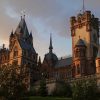

Perched halfway up the Drachenfels hill in the Siebengebirge, Drachenburg Castle, Königswinter commands sweeping views over the Rhine Valley. Baron Stephan von Sarter commissioned this extravagant villa in 1882 yet never spent a single night within its walls. Architects built the castle in just two years, fusing Gothic Revival spires with Renaissance interiors. Today this historicist masterpiece draws visitors from across the world to its terraced gardens and richly restored rooms.
Plan your visit to Drachenburg Castle, Königswinter
Location of Drachenburg Castle, Königswinter
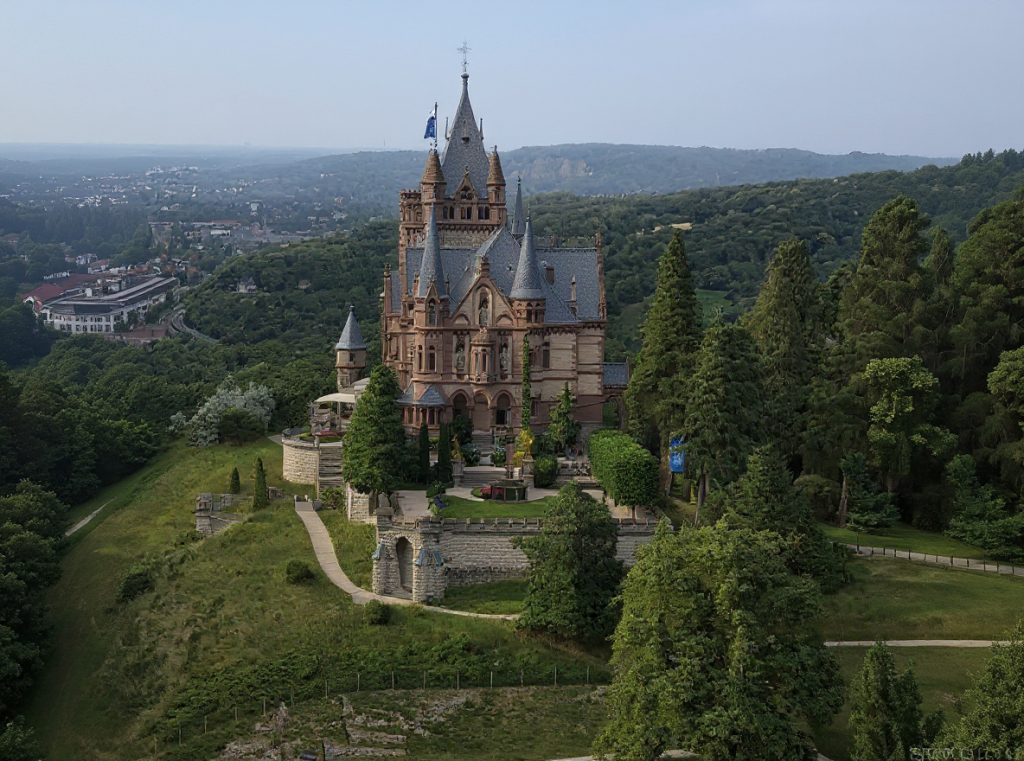
The castle sits on the slopes of Drachenfels in Königswinter, North Rhine-Westphalia, overlooking the Rhine River. Visitors reach the site from Königswinter town centre via the Drachenfelsbahn, Germany’s oldest rack railway, which opened in 1883. The railway stops directly below the castle after an eight-minute climb. Alternatively, the Eselsweg footpath winds uphill from the valley station past the Nibelungenhalle to the castle gate in about thirty minutes. The location offers expansive views across the Rhine Valley toward Bonn and Cologne. Meanwhile, the ruins of twelfth-century Burg Drachenfels crown the summit above.
History of Drachenburg Castle, Königswinter
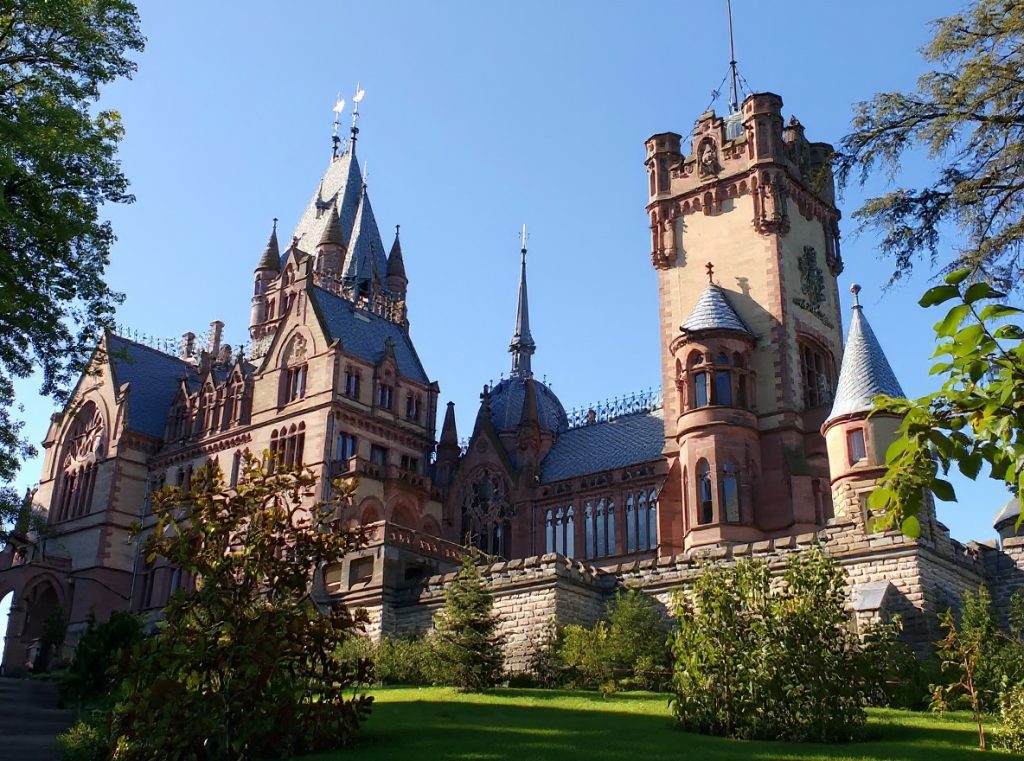
Stephan Sarter built the castle between 1882 and 1884 after making his fortune in the Suez Canal Company and purchasing a baronial title. Architects Bernhard Tüshaus and Leo von Abbema designed the structure when construction began in 1882. The project involved three architects, twenty specialized firms, and numerous artists and craftsmen. Builders completed the castle for 1.8 million gold marks. Though Sarter envisioned a residence befitting his new status, he chose to remain in Paris so the castle stood largely unused during his lifetime.
After Sarter’s death in 1902, his nephew Jakob Hubert Biesenbach inherited the property and opened it to the public in 1903. Biesenbach sold the castle in 1910 to Egbert von Simon. In 1930 the Catholic order of De La Salle Brothers purchased it and established St Michael’s boarding school there. During the Third Reich, authorities converted the building into a Nazi elite training centre. Post-war, the State of North Rhine-Westphalia took ownership, then left the castle empty so it began to deteriorate. In 1963, a Syndicate for the Preservation of Drachenburg succeeded in getting the castle classified as worth preserving.
Current status
The state of North Rhine-Westphalia acquired Drachenburg in 1989 and carried out extensive restoration completed in 2010. The Nordrhein-Westfalen-Stiftung Naturschutz, Heimat- und Kulturpflege now manages the property. The Schloss Drachenburg gGmbH operates the castle as a museum and event venue year-round. The castle extends over three floors with lavishly restored rooms, while visitors can enjoy the eleven-hectare castle park. Restoration teams used original plans and photographs to return the castle to its 1884 condition. Guided tours lead through the Music Room, the Nibelungen Room with its legendary frescoes, and the grand staircase illuminated by magnificent stained glass windows.
The castle represents one of Germany’s most significant examples of late nineteenth-century historicist architecture. Builders completed it between 1882 and 1884, and today it attracts many thousands of visitors per year from all over the world. The interiors preserve the opulent vision of the Gründerzeit era, while the terraced gardens frame views across the densely wooded Siebengebirge Nature Park. From its battlements, the Rhine curves below and Cologne Cathedral rises faintly on the horizon.
Castles near Drachenburg Castle, Königswinter
Frequently asked questions
Can I reach Drachenburg Castle by car?
The castle cannot be reached directly by car. Park at P6 Oberweingartenweg car park and walk 10 minutes uphill to the castle, or use the Drachenfelsbahn cog railway from the valley station.
What does a Drachenburg Castle ticket include?
The ticket grants access to the castle's historic state rooms and private quarters, the landscaped park, the permanent history exhibition, and the north tower. Audio guides are available for a more detailed tour.
Is Drachenburg Castle open in winter?
Yes, the castle is open year-round with reduced hours in winter (12:00–17:00 from 2 November to 28 February). It is closed on 14 December, Christmas Eve, and New Year's Eve.
How long is the walk from Königswinter to Drachenburg Castle?
The uphill walk from Königswinter station takes about 30 minutes via the Eselsweg path. Alternatively, take the Drachenfelsbahn cog railway, which stops at the castle mid-station.
When was Drachenburg Castle built?
Drachenburg Castle was built in just two years, from 1882 to 1884, for Baron Stephan von Sarter. It is one of Germany's most important 19th-century palace buildings and an excellent example of historicist architecture.
Popular right now
Featured listings