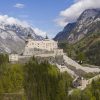

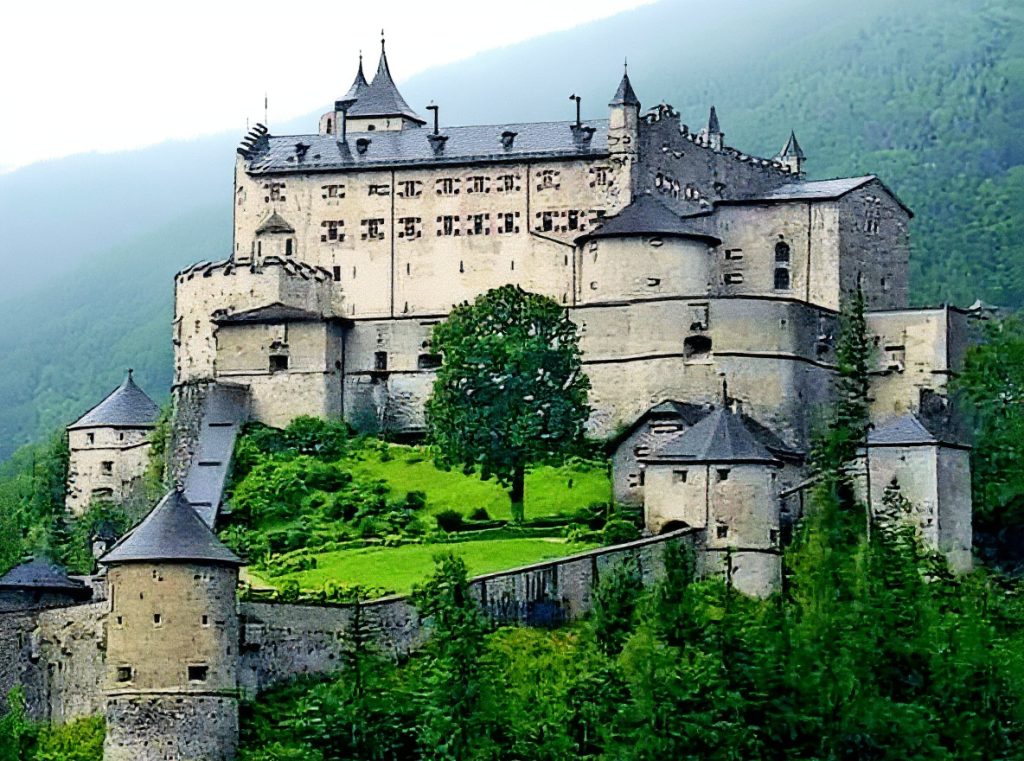
Rising 155 metres above the Salzach Valley on a sheer rock pillar, Hohenwerfen Castle commands one of the most dramatic settings in the Austrian Alps. Archbishop Gebhard of Salzburg built this medieval fortress between 1075 and 1078 to guard the vital southern approaches to his archbishopric. The castle sits approximately 40 kilometres south of Salzburg, surrounded by the towering peaks of the Berchtesgaden Alps and Tennen Mountains. For more than nine centuries these stone walls have watched over the market town of Werfen below.
Plan your visit to Hohenwerfen Castle
Tue–Sun 09:30–16:00Open 1 Apr–2 Nov; closed Mondays Apr, Oct, Nov (open holidays); May–Sept 09:00–17:00; shoulder months 09:30–16:00
Location of Hohenwerfen Castle
Hohenwerfen Castle crowns a steep rocky spur in the Salzach Valley, in the Pongau district of Salzburg state. The fortress stands at an altitude of 623 metres above sea level, yet rises 155 metres above the valley floor. Visitors find the castle in the market town of Werfen, which the A10 motorway serves well. From Salzburg city, drivers reach the fortress in 40 minutes. Trains connect Werfen station to Salzburg regularly. A steep walk or funicular ride then carries visitors from the town to the castle gates. The Lueg Pass narrows the valley here, so the castle controlled the only southern route into Salzburg for centuries. The surrounding Berchtesgaden Alps and Hochkönig massif to the west, and the Tennen range to the east, create an Alpine amphitheatre around the fortress.
History of Hohenwerfen Castle
Archbishop Gebhard of Salzburg ordered the construction of Hohenwerfen between 1075 and 1078, when the Investiture Controversy pitted Pope Gregory VII against Emperor Henry IV. Gebhard, an ally of the Pope and anti-king Rudolf of Rheinfelden, erected three major fortresses—Hohenwerfen, Hohensalzburg, and Petersberg—to defend his archbishopric. Imperial forces compelled Gebhard to flee in 1078, yet he returned in 1086 and died at Hohenwerfen in 1088. Archbishop Konrad I enlarged the castle in the twelfth century, adding a larger residential building and connecting it to the chapel. The fortress then guarded the lucrative salt trade that flowed through the valley.
Rebelling peasants and miners captured and burned the castle in 1525 during the German Peasants’ War. The archbishops rebuilt it afterward, and Archbishop Johann Jakob Kuen-Belasy added a central keep in 1573. Between 1608 and 1638, during the Thirty Years’ War, Prince-Archbishop Paris Lodron strengthened the defences with new bastions, a gunpowder tower in 1623, and additional walls adapted for artillery. The castle also served as a state prison, so its walls held various noblemen, including Archbishop Adalbert III in 1198 and Count Albert of Friesach in 1253. Archduke Eugen of Austria owned the fortress from 1898, but fire damaged it again in 1931. After restoration, the state forced him to sell it to the Salzburg Reichsgau administration in 1938.
Current status
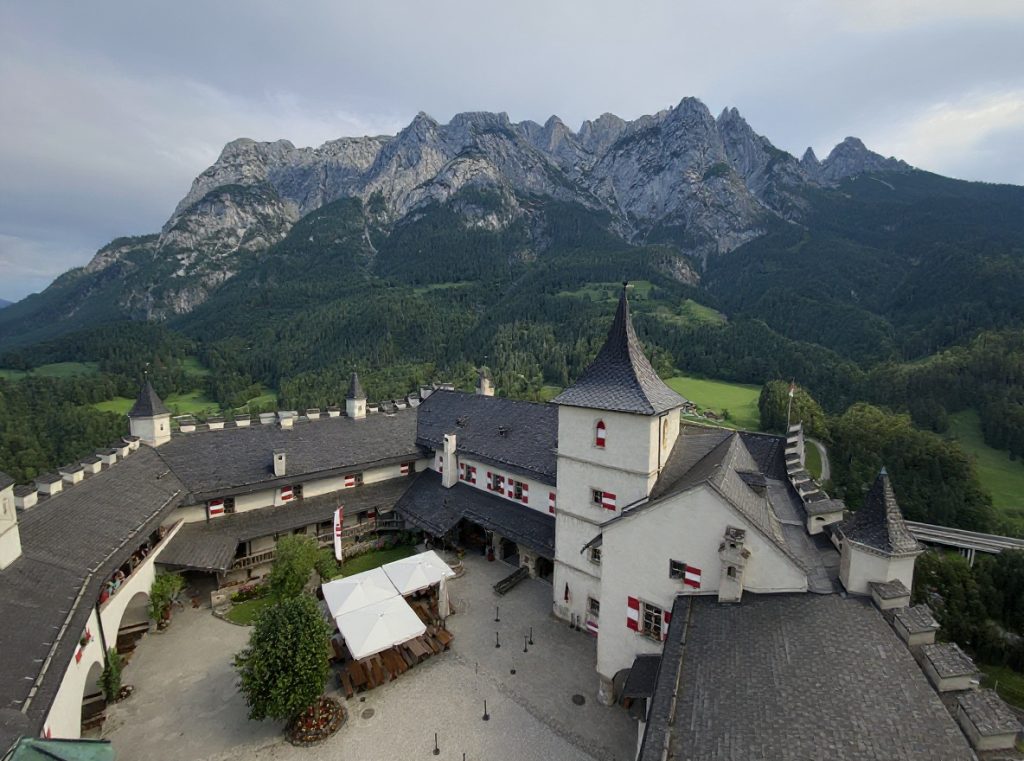
The state of Salzburg owns Hohenwerfen Castle today. After World War II, when the Nazis used it as a training centre, the Austrian Gendarmerie ran a training camp there until 1987. The castle now opens to the public as the Erlebnisburg Hohenwerfen—”Hohenwerfen Adventure Castle”—and welcomes visitors from April through early November. Guided tours lead guests through the courtyards, great halls, and defensive walkways. The Austrian Falconry Museum occupies part of the complex, and daily flight demonstrations showcase eagles, falcons, and vultures soaring above the ramparts. Exhibitions chronicle the castle’s construction, the 1525 peasant uprising, and 700 years of weapons history.
The chapel retains its Romanesque character, adorned with red marble columns and medieval frescoes. Visitors walk the battlements, peer through loopholes, and climb watchtowers for panoramic views of the Salzach corridor. The four-ton bell cast in 1568 still hangs in the belfry. International audiences recognise Hohenwerfen from the 1968 film Where Eagles Dare, starring Richard Burton and Clint Eastwood. The fortress stands today as both a monument to Alpine military architecture and a vibrant cultural site, where history meets the living tradition of falconry high above the valley that it has guarded since the eleventh century.
Castles near Hohenwerfen Castle
Frequently asked questions
Is Hohenwerfen Castle open year-round?
No, Hohenwerfen Castle is seasonal, opening 1 April to 2 November 2026. The castle is also closed on Mondays in April, October and early November, except on public holidays.
What is included in the Hohenwerfen Castle ticket?
The basic ticket includes access to the fortress grounds, the Austrian Falconry Museum, all exhibitions, and the daily birds of prey flight demonstrations at 11:15 and 15:15. An optional interior castle tour costs an additional €6 per person.
Can I walk up to Hohenwerfen Castle or must I take the lift?
You can choose either option. The footpath ticket is cheaper and involves a 15–20 minute walk through woodland to the gate. The lift ticket costs €4 extra and takes you directly from the base station to the castle courtyard.
How long does the falconry show at Hohenwerfen Castle last?
The birds of prey flight demonstrations run daily at 11:15 and 15:15 (with an additional show at 14:15 in high summer) and last approximately 25 minutes, weather permitting. They are included in all ticket types.
Can I visit both Hohenwerfen Castle and the Eisriesenwelt ice caves in one day?
Yes, both attractions are in Werfen and a combined day trip is popular from Salzburg. Most visitors do the ice caves in the morning (arrive before 10:00 to avoid crowds) and Hohenwerfen Castle in the afternoon.
Featured listings