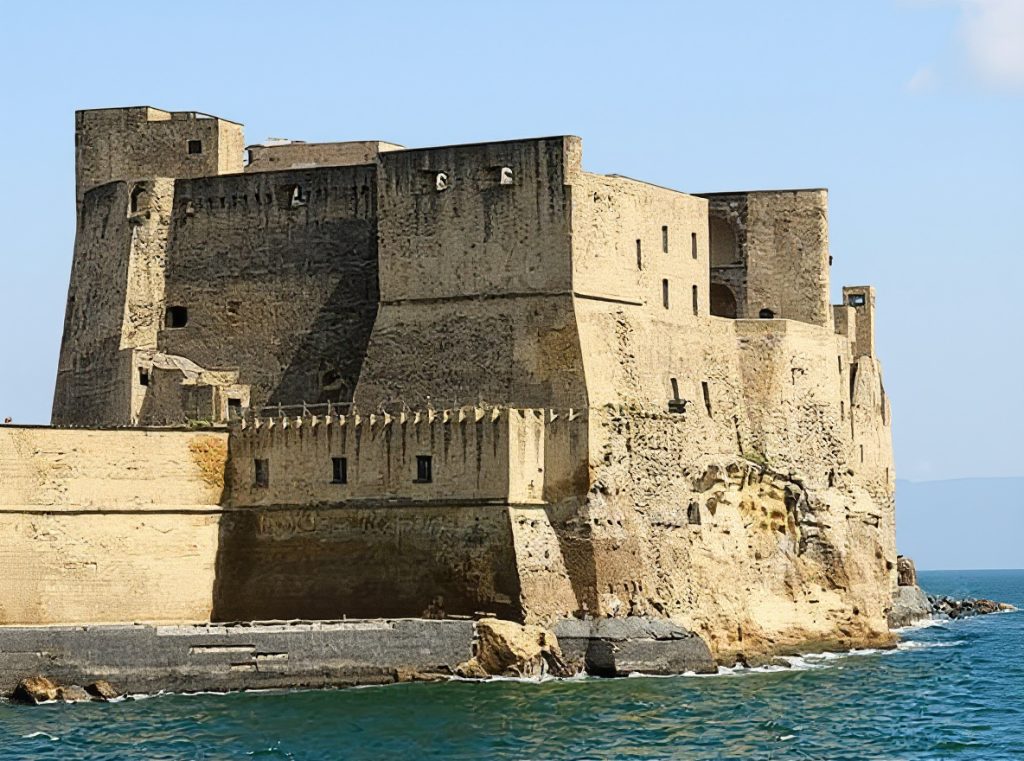
Castel dell’Ovo rises from the volcanic tuff of the ancient Megaride islet and commands the Gulf of Naples as the city’s oldest fortress. Roger the Norman built the castle in 1140, though the site hosted a luxurious Roman villa belonging to Lucius Licinius Lucullus in the first century BC. Emperor Valentinian III later fortified it in the 5th century. Legend weaves through the fortress walls because the Roman poet Virgil, who earned a reputation as a great sorcerer in the Middle Ages, supposedly placed a magical egg in the foundations to support the fortifications. A cage protected the sacred egg, which would bring good fortune to the city if it remained intact. Many still believe the castle can never collapse while the egg endures.
Plan your visit to Castel dell’Ovo
Location of Castel dell’Ovo
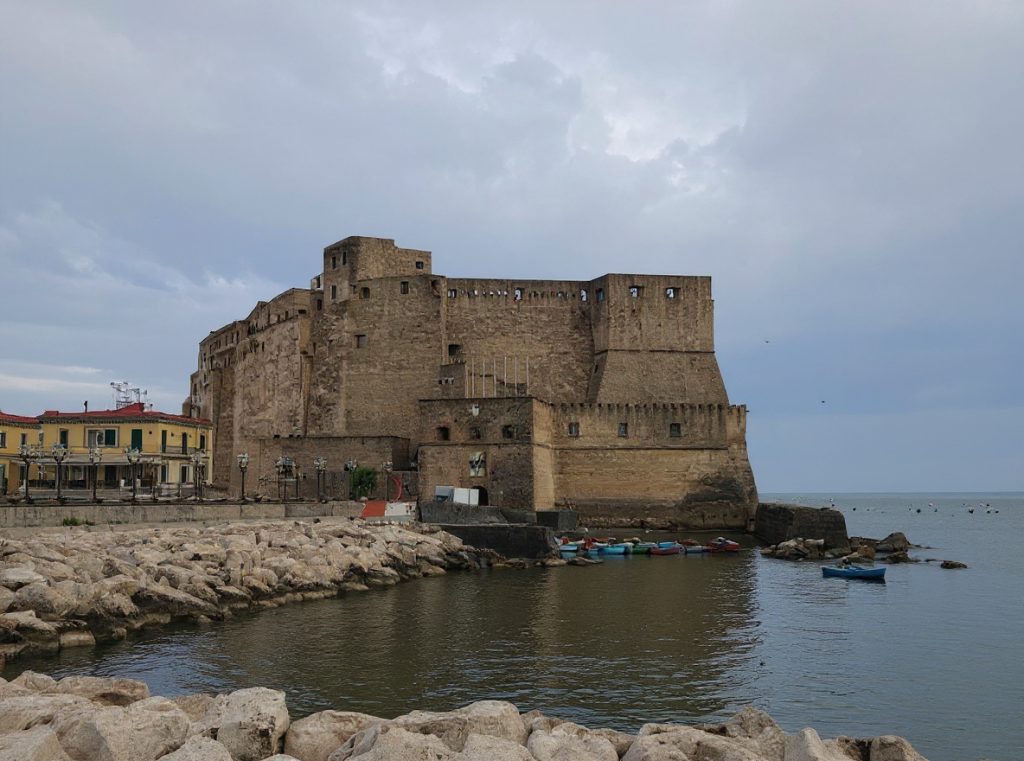
The castle sits on the former island of Megaride, now a peninsula, on the Gulf of Naples. A causeway joins the islet to the mainland in the Santa Lucia area of modern Naples. The castle lies in the Santa Lucia district, and visitors can reach it easily by public transport. The nearest metro station is Municipio on Line 1. The fortress stands on Via Partenope, the city’s seafront promenade. From Piazza del Plebiscito, the walk takes about 10 minutes on foot. Its location affords excellent views of the Naples waterfront and the surrounding area. The Borgo Marinari, a small harbour with fishing boats, yachts and seafood restaurants, sits beside the castle.
History of Castel dell’Ovo
The castle stands as the oldest fortification in Naples. The island of Megaride marks the spot where Greek colonists from Cumae founded the original nucleus of the city in the 6th century BC. The Cumans founded the Greek sub-colony of Parthènope in the eighth century BC, then re-founded it as Neapolis at the end of the sixth century BC. Valentinian III fortified it in the mid-5th century, and it became the site where the last western Roman emperor, Romulus Augustulus, went into exile in 476. Eugippius founded a monastery there after 492.
Roger the Norman conquered Naples in 1140 and made Castel dell’Ovo his seat. The castle served as a fortification against Saracen invaders, though it also functioned as a prison and royal palace over the centuries. When the Swabians arrived, the fortress received further fortifications. In 1222 Frederick II had the Tower of Colleville, the Master Tower and the Middle Tower constructed. During this period the castle served as both a royal residence and state prison. In 1191, Sicilians captured Empress Constance and imprisoned her here, where she remained until 1192.
Castel dell’Ovo began to decline in importance when king Charles I of Anjou built a new castle, Castel Nuovo. Yet it became the seat of the Royal Chamber and the State Treasury and also served as a prison. An earthquake destroyed part of the castle in 1370, and Queen Giovanna I repaired it. Her enemies later imprisoned her there in 1381 after Charles of Durazzo’s forces entered Naples. Alfonso V of Aragon, King of Naples from 1442, made more modifications to the castle and died there in 1458. The Spanish rebuilt the towers as they are today, octagonal in shape.
Current status
After Italian Unification the fortress’s defensive role became obsolete. Officials considered demolishing it for a long time, but the castle fell into neglect until restoration work in 1975. At that time it passed first under the management of the Ministry of Cultural Heritage and subsequently to the Municipality of Naples. The castle now houses the offices of the Regional Directorate for Cultural and Landscape Heritage of Campania Region. Today an artificial isthmus connects the fortress to the historic district of Santa Lucia, and it hosts exhibitions, conferences and events.
Castel dell’Ovo opens to the public daily from 9:00 AM to 7:00 PM. Admission is free, though certain exhibitions and events may require a ticket. The castle serves as a vibrant cultural centre hosting concerts, art exhibitions, conferences and special events. It offers completely free admission except during special exhibitions while maintaining its role as a living part of Naples’ cultural life. Its halls host exhibitions and conferences. From the exterior the castle offers one of the finest views across the entire Gulf of Naples. The causeway, measuring a little more than 100 metres in length, attracts newlyweds who have their wedding photos taken there.
Yellow tuff stone walls rise directly from the sea, while ancient towers frame views across the bay towards Mount Vesuvius and distant islands. The fortress guards the waterfront as it has for nine centuries. Its stone ramparts and vaulted chambers bear witness to Greek settlers, Roman emperors, Norman conquerors and Aragonese kings. Below, fishing boats bob in the Borgo Marinari marina, where the scent of seafood mingles with salt air and the rhythm of Neapolitan life continues.
Castles near Castel dell’Ovo
Frequently asked questions
What is the legend behind the name Castel dell'Ovo?
The name 'Egg Castle' comes from a medieval legend that the Roman poet Virgil placed a magical egg in the castle's foundations. According to the tale, if the egg breaks, the castle and the city of Naples would suffer catastrophe.
Is Castel dell'Ovo really free to visit?
Yes, admission to Castel dell'Ovo is completely free for all visitors, including access to the courtyards and battlements. Some temporary exhibitions or special events held inside may charge a separate fee.
What can you see from the terraces of Castel dell'Ovo?
The upper terraces and battlements offer panoramic views across the Bay of Naples, with Mount Vesuvius to the east and the Naples waterfront extending towards the city centre. The castle's seafront location provides unobstructed views over the Gulf of Naples.
Do I need to book in advance to visit Castel dell'Ovo?
No advance booking is required for individual visitors or small groups. You may be asked to show photo ID at the entrance. Large groups should contact the Naples municipality in advance.
How does Castel dell'Ovo compare to other Naples castles?
Castel dell'Ovo is the oldest castle in Naples with the best sea views and free entry. Castel Nuovo (Maschio Angioino) has a civic museum and charges €10, whilst Castel Sant'Elmo on Vomero hill (€5) offers the best panoramic city views.
Featured listings