
On the Isle of Anglesey, Beaumaris Castle rises from marshland beside the Menai Strait with near-perfect geometric precision. Edward I of England built this fortress from 1295 to protect his territorial gains in the region. It was the last of the four great fortresses Edward I built in north Wales, following Conwy, Caernarfon and Harlech. UNESCO considers Beaumaris to be one of “the finest examples of late 13th century and early 14th century military architecture in Europe”. Yet this formidable concentric castle never reached completion, earning its famous epithet as the greatest castle never built.
Plan your visit to Beaumaris Castle
Location of Beaumaris Castle
Beaumaris Castle sits in Anglesey in Wales. Visitors can access it via the A545 along the isle’s east coast. The castle occupies Castle Street in the town of Beaumaris, directly beside the Menai Strait that separates Anglesey from mainland Wales. The nearest train station is Bangor, 9 miles away, while a number of bus services run to the nearby area. Edward and his architect James of St George took full advantage of a blank canvas: the ‘beau mareys’ or ‘beautiful marsh’ beside the Menai Strait. The flat terrain allowed the designers to create a symmetrical fortification without the constraints that uneven ground imposed. From the castle ramparts, views extend across the strait to the mountains of Snowdonia beyond.
History of Beaumaris Castle
Planners probably first conceived the castle in 1284, but this was delayed because of lack of funds. Work only began in 1295 following the Madog ap Llywelyn uprising. A Welsh revolt broke out when Madog ap Llywelyn led his forces in 1294. Although Edward put it down, he realised the need to further strengthen his grip on the region. The Isle of Anglesey in particular served as an important source of food. The chief architect and engineer who planned and oversaw the construction was the experienced Master James of St Georges. He was also involved in Edward’s other castles in Wales such as Harlech Castle, Conwy Castle, and Caernarfon Castle. Work began and progressed quickly, since approximately 2,600 workers laboured on the site.
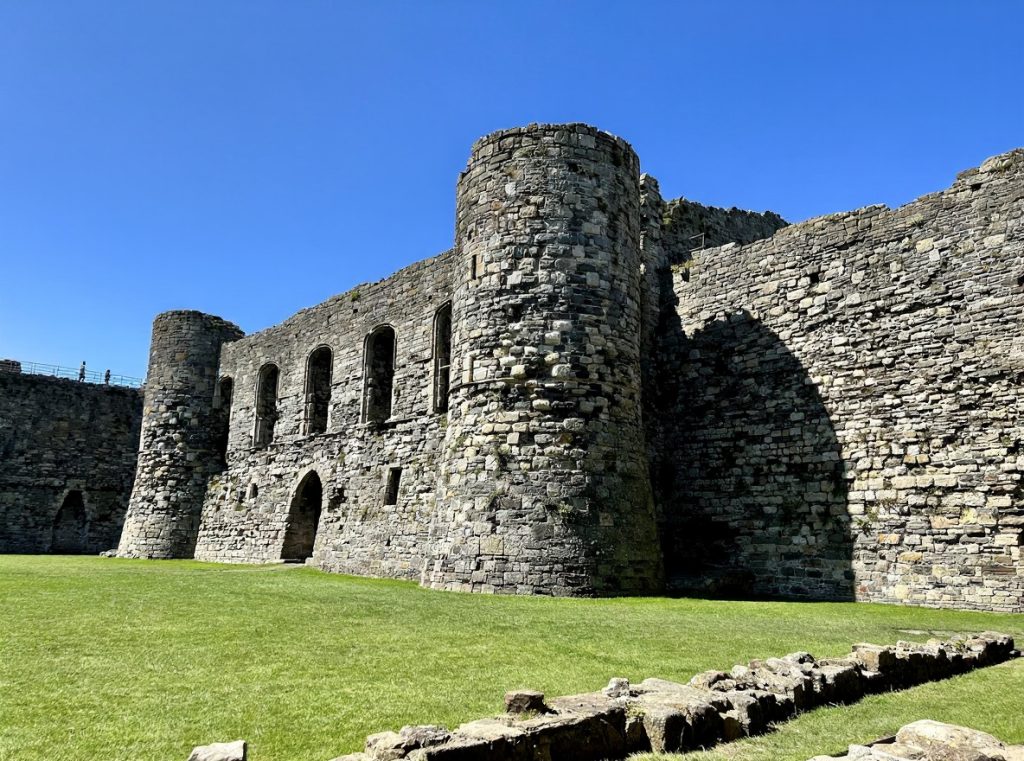
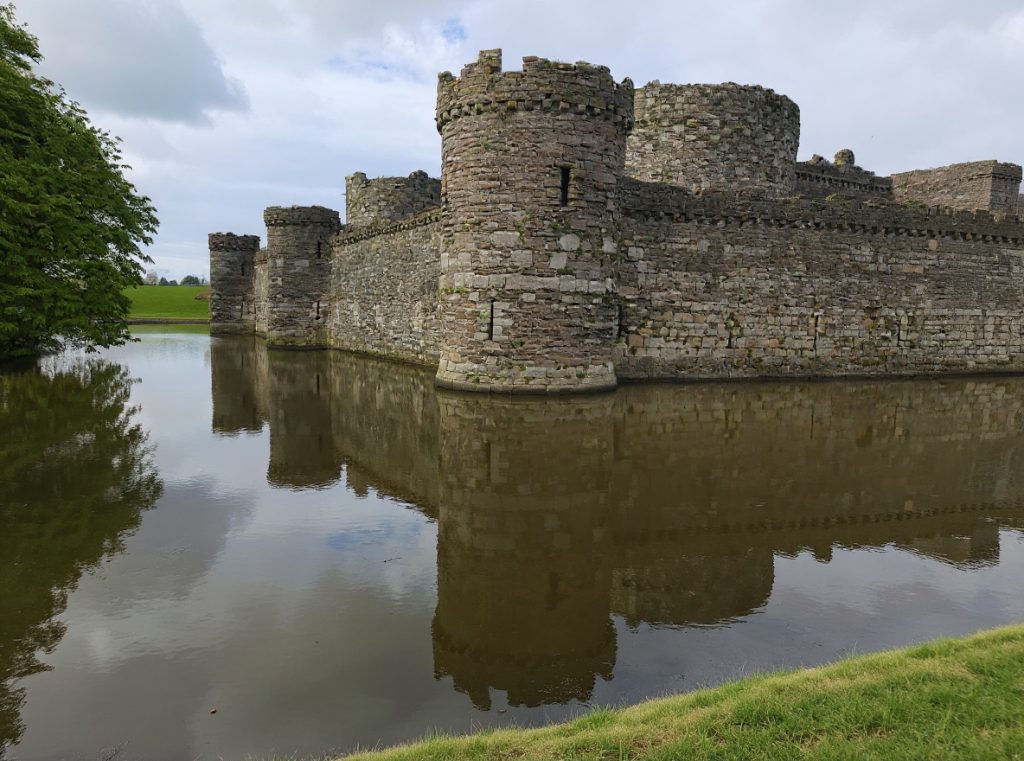
The castle featured the latest defensive designs of the period. These included round towers, inner and outer circuit walls, massive towered gates and a fortified dock. Builders constructed the fortification from local stone, with a moated outer ward. Twelve towers and two gatehouses guarded this outer ward, while an inner ward with two large, D-shaped gatehouses and six massive towers overlooked it. Ships could reach the south gate, allowing direct supply of the castle by sea. Edward’s invasion of Scotland soon diverted funding from the project, however, and work stopped. Building only recommenced after an invasion scare in 1306. Lack of money and trouble brewing in Scotland meant building work had petered out by the 1320s. The south gatehouse and the six great towers in the inner ward never reached their intended height.
During the English Civil War in 1642, forces loyal to Charles I held the castle. They held out until 1646 when they surrendered to the Parliamentary armies.
Current status
In 1807, Lord Thomas Bulkeley bought Beaumaris Castle from the Crown for £735. In 1925, Commissioners of Works took it into their care and carried out a massive restoration programme. In 1950, authorities designated it as a Grade I listed building. In 1986 it became part of the UNESCO world heritage sites. Cadw, the Welsh historic environment service, now manages Beaumaris Castle. It takes its rightful place on the global stage as part of the Castles and Town Walls of King Edward in Gwynedd World Heritage Site. The castle welcomes visitors year-round, though admission charges apply for entry.
Today the castle stands open to exploration. Its ramparts and passageways reveal the sophisticated military thinking of the late thirteenth century. The water-filled moat still encircles the outer walls, while the inner ward displays the elegant proportions that made this design so celebrated. Though the towers never soared to their intended heights, the castle’s concentric layout remains remarkably complete. Walking through the gatehouses and along the wall-walks, visitors trace the same defensive circuits that Edward and Master James planned over seven centuries ago, when they envisioned their ultimate fortress on the marshes of Anglesey.
Castles near Beaumaris Castle
Frequently asked questions
Is Beaumaris Castle suitable for children?
Yes, children enjoy exploring the castle walls, towers, moat and grounds. The site is largely open-air with stairs and uneven surfaces, so supervise young children carefully on wall walks and near the moat.
Why was Beaumaris Castle never completed?
Edward I's Scottish campaign diverted funds and manpower after 1298, halting work before the towers reached full height. The castle remains the purest example of concentric design precisely because it was frozen mid-construction.
Can I buy Beaumaris Castle tickets on the day?
Yes, tickets are available at the gate, though booking online saves 5% and guarantees entry. During peak summer periods, advance booking is recommended to avoid disappointment.
Is Beaumaris Castle wheelchair accessible?
The ground floor courtyard and parts of the outer ward are accessible, but the wall walks and towers involve stairs. Disabled visitors and a companion receive free entry; two dedicated parking spaces are available near the entrance.
What else is there to see in Beaumaris besides the castle?
The Georgian town offers Beaumaris Gaol, the courthouse, Victorian pier, St Mary's Church and independent shops and cafés. All are within a ten-minute walk of the castle in the compact town centre.
Featured listings