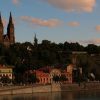
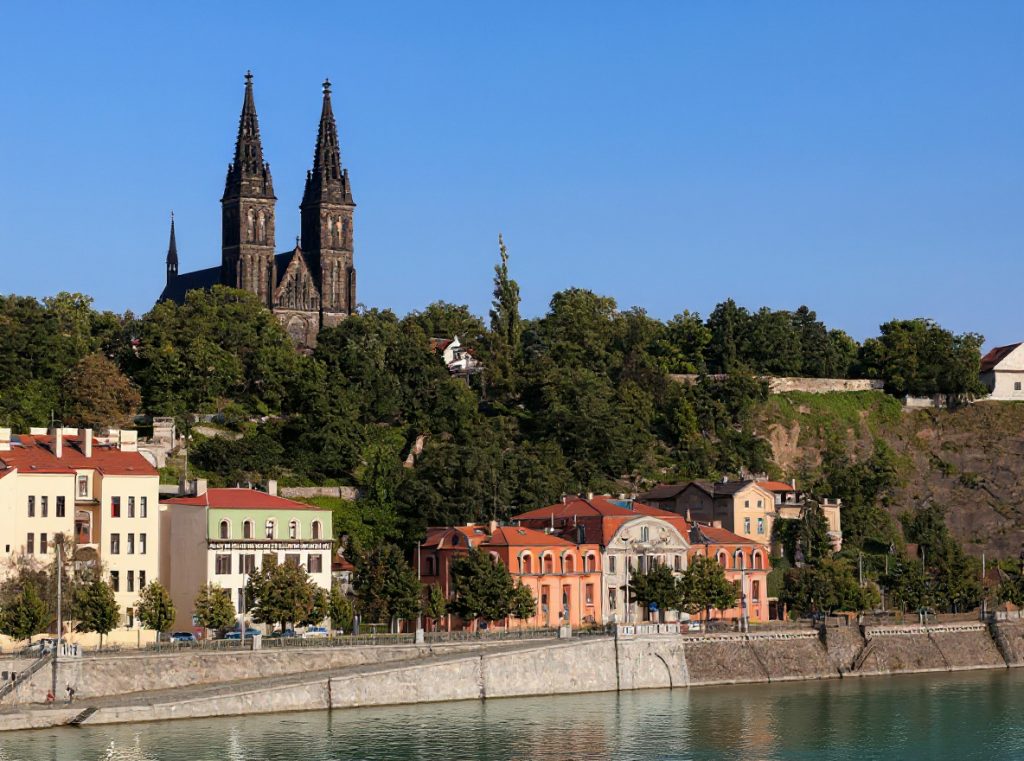
On a steep cliff above the Vltava River, Vyšehrad has commanded the approaches to Prague for more than a thousand years. This historic fort sits just over three kilometres southeast of Prague Castle, on the east bank of the Vltava. Builders founded the fortress around the middle of the tenth century, possibly at a similar time as Prague Castle. Inside the fort stand the Basilica of St Peter and St Paul and the Vyšehrad Cemetery. Prague’s oldest surviving building, the Rotunda of St Martin from the eleventh century, occupies the grounds.
Plan your visit to Vyšehrad
Location of Vyšehrad
Vyšehrad sits on a rocky promontory above the Vltava River and offers stunning views of the city. The address is V Pevnosti 159/5b, 128 00 Prague 2. Visitors can reach Vyšehrad easily via metro line C (red line) at Vyšehrad stop. From there it takes about ten minutes to walk to the fortress. Alternatively, tram line 17 from the National Theatre stops closer to the fortress, though the hill climb is steeper. The Vyšehrad National Cultural Monument complex forms part of the Prague Heritage Reserve, which appears on the UNESCO World Cultural and Natural Heritage List. The fortress rises south of Prague New Town on a hill that climbs steeply above the right bank of the Vltava River. From here the view reaches all the way to Prague Castle.
History of Vyšehrad
Czech dukes founded Vyšehrad to guard the trade route along the Vltava, around the middle of the tenth century. The fortress proved more prominent than Prague Castle for a period in the eleventh century under the Přemyslid dynasty. During this time, King Vratislav II of Bohemia moved his seat there from Prague Castle. Duke Vratislav built a magnificent Romanesque palace here and ordered construction of the Basilica of St Peter and Paul. He also founded a chapter answering directly to the Pope. The duke built the oldest surviving Romanesque monument in Prague, the Rotunda of St Martin. After Vratislav’s death, the Czech dukes continued to live at Vyšehrad but moved back to Prague Castle only in the middle of the twelfth century.
Vyšehrad underwent something of a revival during the reign of King Charles IV between 1346 and 1378. He considered it one of the most important places in Bohemian history and incorporated it into the coronation route. In place of the desolate Romanesque court, Charles built a spectacular royal palace with high arcades and adjoining houses for castle staff. He also added a water conduit and a school, then constructed new fortifications with battlements, towers, portals and two gates. The fifteenth century brought a downturn during the Hussite Wars when the Hussites sacked the site. After their victory, attackers destroyed all buildings of that era except for the rebuilt chapter temple and the Romanesque Rotunda of St Martin.
The Hussite Wars destroyed Vyšehrad almost to the ground. After this destruction, small artisans and merchants settled here until the second half of the seventeenth century, when authorities evicted everyone. The Habsburg Monarchy took over the Czech lands after the Thirty Years’ War.
Current status
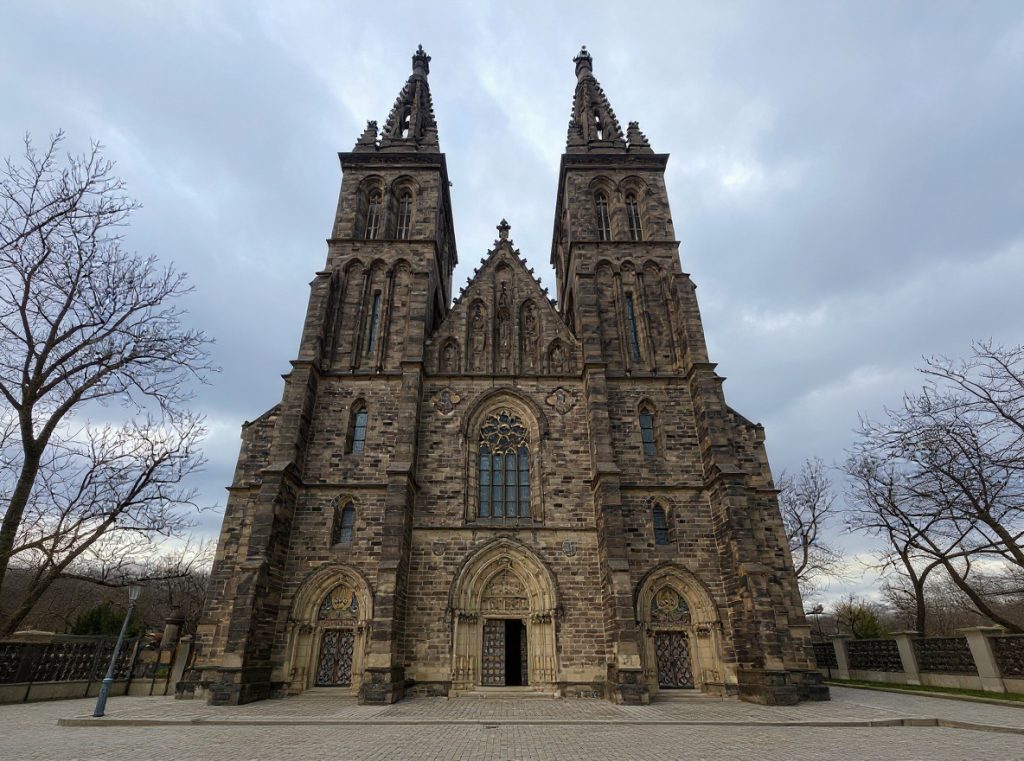
In 1962, authorities declared Vyšehrad a national cultural monument. In 1991, officials returned part of the property within the premises to the Vyšehrad Chapter. The magistrate owns the remaining part and runs it via the Administration of the Vyšehrad National Cultural Monument. Visitors can visit the complex free of charge all year round. The park area holds hidden architectural treasures including the rare Romanesque Rotunda of St Martin, the neo-Gothic Church of Sts Peter and Paul, and the national cemetery Slavín. Underground casemates house some of the original Baroque statues from the Charles Bridge. In 1869, officials converted the cemetery into the national cemetery that serves as the resting place of notable personalities of Czech art and history. About 550 notable people lie buried there.
The fortress plays a vital cultural role in Czech national life today. Guided tours explore the royal history and lead visitors through the underground casemates, where troops once moved rapidly through corridors beneath the Baroque ramparts. From the walls, the views sweep across the Vltava and the rooftops of Prague. In contrast, the park offers peaceful walks through centuries of history. The ancient rock where legend says Princess Libuše prophesied the glory of Prague now draws visitors. They seek both panoramic vistas and connections to the mythic origins of the Czech nation.
Castles near Vyšehrad
Frequently asked questions
Is Vyšehrad free to visit?
The fortress grounds, park, ramparts and cemetery are free to enter year-round. A ticket (170 Kč) is required for the underground casemates and Gorlice Hall, which can only be visited on a guided tour.
What are the main things to see at Vyšehrad?
The neo-Gothic Basilica of St Peter and Paul, the Vyšehrad Cemetery with graves of Czech cultural figures, panoramic views from the ramparts, and the underground casemates housing original Baroque statues from Charles Bridge. The Romanesque Rotunda of St Martin dates from the 11th century.
How long does the Vyšehrad casemates tour take?
The guided tour of the casemates and Gorlice Hall lasts approximately 45 to 60 minutes. Tours operate daily with specific departure times; booking in advance is recommended as capacity is limited.
How do I get to Vyšehrad from Prague city centre?
The easiest route is Metro line C (red) to Vyšehrad station, then a flat 10-minute walk through the park. Alternatively, take tram 2, 3, 7, 17 or 21 to Výtoň stop for a scenic approach from the river side with a short uphill walk.
Is Vyšehrad less crowded than Prague Castle?
Yes, Vyšehrad receives far fewer tourists than Prague Castle and offers a more peaceful atmosphere. It's a favourite with locals for walks and remains relatively quiet even during peak tourist season, making it ideal for those seeking a calmer experience.
Featured listings