
On a commanding hill above the Berounka River, Karlštejn Castle rises through wooded terrain 30 kilometres southwest of Prague. Charles IV founded this fortress in 1348 when he ruled as both King of Bohemia and Holy Roman Emperor. The castle served to safeguard the Imperial Regalia, the Bohemian crown jewels, holy relics, and other royal treasures. Construction reached completion in 1365 when workers consecrated the Chapel of the Holy Cross in the Great Tower.
Plan your visit to Karlštejn Castle
Tue–Sun 09:30–16:30
Location of Karlštejn Castle
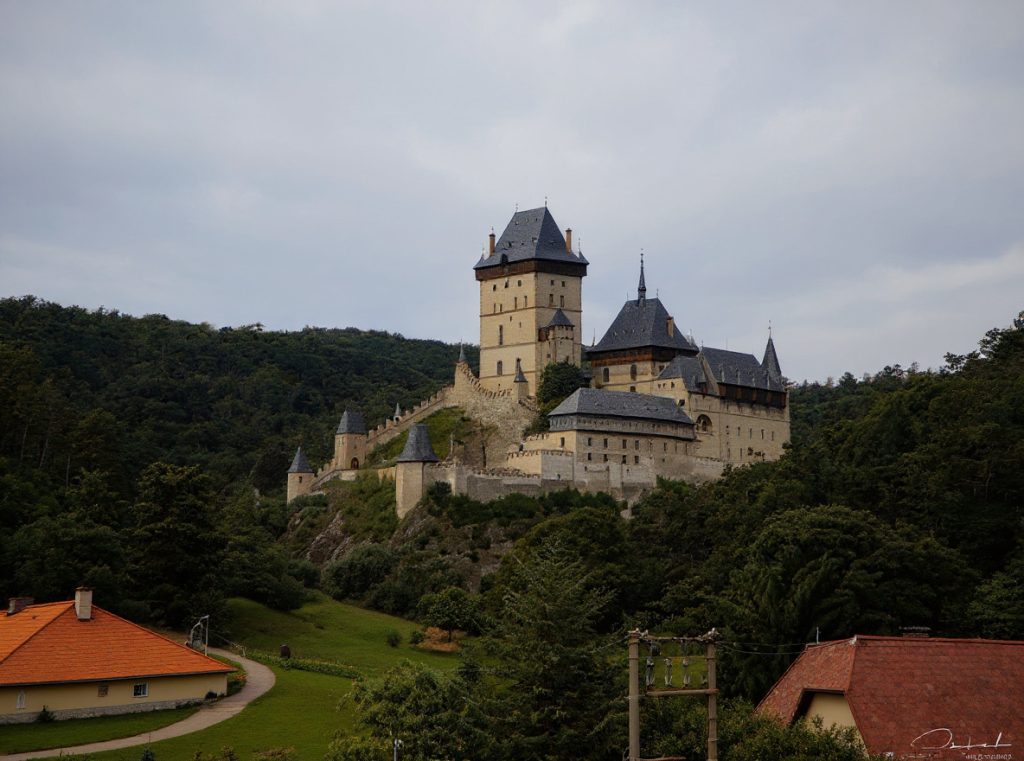
Karlštejn Castle sits in the market town of Karlštejn, in the Central Bohemian Region, on a hill overlooking the Berounka river roughly 30 kilometres southwest of Prague. The castle perches on terraced levels cut into the limestone ridge, while the village spreads along the valley floor below. Train services from Prague’s main station reach Karlštejn in approximately 40 minutes. The station sits just over a kilometre from the castle entrance. From the railway stop, a gently climbing path winds through the village and passes restaurants and small shops before it steepens near the castle gates. Visitors can also drive from Prague via Route 116, though parking areas lie in the village rather than at the castle itself. The wooded hills of the Bohemian Karst surround the site. Trails lead from Karlštejn to nearby limestone quarries and nature reserves. The castle’s elevated position offers sweeping views across the river valley and the rolling Central Bohemian countryside.
History of Karlštejn Castle
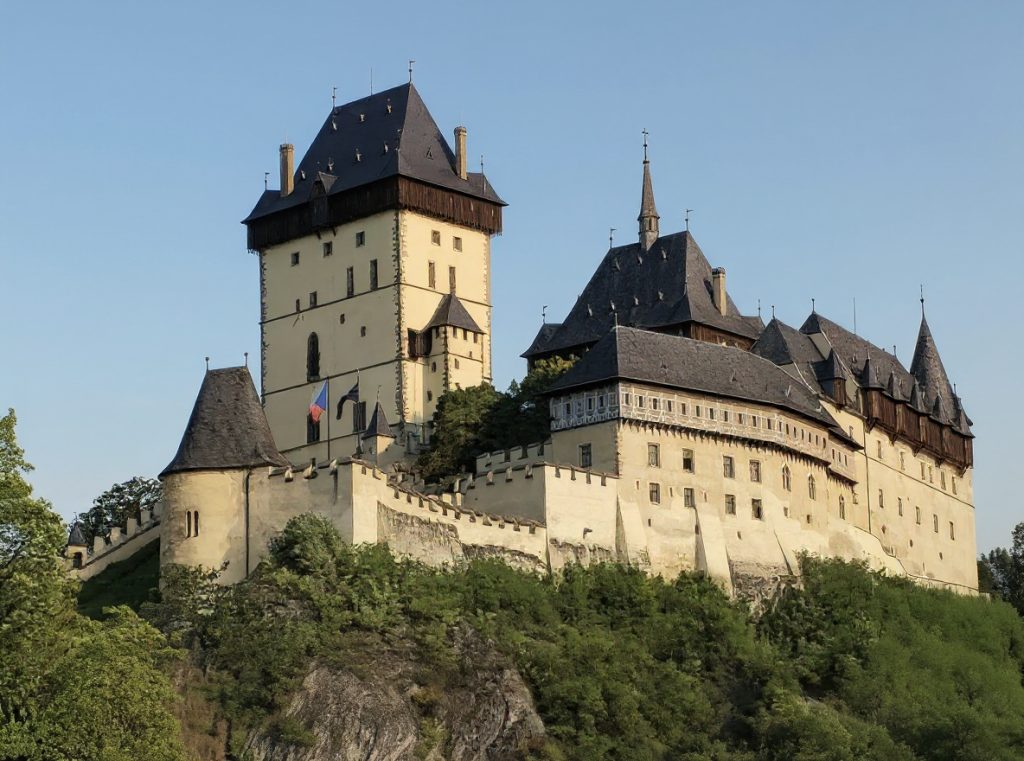
Charles IV founded Karlštejn Castle in 1348 as his private residence and a place of safekeeping for royal treasures, especially his collections of holy relics and the Imperial Crown Jewels. Construction proceeded under the direction of the later Karlštejn burgrave Vitus of Bítov. Charles IV stayed here for the first time in 1355 and oversaw the construction and decoration work, especially in chapels. The emperor himself supervised every detail of the interior design because he wanted religious spaces to meet his exacting standards. The work concluded in 1365 when workers consecrated the Chapel of the Holy Cross in the Great Tower.
The castle served as a representative residence of Charles IV and his son Wenceslas IV only till 1419. The Chapel of the Holy Cross safeguarded the imperial crown jewels until 1420 when the Hussite wars began. After that, the jewels never returned to Karlštejn Castle. During the conflict, Hussite forces laid siege to the fortress from 1421 to 1422. The castle withstood even the use of artillery and defended itself successfully. After the wars in 1436, the Bohemian crown jewels came to the Chapel of the Holy Cross where they remained till 1619. As a fortress, Karlštejn Castle protected the crown jewels, holy relics, and royal archives till the 17th century.
The centuries brought architectural evolution to the complex. After 1480 builders rebuilt the castle in the late Gothic style. In the last quarter of the 16th century, they remodeled it in the Renaissance style. Emperor Rudolf II ordered further repairs and modifications from 1579 to 1597 when the castle gained new Renaissance decorations and sgraffito plaster. During the last reconstruction at the end of the 19th century, architect Josef Mocker worked in the spirit of purism.
Current status
Over the centuries the castle has always remained in the hands of the king or a state institution, never in private hands. Nowadays the state owns it. The National Heritage Institute operates the castle, which opened to the public in 1905. As of 2019, it ranked as the fifth most-visited castle and received more than 200,000 visitors. Guided tours lead visitors through the Imperial Palace and Marian Tower and show the emperor’s chambers, the Knights’ Hall with its portrait gallery, and the Treasury. A second tour route climbs through the Great Tower to the Chapel of the Holy Cross, where 129 paintings by Master Theodoric cover the walls. This represents the largest such collection in the world.
The castle hosts cultural events throughout the year, from medieval festivals to wine harvest celebrations that honour the surrounding vineyards Charles IV himself established. Researchers continue to study the fourteenth-century wall paintings and architectural details, while conservation teams maintain the structure’s fabric. The stepped layout of the buildings rises from the Well Tower through the Imperial Palace to the separately fortified Great Tower. This demonstrates the hierarchical design Charles IV envisioned. Entrance to the castle grounds costs nothing, though interior tours require paid admission. The fortress closes on Mondays except during peak season. Winter brings reduced hours as the cold affects the historic interiors.
From its terraces, the view stretches across forested ridges where limestone outcrops break through the canopy. The Berounka winds below, its course unchanged since Charles IV rode up this same hill seven centuries ago to inspect his fortress rising stone by stone from the bedrock.
Castles near Karlštejn Castle
Frequently asked questions
Can you visit Karlštejn Castle without a tour?
Entry to the castle courtyards is free, but access to the interior is only possible with a guided tour. Tour I (Imperial Residence) requires booking for groups only; individual visitors can usually join without advance reservation.
How long is the walk from Karlštejn village to the castle?
The uphill walk from the train station through the village to the castle entrance takes 20–25 minutes. Horse-drawn carriages are available for an additional fee if you prefer not to walk.
What is the difference between Tour I and Tour II at Karlštejn Castle?
Tour I (300 Kč, 55 minutes) covers the Imperial Residence and basic castle interiors. Tour II (640 Kč, 100 minutes) is an exclusive tour of the Chapel of the Holy Cross with original 14th-century decoration; advance booking strongly recommended and only available May–October.
Is Karlštejn Castle open on Mondays?
No, Karlštejn Castle is closed on Mondays throughout most of the year. The only exception is during the winter holiday period (26 December–4 January) when it opens daily.
How much does the train cost from Prague to Karlštejn Castle?
A one-way train ticket from Prague to Karlštejn costs approximately 82 Kč (around €3.50). Trains depart from Prague's main station regularly, usually every 30 minutes, with a journey time of about 40 minutes.
Featured listings