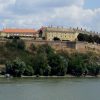

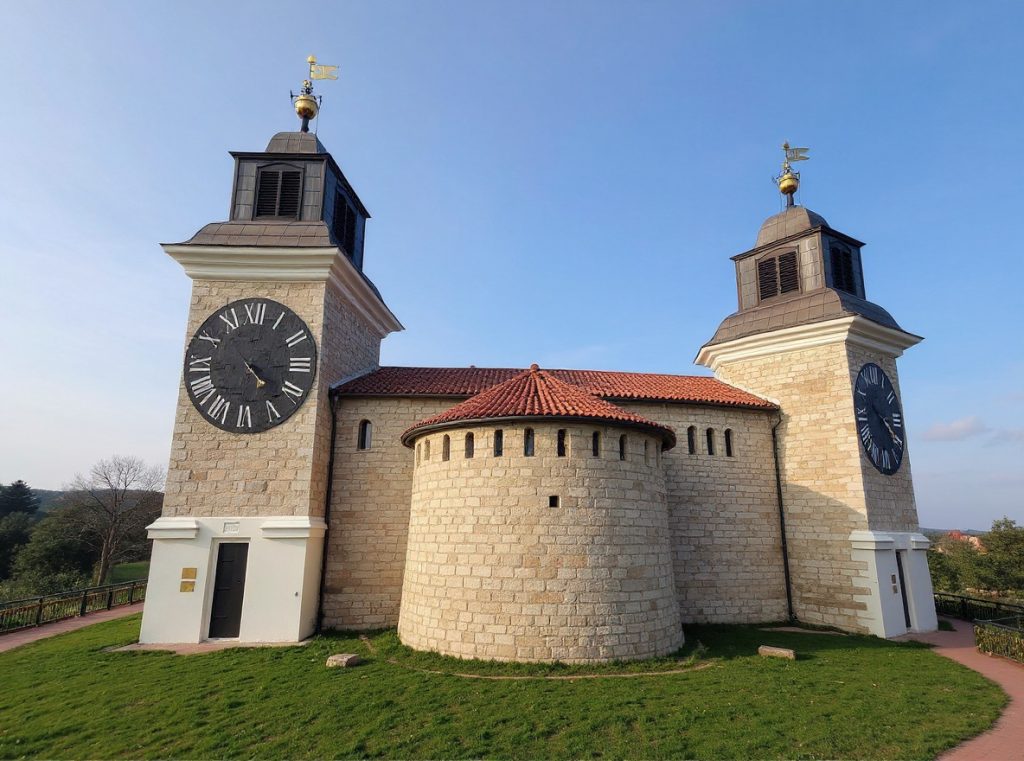
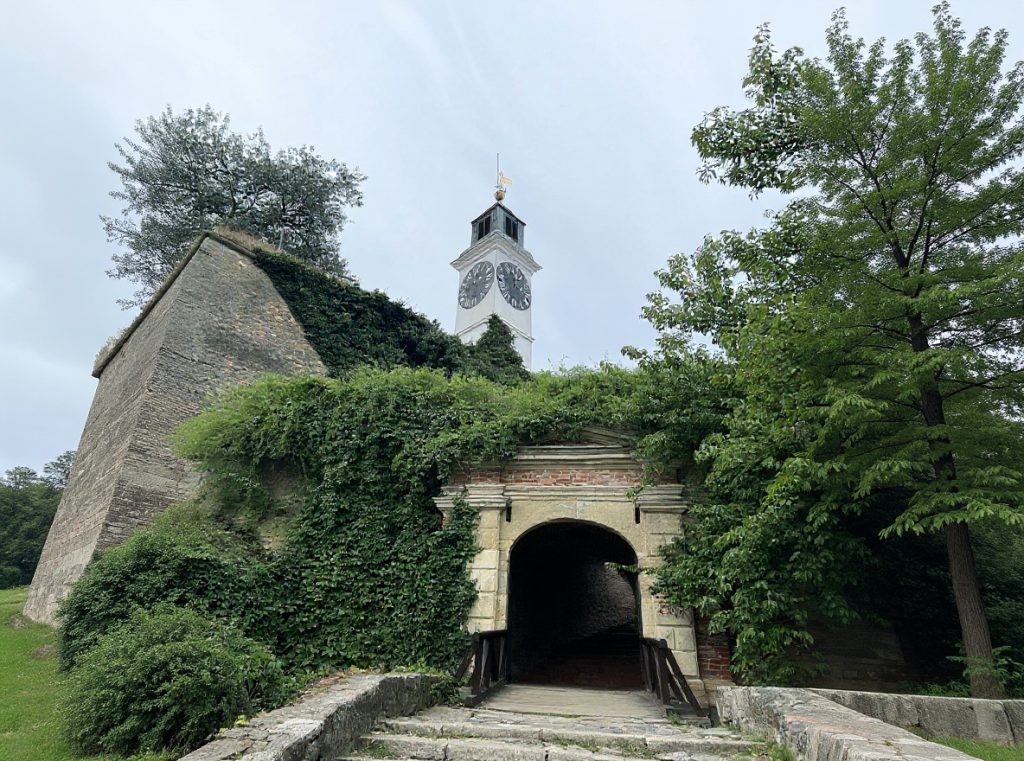
Dominating the right bank of the Danube River, Petrovaradin Fortress rises from a volcanic rock cliff above Novi Sad, Serbia. The Habsburgs built this monumental bastion fortress between 1692 and 1780 to shield their empire from Ottoman expansion. People know it as the “Gibraltar on the Danube” because it spreads across 112 hectares with five massive bastions, 12,000 loopholes, and an extraordinary 16-kilometre network of underground military galleries. Its famous clock tower displays reversed hands so that fishermen on the river below could read the time from a distance.
Plan your visit to Petrovaradin Fortress
Location of Petrovaradin Fortress
Petrovaradin Fortress sits in the town of Petrovaradin, now part of Novi Sad in the Serbian province of Vojvodina. The fortress occupies a strategic cliff on the Danube’s northern slopes of Fruška Gora mountain. Visitors cross the Varadinski Bridge from central Novi Sad and then climb the streets of the Lower Town to reach the Upper Fortress. The site lies roughly 2.5 kilometres from Novi Sad’s city centre.
Regular city buses connect the fortress with downtown Novi Sad. Those on foot can walk across the bridge in about 25 minutes. The fortress grounds remain accessible throughout the day. Its elevated position offers sweeping views across the Danube to the old town and the Pannonian Plain beyond.
History of Petrovaradin Fortress
Celts founded the first fortified settlement here several centuries before the Common Era. Romans later built the Cusum fortress on the same rock as part of their Danube frontier defences. In 1235, King Béla IV of Hungary established a Cistercian monastery atop the Roman ruins. Ottoman forces seized the medieval fort after a two-week siege in 1526 and held it for more than 150 years.
The Austrian army recaptured Petrovaradin during the Great Turkish War in 1687. Habsburg military planners then decided to raze the old fortress and construct a modern fortification. Prince Charles Eugène de Croÿ, Emperor Leopold I’s envoy, laid the cornerstone on 18 October 1692. Austrian military engineers Mathias Kaisersfeld, Luigi Ferdinando Marsigli, and Michael Wamberg designed the complex. Construction proceeded slowly because wars and shifting imperial priorities delayed the work.
In August 1716, Grand Vizier Damat Ali led 150,000 Ottoman soldiers against the still-incomplete fortress. Prince Eugene of Savoy commanded an Austrian force half that size. His decisive victory ended Ottoman ambitions in Central Europe. Workers continued to expand the fortress until 1780, adding outerworks and completing the underground countermine system by 1783. By the early 19th century, it ranked as the strongest and best-equipped fortress in the Austrian Empire. The structure never again faced a serious military threat from the Turks.
Hungarian revolutionaries briefly held Petrovaradin in 1848 and 1849 before Austrian forces recaptured it. The fortress then served as a military barracks and storage depot through World War I. After 1918, it passed to the Kingdom of Serbs, Croats and Slovenes, which later became Yugoslavia and finally independent Serbia.
Current status
The state demilitarised Petrovaradin Fortress in the mid-20th century. Authorities declared it a cultural monument in 1948. Serbia added it to the list of Spatial Cultural-Historical Units of Great Importance in 1991. The Republic of Serbia now protects the site. The City Museum of Novi Sad occupies the 1775 Mamula Barracks in the Upper Fortress.
The fortress grounds open to the public without charge. Visitors can explore the Upper and Lower Towns, though access to the underground galleries requires a guided tour for safety. The Lower Town retains its military-baroque street plan, with churches, gates, and barracks buildings intact. Around 100 artist studios now fill the old structures, and galleries, cafés, and restaurants enliven the complex.
Since 2000, the fortress has hosted EXIT Festival, one of Europe’s largest music events, drawing tens of thousands each summer. The fortress continues to anchor Novi Sad’s identity. Its bastions, gates, and ramparts stand as an exceptional example of 18th-century military engineering, while its tunnels and clocktower fascinate those who climb its slopes above the great river.
Castles near Petrovaradin Fortress
Frequently asked questions
Is Petrovaradin Fortress free to visit?
Yes, the fortress grounds, ramparts, and clock tower area are open 24 hours and free to explore. Only the City Museum of Novi Sad and the guided underground tunnel tours require paid tickets.
Can you visit the underground tunnels at Petrovaradin Fortress?
Yes, guided tours of the underground military galleries are available through the City Museum of Novi Sad. The 30–40 minute tour covers 1 km of the 16 km tunnel network and costs 300 RSD for adults.
What is special about the Petrovaradin Fortress clock tower?
The clock tower has reversed hands—the long hand shows hours and the short hand shows minutes. This unusual design allowed boatmen on the Danube to read the time from a distance.
How do I get to Petrovaradin Fortress from Novi Sad city centre?
You can walk across the Varadin Bridge (about 20–30 minutes) or take buses 3, 6, 9, 61, 64, or 69, which run regularly and take 15–20 minutes. Free parking is available near the fortress for those driving.
What is the history of Petrovaradin Fortress?
Built by the Habsburg Empire between 1692 and 1780 to defend against Ottoman invasion, it is one of Europe's largest preserved fortifications. Known as the 'Gibraltar on the Danube', it was never conquered and features 16 km of underground tunnels across four levels.

Top Rated Castle 2026
Petrovaradin Fortress is one of the best rated castles in Europe: 4.8 stars from 15,073 visitors on Google. See all winners.
Is this your castle? Show the award on your website
Copy this code into your website:
Popular right now
Featured listings