
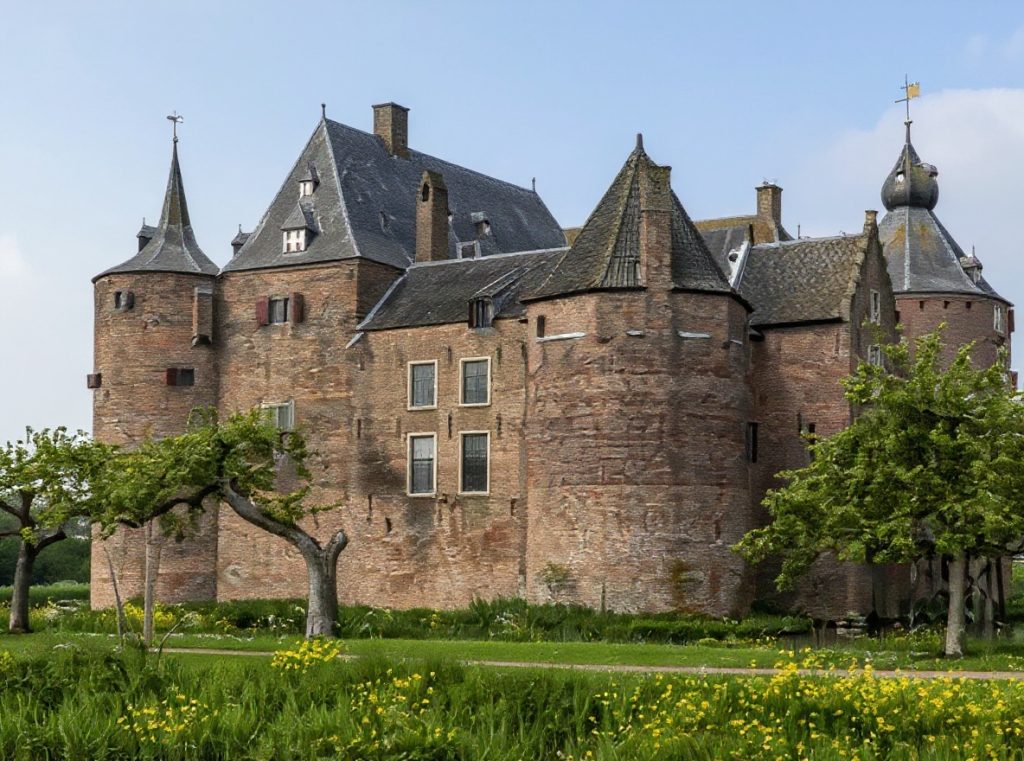
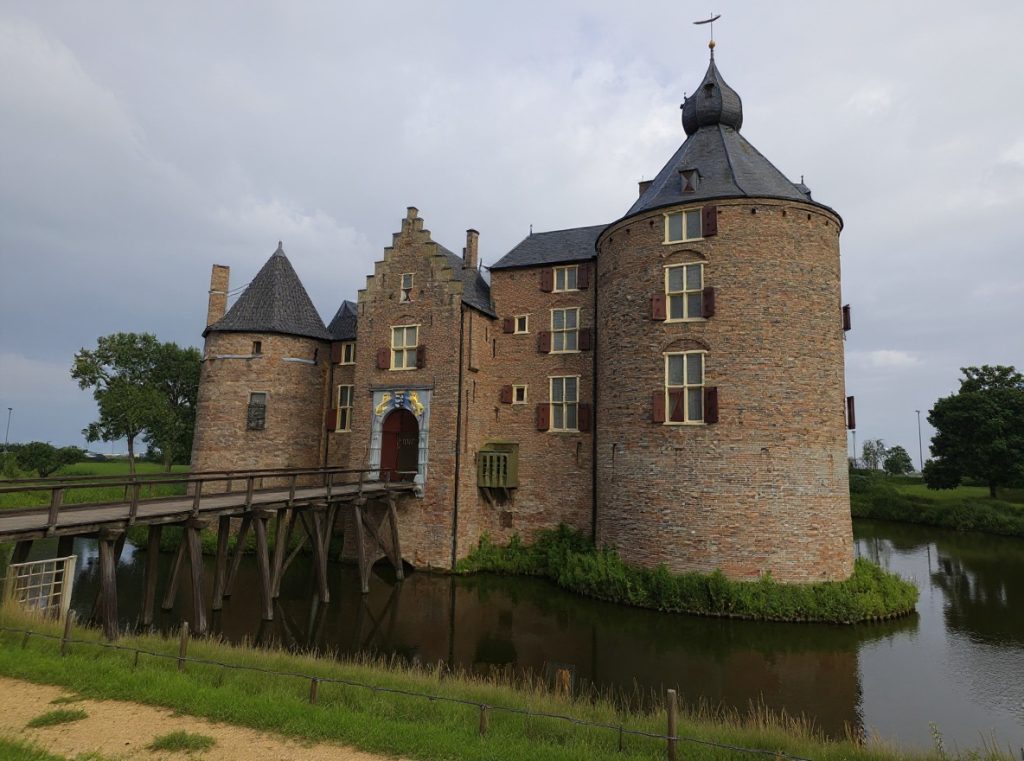
Surrounded by a double moat in the Bommelerwaard region of Gelderland, Castle Ammersoyen ranks among the Netherlands’ most authentically preserved medieval water fortresses. Dirk van Herlaer built the stone fortress in the early 1350s, creating a defensive stronghold along what was then a branch of the river Maas. The castle followed a fixed plan, something quite uncommon for medieval castles. It has a rectangular almost square layout of four wings centered around a little courtyard. Heavy round towers anchor its four corners.
Plan your visit to Castle Ammersoyen
Tue–Sun 11:00–17:00Apr–Oct: Tue–Sun 11:00–17:00; Jan–Mar & Nov–Dec: Sun only 11:00–17:00; extra opening during school holidays
Location of Castle Ammersoyen
Castle Ammersoyen sits in Ammerzoden in the Bommelerwaard region in the province of Gelderland, the Netherlands. The castle occupies the characteristic Dutch river landscape between the Maas and the Waal. Visitors can reach Ammerzoden by car via the A2 motorway. They take the exit towards Zaltbommel and follow signs to the village. The address is Kasteellaan 1, making it simple to find on the edge of the village centre. Since 1999, the village has formed part of the municipality of Maasdriel. Public transport connections run through nearby Zaltbommel, though a car offers the most convenient access to this rural location.
History of Castle Ammersoyen
Dirk van Herlaer built the castle in 1350 along the river Maas. Just a few years after builders completed construction, engineers rerouted the river, leaving the castle surrounded by a moat. When Dirk died in 1354, his eldest son Gerhard inherited the castle. In 1386, Willem van Gulik, the Duke of Gelre, took the castle by force. The Dukes of Gelre remained owners for 25 years. In 1424, Johan van Broeckhuysen, lord of Waardenburg, purchased the castle. The Van Arkel family gained control through marriage in 1496.
The fortress weathered many military challenges through the centuries. Burgundian troops, led by Count Henrick Van Nassau, occupied the castle for a brief time in the mid-16th century. They caused moderate damage. In 1572, the Spanish invaded but Prince Willem Van Oranje and his troops drove them out. By 1590, a fire nearly destroyed the castle. Joris Van Arkel, Lord of Ammersoyen, died from injuries he sustained during the fire. In 1672, French troops invaded the Netherlands. The last Lord of the Van Arkel family saved the castle by paying a ransom of 7,000 guilders.
Baron Arthur de Woelmont sold the castle in 1873 to the Roman Catholic Church of Ammerzoden. The Church then founded a convent in the castle. The nuns had the moat filled in and built an adjoining chapel. Between 1944 and 1945, the castle suffered severe war damage. During World War II, the castle endured heavy damage, so the nuns left afterward. The village used the castle as a village hall until the Gelderland Castle Trust bought it in 1957. The Friends of Gelderland Castles Foundation began a sixteen-year restoration in 1959.
Current status
The Friends of Gelderland Castles Foundation manages Castle Ammersoyen today, operating it as a museum and cultural venue. Restoration work took 16 years, bringing the castle back to its medieval glory. The filled-in moat turned out to be an archaeological treasure trove. The restoration revealed medieval staircases, arrow slits, plastered fireplaces, a well, and hidden chambers. Craftsmen restored the Knight’s Hall ceiling to its original height. Visitors explore the tower chambers, the great hall, and the women’s quarters while discovering medieval life through period furnishings and exhibits.
Archaeological investigations preserved artifacts from the 14th century onwards. The extensive artifact collection on display at the castle ranks among the largest in the Netherlands. The attic houses archaeological finds including pottery, glass, silver, tin, and bronze recovered from the moat. The castle welcomes individual visitors and guided tours from Tuesday to Sunday between April and October. It maintains limited Sunday hours during winter months. The on-site restaurant Het Koetshuis serves refreshments on a terrace overlooking the moat. The castle also hosts weddings, corporate events, and educational programmes for children. Young visitors can try on armour in the weapon room.
Four round towers anchor the corners of this perfectly proportioned fortress. Their thick walls rise from still waters that have guarded these stones for more than six centuries. The medieval atmosphere endures in every shadowed corridor and vaulted chamber. Each stone bears witness to dynastic struggles, fires, sieges, and the patient work of restoration. This careful reconstruction returned the water castle to its former strength.
Castles near Castle Ammersoyen
Frequently asked questions
What can I see inside Castle Ammersoyen?
The castle features medieval furnished rooms including the imposing knight's hall, tower chambers, and the women's quarters. The museum attic displays archaeological finds recovered from the moat during post-war excavations, including pottery, glass, and metalwork spanning 600 years of history.
Is Castle Ammersoyen suitable for children?
Yes, children can try on pieces of armour in the weapon room and participate in activities on the museum attic floor. The castle's thick walls, narrow staircases, and drawbridge create an authentic medieval adventure, though steep stairs require supervision.
Can I visit Castle Ammersoyen with a Museumkaart?
Yes, Museumkaart holders receive free admission during regular opening hours (not valid during special tours and events). Simply present your valid Museum Card at the entrance.
Are guided tours available at Castle Ammersoyen?
Guided tours are offered, including a highlights tour on Tuesdays at 11:30 that lasts approximately one hour and is included in the entrance fee. Self-guided exploration with information panels is also possible, though some visitors note that English signage is limited.
How old is Castle Ammersoyen and why was it built?
Castle Ammersoyen was built around 1300 by the Van Herlaer family as a defensive fortress near the River Maas. It is one of the best-preserved medieval water castles in the Netherlands, featuring four round corner towers and a square layout typical of that era.
Featured listings