Commanding a rocky promontory above Oslo’s inner harbour, Akershus Fortress has guarded the Norwegian capital for over seven centuries. King Håkon V Magnusson commissioned this medieval stronghold around 1290 when he moved the seat of power from Bergen to Oslo. The fortress occupies a strategic position at the end of a headland. Its stone walls and towers once controlled all sea and land access to the city. Through sieges, fires, wars and centuries of transformation, it has remained an active symbol of Norwegian sovereignty and military strength.
Plan your visit to Akershus Fortress
Location of Akershus Fortress
The fortress sits on the Akersneset peninsula in central Oslo, directly on the banks of the Oslofjord. Visitors enter through gates at the end of Akersgata or via a drawbridge spanning Kongens gate at the southern end of Kirkegata. The complex occupies green parkland within easy walking distance of Oslo’s city hall and waterfront district. Tram number 12 to Christiania Torv provides convenient public transport access. The fortress grounds offer sweeping views across the harbour and fjord, yet remain firmly integrated into the modern capital’s urban fabric. Its position along the seafront makes it visible from ferries and boats approaching Oslo from the water.
History of Akershus Fortress
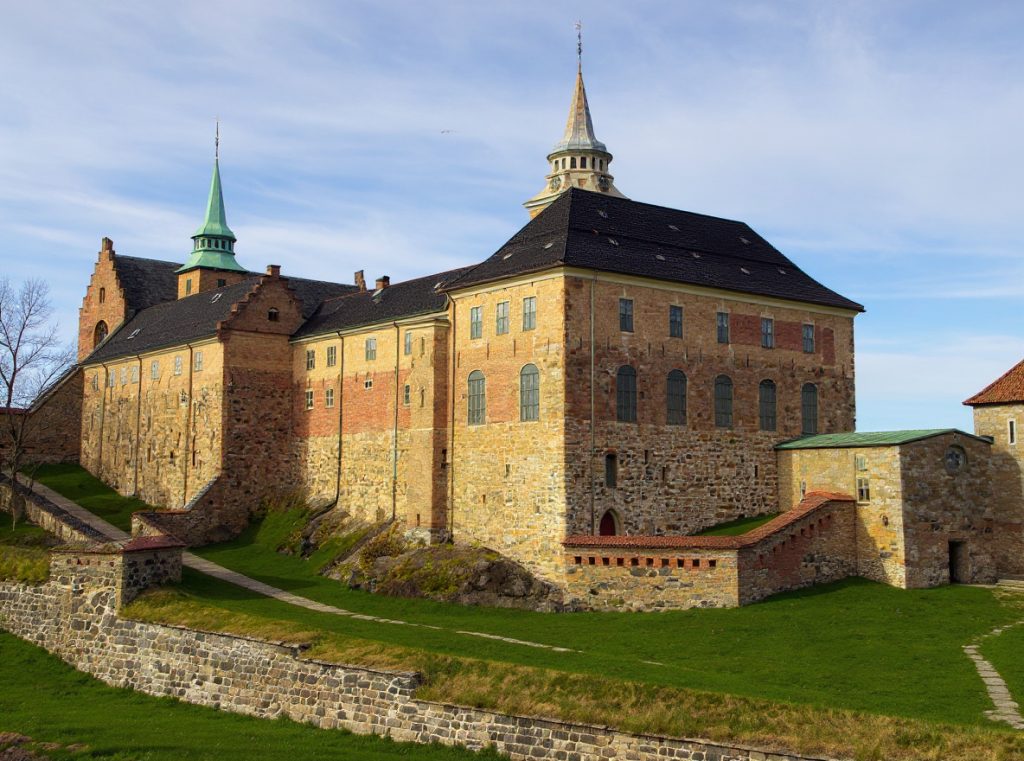
Earl Alv Erlingsson attacked Oslo in 1287, so King Håkon V decided to build stronger defences for the vulnerable city. Construction began around 1290 on what would become Norway’s most important medieval castle. The king completed the fortification in the early 1300s. He made it his royal residence when Oslo officially replaced Bergen as capital in 1300. The original structure followed typical medieval castle design, with thick stone walls, defensive towers and a strategic hilltop keep overlooking the fjord approach.
Swedish forces besieged the fortress repeatedly through the centuries but never captured it by force. Notable attacks occurred in 1308, 1449, 1502, 1567 and 1716, when Charles XII’s army occupied the city but failed to take the fortress itself. The invaders withdrew after 39 days. This remarkable defensive record earned Akershus its reputation as an unconquered fortress that successfully protected Oslo for 700 years.
King Christian IV of Denmark-Norway transformed the medieval castle during the early 17th century. After a catastrophic fire destroyed much of Oslo in 1624, Christian IV rebuilt the city closer to the fortress and renamed it Christiania. He simultaneously modernised Akershus and converted it into a Renaissance palace with bastioned ramparts, elegant halls and royal chambers. Engineers influenced by Italian military design added bastion fortifications, earthworks and artillery batteries to counter the advent of gunpowder warfare. The fortress served as a royal palace until the early 19th century. Builders added new towers, gates and reception rooms over time.
German forces occupied the fortress on 9 April 1940 when Norway surrendered without battle at the start of World War II. The occupiers used Akershus as barracks, prison and execution ground throughout the war. They shot resistance fighters and hostages at the fortress walls, including 42 Norwegians executed in reprisal killings.
Current status
The Norwegian Defence Estates Agency manages Akershus Fortress through its National Fortifications Heritage division. The fortress remains an active military installation under a commander. It simultaneously serves the Norwegian government as an official ceremonial venue. The castle houses banquet halls, government reception rooms and the Royal Mausoleum, where King Håkon V and later Norwegian monarchs rest. A small historic church within the complex contains royal sarcophagi and features a Nordic Baroque altar and pulpit dating from the 16th century.
The fortress grounds open free to the public year-round as a popular recreational area and cultural venue. Two museums operate within the complex: the Norwegian Armed Forces Museum and Norway’s Resistance Museum, which chronicles the occupation years. Guided tours of the castle interior require paid admission. The fortress hosts concerts, ceremonies and national holiday celebrations throughout the year. A visitor centre in the red building by Karpedammen pond provides historical exhibits and trail maps in multiple languages.
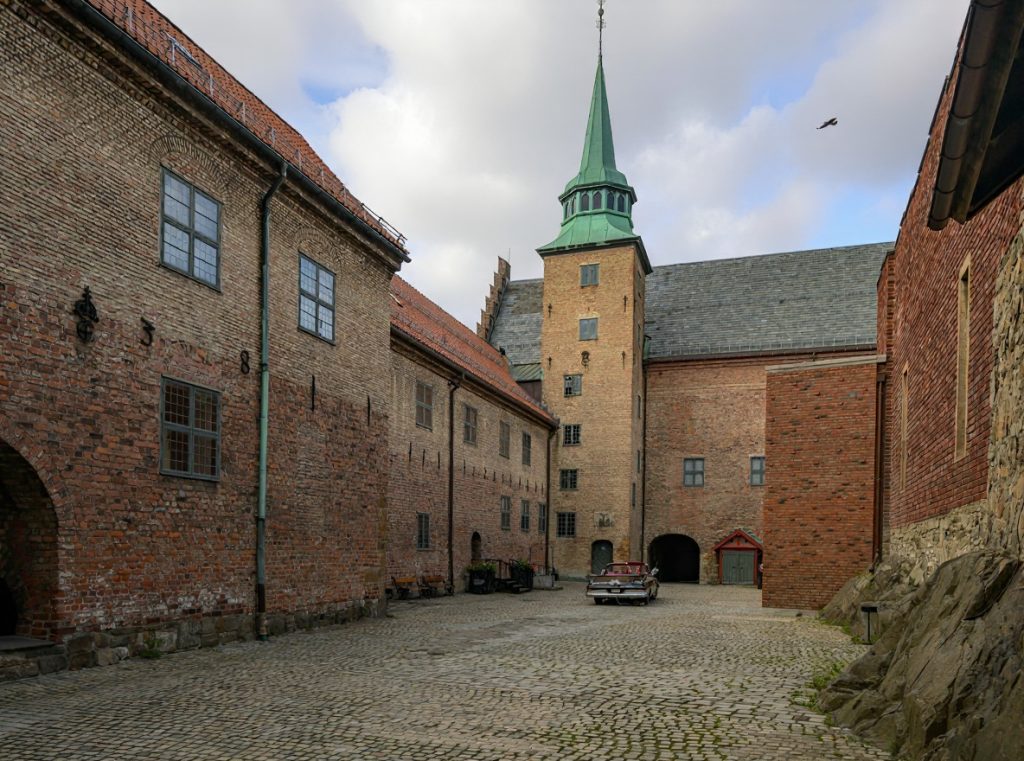
Stone ramparts and cobblestone courtyards wind through the extensive grounds. Locals and tourists alike stroll among centuries of accumulated history. The fortress underwent major restoration in the late 19th century, when conservators recreated medieval design elements while preserving Renaissance additions. Today it functions as headquarters for Norway’s Ministry of Defence and temporarily houses offices of the Prime Minister. From its weathered battlements, Oslo’s modern skyline rises beyond the harbour where medieval galleys once anchored, linking past and present in an unbroken chain.
Castles near Akershus Fortress
Frequently asked questions
Is Akershus Fortress free to enter?
The fortress grounds, ramparts and Armed Forces Museum are free to enter and open daily 06:00–21:00. Entry to Akershus Castle interior and the Resistance Museum requires separate paid tickets.
How long does it take to visit Akershus Fortress?
Plan 1.5 to 2 hours for the fortress grounds and views. Add another hour if visiting the castle interior or museums such as the Resistance Museum or Armed Forces Museum.
What can you see at Akershus Fortress?
The medieval fortress offers ramparts with harbour views, the Armed Forces Museum (free), Norway's Resistance Museum, and Akershus Castle with its royal chambers and mausoleum. The grounds include historic cannons and ceremonial areas.
Is Akershus Fortress included in the Oslo Pass?
Yes, the Oslo Pass includes free entry to Akershus Castle interior and the Resistance Museum. The fortress grounds are already free for all visitors.
Can you walk around Akershus Fortress at any time?
The main gate is open 06:00–21:00 daily year-round for exploring the grounds and ramparts. The castle interior and museums have more limited hours, typically 10:00–16:00 with seasonal variations.
Featured listings