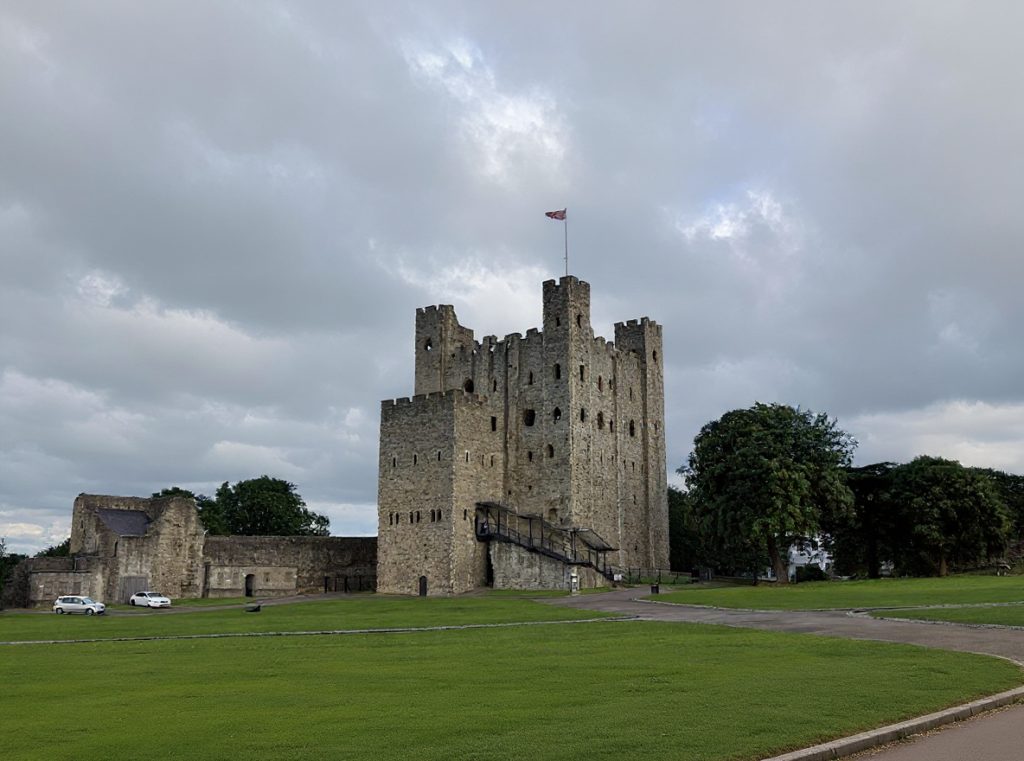
Towering above the River Medway in Kent, Rochester Castle commands one of England’s most strategic crossings with its formidable Norman keep. This fortress stands among the finest examples of Norman military architecture in Europe. Its walls bear witness to nine centuries of conflict and reconstruction. The massive stone keep rises 113 feet high, a monument to medieval engineering and the castle’s enduring role in English history. Together with Rochester Cathedral, the castle forms an imposing skyline that has dominated this ancient city since Norman times.
Plan your visit to Rochester Castle
Tue–Sun 10:00–16:001 April–30 September 10am–6pm; 1 October–31 March 10am–4pm; closed Mondays except Bank Holidays.
Location of Rochester Castle
Rochester Castle sits in the heart of Rochester, Kent, where the River Medway meets the historic Roman road of Watling Street. The castle occupies the south-west corner of the old Roman city walls. Builders positioned it to guard the vital river crossing on the route between London and the coast. Visitors can reach Rochester easily by train, as Rochester station lies within walking distance of the castle. The fortress stands adjacent to Rochester Cathedral on Castle Hill, surrounded by the town’s cobbled streets and medieval buildings. Several pay-and-display car parks serve the area, though no parking exists at the castle itself. The castle’s elevated position offers commanding views across the Medway valley and the surrounding Kent countryside.
History of Rochester Castle
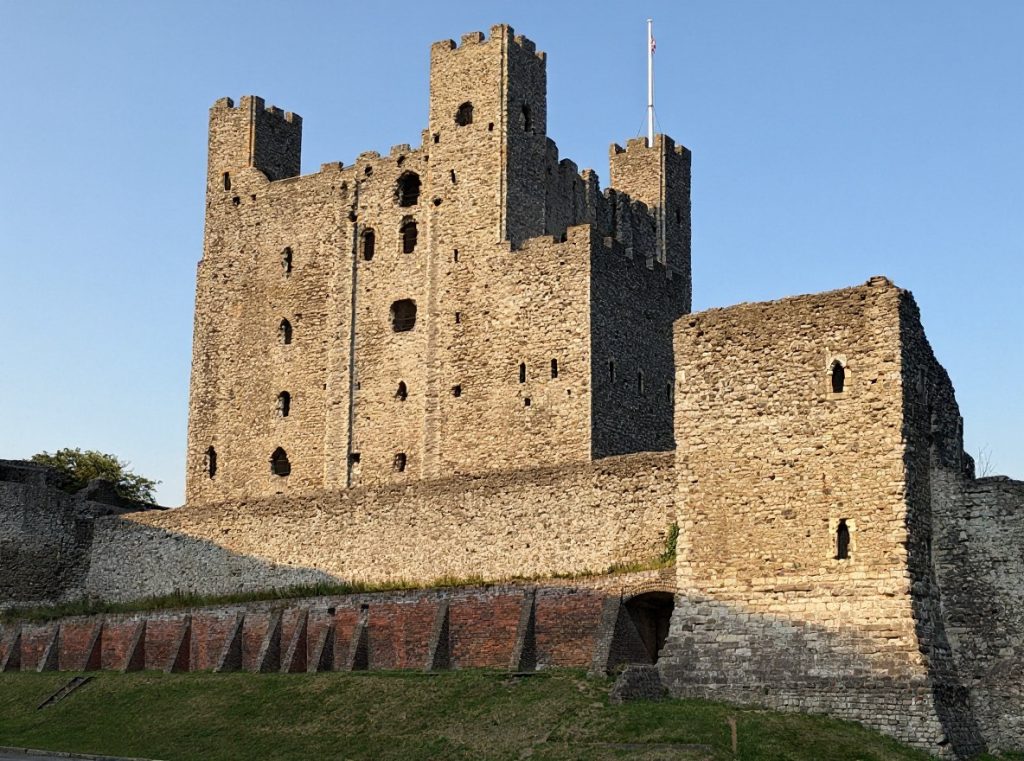
The first castle at Rochester appeared soon after the Norman Conquest of 1066. Builders raised a timber fortification to secure this crucial crossing point. Between 1087 and 1089, William Rufus commissioned Gundulf, Bishop of Rochester, to build a new stone castle on the present site. Gundulf, who also designed the Tower of London, created defensive walls that still define the castle’s extent today. In 1127, Henry I granted the castle to William de Corbeil, Archbishop of Canterbury. The archbishop began construction of the great keep that dominates the fortress. Workers completed this massive tower around 1136-1140, raising it to 113 feet with walls twelve feet thick in places. They built it from Kentish ragstone with fine Caen stone detailing. The castle consisted of three floors above a basement, with the grandest apartments on the second floor including a private chapel for the archbishop.
Rochester endured its most famous trial in 1215 when rebel barons opposing King John garrisoned the castle. John besieged the fortress for two months in an epic struggle that tested the keep’s defences to their limits. The king’s forces first undermined the outer wall. Then John famously ordered the fat of forty pigs to fuel a mine beneath the keep’s south-east corner. The explosion brought the tower crashing down, yet the defenders held on until starvation forced their surrender. Henry III, John’s son, rebuilt the damaged corner as a round tower. This round tower contrasts with the three original square towers today. The castle saw further action in 1264 when royalist forces successfully defended it against rebel siege. Edward III began extensive rebuilding between 1367 and 1370, though the castle remained a viable fortress only until the sixteenth century.
Current status
English Heritage maintains Rochester Castle in partnership with Medway Council, who manage day-to-day operations and visitor services. The castle opens to the public Tuesday through Sunday, with extended hours during bank holidays and summer months. Visitors can explore the magnificent keep, climbing its stone staircases to reach the battlements. From there, panoramic views stretch across the Medway and Rochester’s historic roofscape. The bailey, once filled with domestic buildings and workshops, now forms the peaceful Castle Gardens where families picnic among the ancient walls. Information panels in English and French guide visitors through the castle’s turbulent history. Audio guides provide deeper insights into medieval life and warfare. A small shop in the keep sells heritage books and souvenirs.
The castle plays an active cultural role in Rochester’s community life. Summer concerts at Rochester Castle Live bring major musical acts to perform against the illuminated Norman keep. These events transform the historic grounds into an atmospheric open-air venue. Educational visits welcome school groups throughout the year, bringing medieval history alive for young learners. Conservation work continues to preserve the ancient stonework for future generations. Specialists maintain the Kentish ragstone walls and monitor the keep’s structural integrity. The castle remains an inseparable companion to Rochester Cathedral. The two monuments stand together as they have for centuries, proud reminders of Norman power and medieval grandeur on the banks of the Medway.
Castles near Rochester Castle
Frequently asked questions
Can you climb to the top of Rochester Castle?
Yes, visitors can climb the keep, which is one of the tallest Norman keeps in England at 113 feet. The climb involves steep spiral staircases but rewards you with views over the River Medway and Rochester Cathedral.
How long does it take to visit Rochester Castle?
Most visitors spend 1 to 1.5 hours exploring the castle. This allows time to climb the keep, walk the grounds and examine the curtain walls and historic features.
Is Rochester Castle suitable for children?
Yes, children aged 5–17 pay £4.50 and those under 5 enter free. The keep has narrow spiral stairs and no lift, so younger children will need supervision when climbing.
What is special about Rochester Castle?
Rochester Castle has one of the best-preserved Norman keeps in England or France, built around 1127. It famously withstood a siege by King John in 1215, during which miners tunnelled beneath the walls and brought down part of the keep.
Can you visit Rochester Castle and Rochester Cathedral in one day?
Yes, the castle and cathedral are within a few minutes' walk of each other in Rochester's historic centre. Combined, they make an excellent half-day or full-day visit depending on your pace.
Featured listings