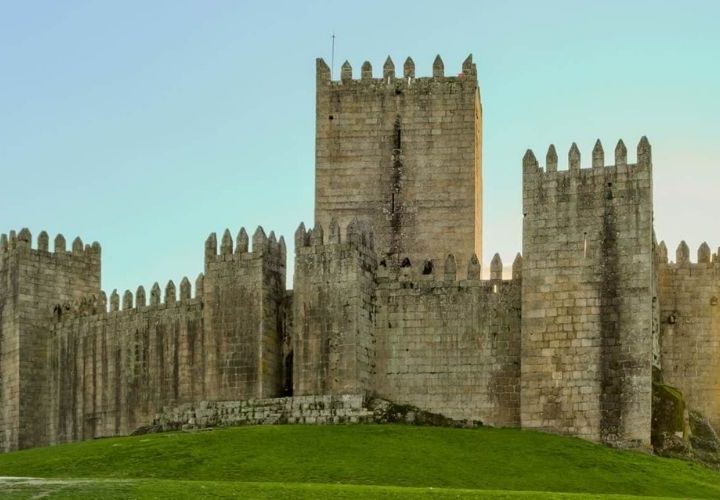
Guimarães Castle stands as one of Portugal’s most historically significant fortresses. Known as the birthplace of the nation, this castle is deeply connected to the foundation of Portugal. Its imposing medieval walls and strategic location have made it a symbol of Portuguese independence. Originally built to defend the region against invasions, it has since become one of the most visited and well-preserved castles in the country. Visitors to Guimarães Castle are transported back in time, experiencing the medieval architecture and rich history that define its legacy.
Plan your visit to Guimarães Castle
Location of Guimarães Castle
The castle is situated in the northern part of Portugal, within the historic city of Guimarães. Positioned on a hill known as Monte Latito, it offers panoramic views of the surrounding landscape. The city itself is part of the Braga district, approximately 55 kilometers from Porto. Due to its historical importance, Guimarães has been recognized as a UNESCO World Heritage Site, attracting tourists from around the world. The castle’s central location within the city makes it easily accessible, and its proximity to other historical landmarks enhances its appeal.

History of Guimarães Castle
The origins of Guimarães Castle date back to the 10th century when it was commissioned by Countess Mumadona Dias. Its construction was undertaken as a defensive measure against frequent attacks by Moors and Normans. Initially, a monastery had been established in the area, but due to ongoing threats, a fortress was deemed necessary to ensure protection.
During the 12th century, the castle gained prominence as the residence of Count Henry of Burgundy and his wife, Teresa of León. Their son, Afonso Henriques, who later became the first King of Portugal, is believed to have spent his early years within its walls. In 1128, the Battle of São Mamede took place near Guimarães, where Afonso Henriques defeated his mother’s forces, marking a decisive moment in Portugal’s struggle for independence. For this reason, the castle is often referred to as the “Cradle of Portugal.”
Throughout the Middle Ages, Guimarães Castle underwent several modifications. Under King Dinis in the 13th century, reinforcements were made to strengthen its defensive capabilities. Towers and battlements were added, further enhancing its role as a military stronghold. However, as Portugal’s military strategies evolved and firearms became more prevalent, the castle’s importance gradually declined.
By the 16th century, Guimarães Castle had fallen into disrepair. Portions of the structure were abandoned, and its walls began to deteriorate. Despite this, the castle remained an important national symbol, referenced in historical texts and local traditions. In the 20th century, efforts to restore the site were initiated, ensuring its preservation for future generations.

Current status
Today, Guimarães Castle stands as one of Portugal’s most well-preserved medieval fortresses. Managed by national heritage organizations, it has been designated as a national monument. Restoration efforts have ensured that its towers, walls, and keep remain intact, allowing visitors to experience its medieval grandeur.
Tourists are welcomed to explore the castle grounds, where historical exhibitions provide insight into its past. Informational displays highlight key events, including the Battle of São Mamede and the early years of Afonso Henriques. The main tower, accessible via stone staircases, offers breathtaking views of Guimarães and its surrounding countryside.
In addition to its historical significance, the castle plays an important role in cultural events. Festivals, reenactments, and educational programs are frequently hosted within its walls, bringing history to life for visitors of all ages. The castle’s connection to Portugal’s independence continues to be celebrated, making it a key attraction for both locals and international tourists.
Guimarães Castle remains a symbol of Portugal’s national identity, offering an unparalleled glimpse into the country’s medieval past. Whether you visit to explore its architectural features, learn about its history, or simply enjoy the stunning views, the experience of Guimarães Castle is one that captures the essence of Portugal’s heritage.
Castles near Guimarães Castle
Frequently asked questions
What can I see inside Guimarães Castle?
The visit consists of walking along the castle walls and ramparts on a raised metal walkway with views over the town and surrounding countryside. The watchtower is temporarily closed to the public.
Is there a combined ticket for Guimarães Castle and the Ducal Palace?
Yes, you can purchase a combined ticket for the castle and the Palace of the Dukes of Bragança. The Ducal Palace is currently undergoing partial renovations.
Where do I buy tickets for Guimarães Castle?
Tickets must be purchased at the Ducal Palace ticket office or online in advance. There is no ticket office at the castle entrance itself.
Is Guimarães Castle accessible for visitors with mobility issues?
Access is limited as the visit involves climbing steps to walk along the raised walkways on the castle walls. The terrain is uneven and not wheelchair accessible.
When is Guimarães Castle closed to visitors?
The castle is closed on 1 January, Easter Sunday, 1 May, 24 June (city holiday), and 25 December. It is open daily from 10:00 to 18:00 with last admission at 17:30.
Featured listings