
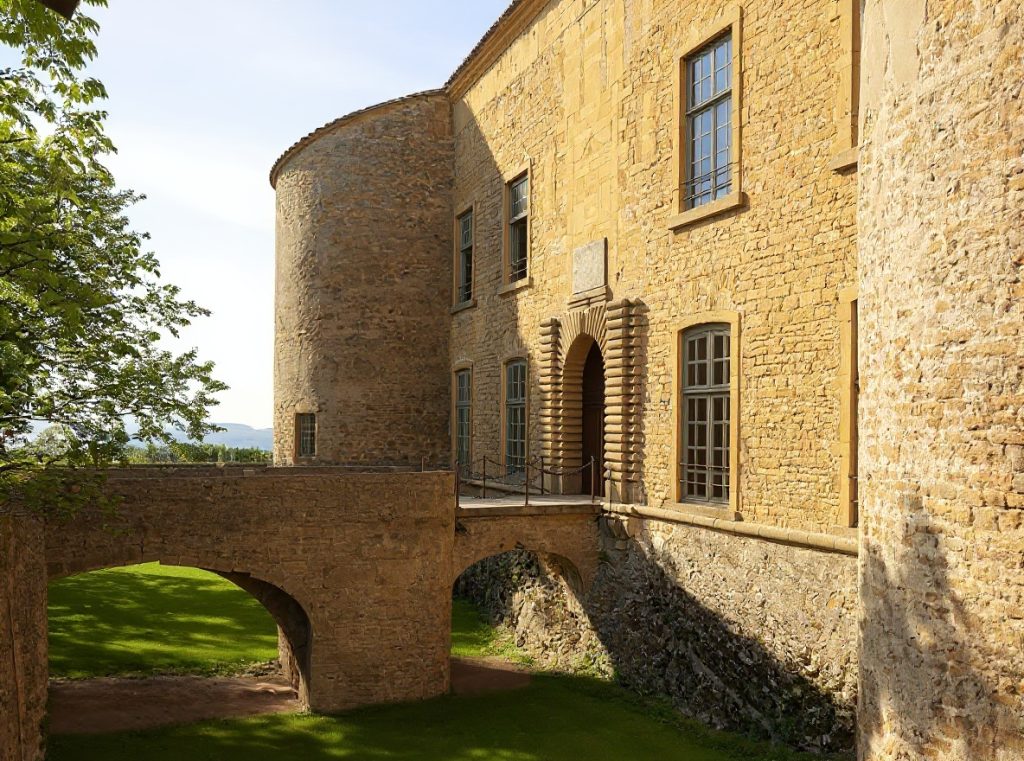
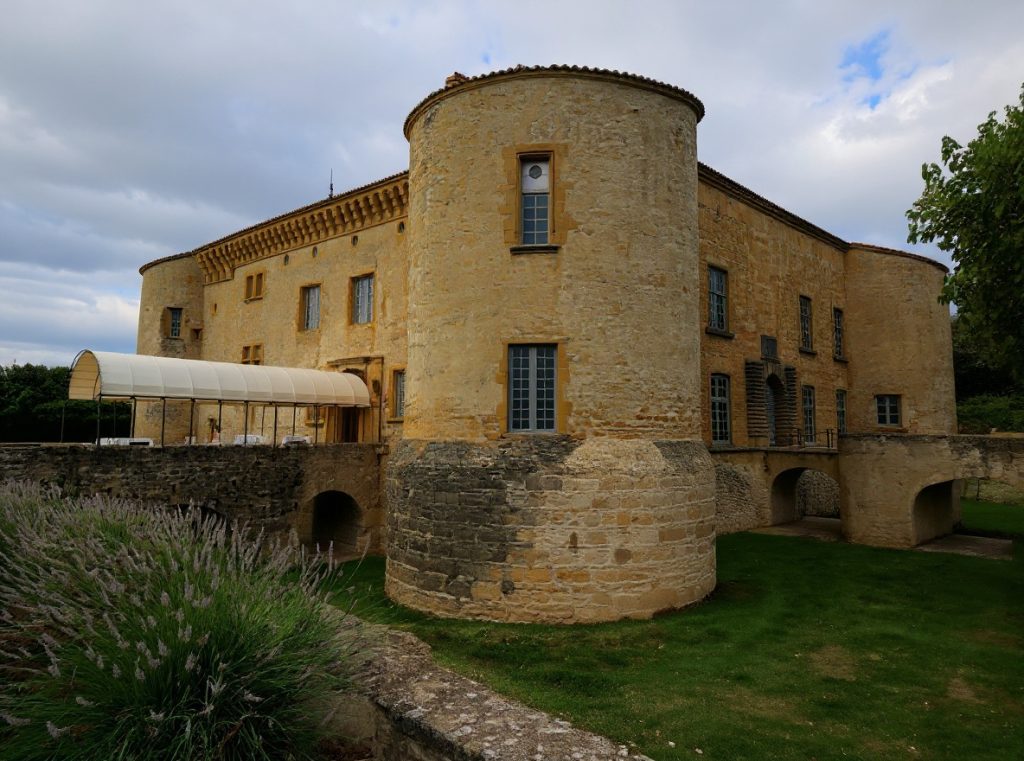
Château de Bagnols first rose between 1217 and 1221 to guard the Beaujolais valley. This medieval fortress commands attention with its distinctive honey-coloured stone walls and formidable towers. A protective moat encircles the château, which overlooks the valley. Eight centuries of history live within these walls. Each era added layers of decoration and refinement while the defensive character endured. The Dugué family created numerous decorations in the 17th century. The Marquise de Sévigné mentions her stays at the château in her extensive correspondence.
Plan your visit to Château de Bagnols
Location of Château de Bagnols
The château sits in the village of Bagnols within the Beaujolais vineyards. It lies 20 kilometres northwest of Lyon, next to the village of Bagnols. Lyon offers a train station and international airport just 30 to 45 minutes’ drive from the château. The property sits approximately one hour’s drive from Lyon-Saint Exupéry Airport. Visitors can reach Geneva in one and a half hours by car. Vineyards spread across the surrounding hills. Forests and rolling green landscape of southeastern France envelop the estate. The château occupies its original medieval site, surrounded by formal French gardens and an orchard.
History of Château de Bagnols
Guichard d’Oingt, co-lord of Châtillon, directed the construction between 1217 and 1221. He secured a loan from the Archbishop of Lyon to establish the fortress and fortify the site. He built the main defensive fortress with three round towers linked by curtain walls with arrow loops. Historical records first mention the castle in 1217. It remained under the control of the Oingt family for much of the 13th century. In 1288, ownership passed to the Albon family through marriage. After Jeanne d’Albon married Rauffet de Balsac in 1453, the estate became part of the Balsac family holdings.
Geoffroy de Balzac grew up at court, becoming a page and then advisor to King Charles VIII. He welcomed the king to his château in Bagnols in October 1490 when Charles VIII was just 20 years old. Gaspard Dugué took responsibility for major renovation work and invested large sums to enhance it while strengthening its defensive character. The château became a symbol of his power and nobility. He had a master fountain builder bring water to the château from the lower courtyard basin to the cast iron taps in the kitchen. In 1711, Barthélémy Joseph Hesseler purchased the seigneury and barony of Bagnols. He maintained it with care and embellished it.
In 1940, during the Second World War, cathedral staff stored the treasures of Saint-Jean Cathedral there to escape the bombing. The Salle des Tonneaux became a shelter for Lyon’s heritage. Over the years, the château fell into disrepair and experienced gradual decline. In 1980, new ownership revived the estate. Helen and Paul Hamlyn discovered the disused property in 1987 and spent four years meticulously renovating the place. In 2011, Jean-Claude Lavorel bought Bagnols and embarked on a project to improve it.
Current status
The château now operates as a five-star establishment. The Lavorel Hotel Group owns it. Château de Bagnols reserves itself exclusively for exceptional occasions, ensuring that your story alone inhabits these walls. The château offers space for seminars, corporate events and galas. Families celebrate weddings, christenings and birthdays within the historic rooms. The location lends itself to productions, films and campaigns with rare authenticity. The château houses 27 suites that blend heritage and modernity. Historic suites retain old-world charm while contemporary suites offer clean lines and soothing light.
Original features include ornate plasterwork and wall hangings, enormous fireplaces, antique furniture, and beamed ceilings. Visitors also find impressive trompe l’oeil wall paintings and original 12th to 18th-century wall murals. The gastronomic restaurant, 1217, takes its name from the château’s year of construction. It has one of the largest Gothic chimneys in Europe. A large outdoor swimming pool sits surrounded by cherry trees and lounge chairs. An extensive spa includes an indoor pool, steam room and four treatment rooms, as well as a gym. The formal French gardens and orchard invite exploration. The surrounding vineyards beckon visitors to walk among the vines and discover the celebrated Beaujolais wine route that winds through this historic region of southeastern France.
Castles near Château de Bagnols
Frequently asked questions
Can I visit Château de Bagnols as a day visitor?
No, Château de Bagnols operates exclusively as a private luxury hotel and event venue. It is not open to the public for day visits or castle tours unless you are a hotel guest or attending a private event.
When is Château de Bagnols open?
The château is open seasonally from mid-May to early October. It closes for the winter season from October through mid-May.
Does Château de Bagnols have a restaurant?
Yes, the château has a Michelin-starred restaurant called 1217, located in the Salle des Gardes. The restaurant serves modern French cuisine inspired by local Beaujolais and Lyonnais traditions, primarily for hotel guests.
How old is Château de Bagnols?
Château de Bagnols dates from the 13th century, having been constructed in 1217 by Lord Guichard d'Oingt. It has been carefully restored and now operates as a five-star Relais & Châteaux property.
What facilities does Château de Bagnols offer?
The château features 27 suites with period furnishings and murals, a spa with indoor pool and hammam, a Roman-style outdoor pool, formal French gardens, and a Michelin-starred restaurant. It is set within three hectares of grounds surrounded by vineyards.
Featured listings