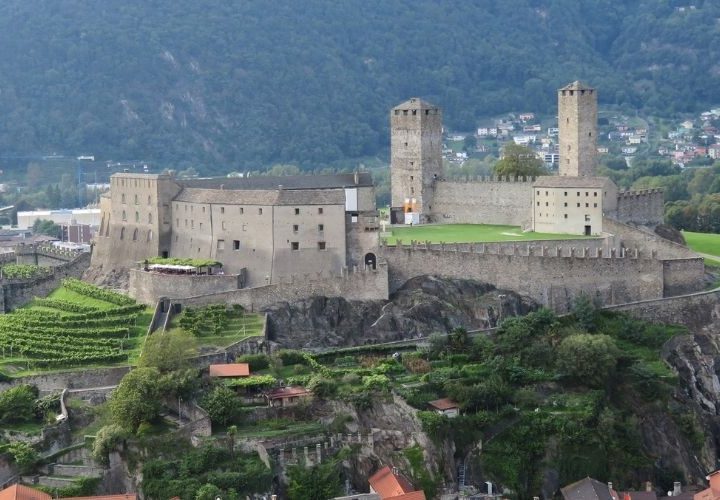
Castel Grande, one of the three iconic castles of Bellinzona, stands as a remarkable testament to medieval military architecture in Switzerland. This fortress, perched on a rocky hill overlooking the city, has played a crucial role in the region’s defense for centuries. Recognized as a UNESCO World Heritage Site, the castle continues to captivate visitors with its well-preserved fortifications. It also offers panoramic views and holds rich historical significance.
Plan your visit to Castel Grande
Location of Castel Grande
Castel Grande is located in the heart of Bellinzona, the capital of the Swiss canton of Ticino. Positioned on a strategic rocky outcrop, the fortress dominates the cityscape and offers breathtaking views of the surrounding Alps and the Ticino Valley. Bellinzona, situated near the Italian border, has long been a crucial point of passage between northern and southern Europe. Its fortifications have held great strategic importance throughout history.
Access to the castle is facilitated by footpaths leading from the city center, as well as an elevator that allows visitors to reach the site with ease. Its central location within Bellinzona makes it an essential stop for visitors. It offers a chance to explore the rich heritage of this historically significant region.
History of Castel Grande
The origins of Castel Grande date back to antiquity, with archaeological evidence indicating that the site was inhabited as early as the Neolithic period. The first documented fortifications on the hill were constructed by the Romans. They recognized the strategic importance of Bellinzona as a defensive stronghold along key trade routes.
During the early Middle Ages, the site was further fortified, with its defensive structures expanding under the rule of the Lombards and later the Frankish Empire. By the 10th century, Castel Grande had become a crucial military outpost within the Holy Roman Empire. It played a key role in protecting the passage through the Alps.
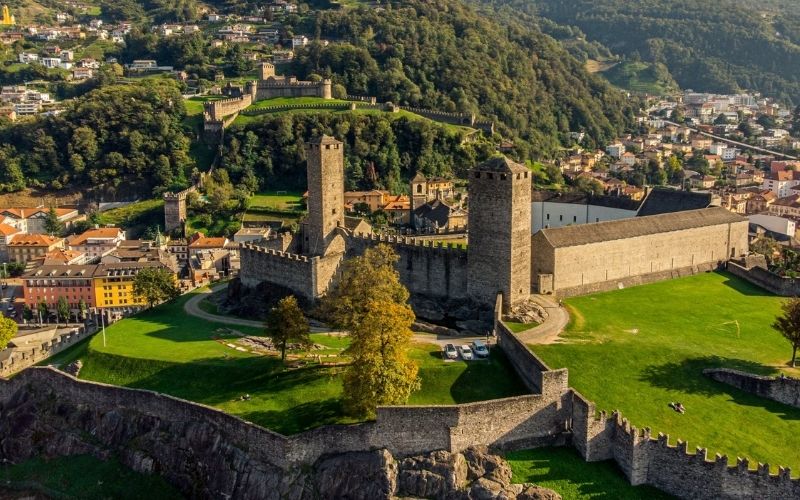
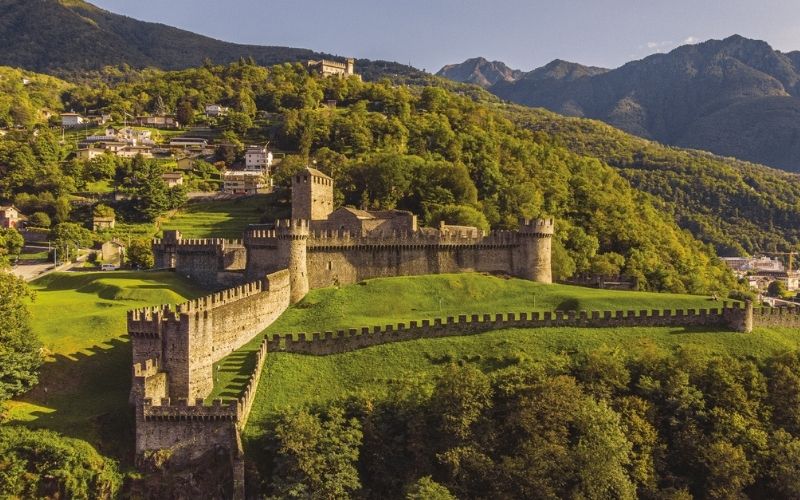
In the 13th and 14th centuries, the Dukes of Milan oversaw significant modifications to the fortress. They strengthened its structure and expanded its defensive walls to connect with the city’s other castles, Montebello and Sasso Corbaro. These fortifications formed a formidable barrier, securing Bellinzona against external threats.
In the late 15th century, the region came under Swiss control following a conflict between the Duchy of Milan and the Swiss Confederation. The Swiss significantly reinforced the castle, adapting it to meet the evolving needs of military defense. Over the following centuries, the fortress gradually lost its military function. It eventually became a historical monument rather than an active stronghold.
Current status
Today, Castel Grande stands as one of the most well-preserved medieval castles in Switzerland. Its imposing stone walls and extensive defensive structures continue to dominate the landscape of Bellinzona. The two prominent towers, known as the White Tower and the Black Tower, add to its striking presence.
As part of the UNESCO World Heritage-listed Bellinzona castles, experts have carefully restored Castel Grande. They have transformed it into a major cultural and historical attraction. Visitors can explore the castle’s courtyards, climb its towers for stunning panoramic views, and walk along its ancient ramparts. The site also houses a museum that showcases archaeological discoveries, medieval artifacts, and exhibits on the history of the castle and the region.
Regular events, exhibitions, and guided tours are organized at Castel Grande, offering an immersive experience into the past. The castle’s elevated location provides visitors with breathtaking vistas of Bellinzona and the surrounding mountains. This makes it a must-visit destination for history enthusiasts and travelers alike.
With its rich history, architectural grandeur, and cultural significance, Castel Grande remains a remarkable landmark. It preserves the legacy of Bellinzona’s medieval past while offering a unique glimpse into Switzerland’s historical heritage.
Castles near Castel Grande
Frequently asked questions
Is Castel Grande part of a UNESCO World Heritage Site?
Yes, Castel Grande is one of three castles forming the Bellinzona Fortress, inscribed as a UNESCO World Heritage Site in 2000. The fortifications are one of the most important medieval defensive systems in the Alps.
What does the Castel Grande ticket include?
The ticket includes admission to the museum with 6,500 years of archaeological finds, the two towers (Torre Nera and Torre Bianca), and temporary exhibitions. The ticket is valid only for Castel Grande; other castles require separate tickets or a Fortezza Pass.
Can I visit Castel Grande in winter?
Yes, Castel Grande is open year-round. From November to late March hours are 10:30–16:00 (last entry 15:30), whilst the other two Bellinzona castles remain closed except for their courtyards.
How do I reach Castel Grande from Bellinzona station?
Walk about 10 minutes via Salita Castelgrande, or take the public lift from Piazzetta della Valle for quick access to the castle. The station is very close and no bus is needed.
What is the difference between a Castel Grande ticket and the Fortezza Pass?
The Castel Grande ticket (CHF 15) covers only this castle. The Fortezza Pass (CHF 28 adults) gives entry to all three castles—Castel Grande, Montebello, and Sasso Corbaro—and is available when all castles are open (late March to November).
Featured listings