
Rising on a sandstone ridge above the Pegnitz River, Nuremberg Castle commands the skyline of Bavaria’s most historic city with its powerful medieval silhouette. This fortress complex, together with the city walls, ranks among Europe’s most formidable medieval fortifications. It represented the power of the Holy Roman Empire when it dominated this region. Between 1050 and 1571, every Holy Roman Emperor stayed here at one point or another. The architectural ensemble blends Romanesque and Gothic styles across three main parts. The Imperial Castle occupies the west, while the ruins of the Burgraves’ Castle with its 11th-century Five-Cornered Tower stand at the centre. Municipal buildings fill the eastern section.
Plan your visit to Nuremberg Castle
Location of Nuremberg Castle
Nuremberg Castle sits on a sandstone ridge north of the Pegnitz River in the city of Nuremberg. Getting to the castle is quite easy because it occupies a hill in the historical centre. Public transport offers the most convenient option. Buses and trams run to the city centre, and from there visitors can reach the fortress on foot. From Nuremberg Central Station, you’ll enjoy an easy 15-minute walk to the castle entrance. The complex occupies an elevated position roughly 50 metres above the old town. As a result, it offers sweeping views across Franconia. The usual access to the castle is via Burgstrasse, which ends in front of the sandstone ridge. Visitors ascend through cobbled streets lined with timber-framed houses to reach the fortress gates. The castle address is Burg 17, 90403 Nürnberg, though the complex spreads across the entire northern edge of the old quarter.
History of Nuremberg Castle
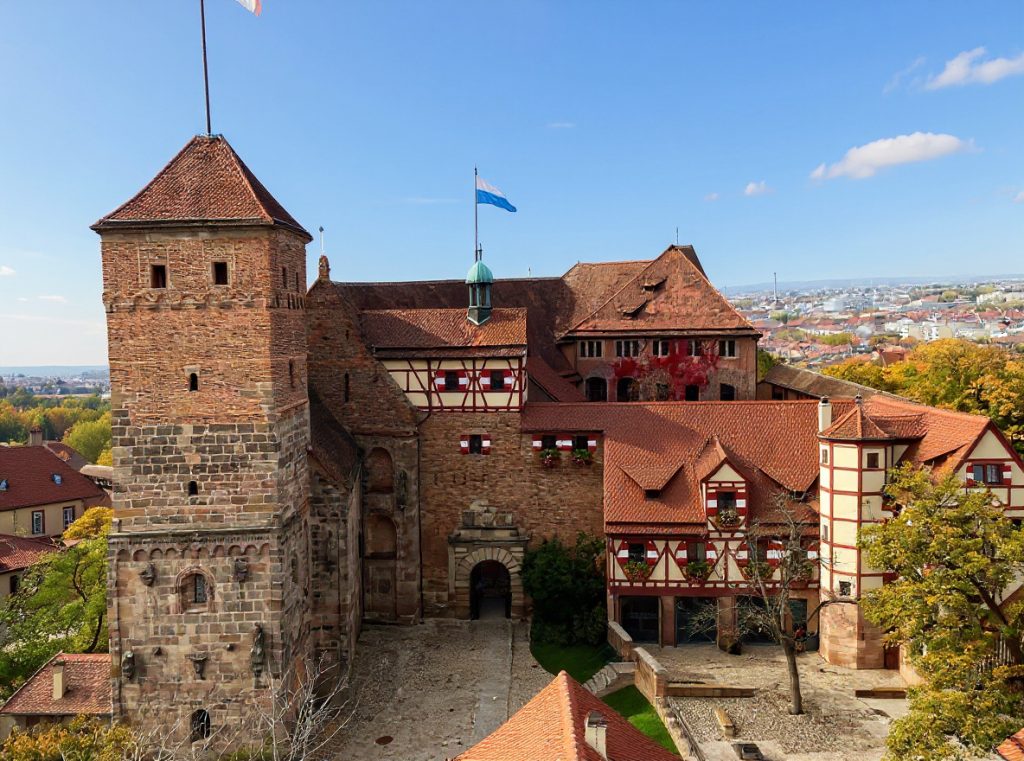
Builders erected the first fortified buildings around 1000. Three major construction periods may be distinguished. The castle built under the Salian kings and Holy Roman Emperors (1027–1125) came first. Then a new castle built under the Hohenstaufen emperors (1138–1254) followed. Finally, workers reconstructed the Palas and made various modifications in the late medieval centuries. The Staufer built an extensive palace complex on the castle rock. This complex still characterizes the appearance of the imperial castle today.
They appointed a burgrave who resided in the front area of the complex. In 1191 the office of burgrave passed to the Counts of Zollern. In the Middle Ages, German kings and Holy Roman Emperors did not have a capital. Instead, they voyaged from one imperial castle to the next. So the castle at Nürnberg became an important imperial seat. All German kings and emperors stayed here, and most visited on several occasions. Ludwig IV the Bavarian stayed 74 times, while Charles IV visited 52 times.
Emperor Friedrich II’s letter from 1219 favoured the civil autonomy of the municipality at the expense of the burgrave’s rights. The development of the independent imperial city gained strength with the end of the Staufer dynasty in 1254. In 1422, Emperor Sigismund gave the city responsibility for the castle. After an attack, the city finally acquired the remains from burgrave Friedrich VI. Since that time, the entire castle complex has belonged to the city.
The castle lost its importance after the Thirty Years’ War (1618 to 1648). In the 19th century with its general interest in the medieval period, architects added some modifications.
Current status
Nuremberg Castle was one of the most important imperial palaces of the Holy Roman Empire in the Middle Ages. For centuries it stood at the centre of European history as a secure base and prestigious retreat for the head of the empire. Today the Bavarian Palace Administration manages the castle and operates it as a museum and visitor attraction. The castle opens daily, with hours varying seasonally. Between April and September it opens from 9 am to 6 pm, while October through March it opens from 10 am to 4 pm.
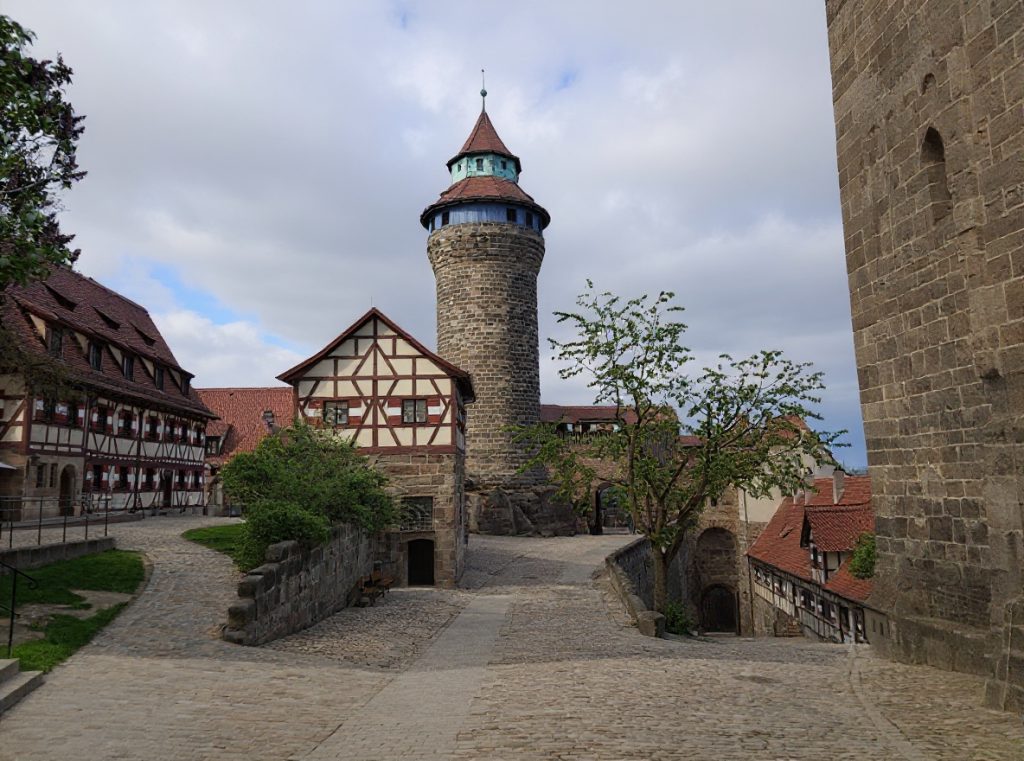
The double chapel dates from around 1200 and features Romanesque style throughout. It includes an upper and lower chapel connected by a ceiling opening. This design symbolized medieval social hierarchy because it reserved the upper chapel for high nobility. The chapel also included a special loge for the emperor. The Sinwell Tower, a cylindrical tower from the 13th century, stands nearby. Workers heightened it in the 1560s. A 53-metre deep well sits near the tower. Craftsmen carved it into the sandstone to supply water during sieges. The Palas houses the exhibition “Emperor – Empire – City.” This exhibition guides visitors through historic rooms filled with tapestries and medieval furnishings while tracing Nuremberg’s imperial connections.
Visitors can climb the Sinwell Tower for panoramic vistas across Nuremberg’s red rooftops and the surrounding Franconian countryside. The castle gardens wind along the old city walls and provide peaceful walking paths with views across the valley. You can explore them for free. The Deep Well demonstration fascinates guests with its medieval engineering. The Imperial Stables, which builders completed in 1494–1495, now house a youth hostel. The fortress continues to embody Nuremberg’s medieval grandeur. Its weathered sandstone walls and towers tell centuries of imperial history against the Bavarian sky.
Castles near Nuremberg Castle
Frequently asked questions
Can I book Nuremberg Castle tickets online in advance?
No, the Bavarian Palace Administration does not offer online booking for Nuremberg Castle. Tickets are purchased at the cash desk in the outer courtyard on the day of your visit, and queues are rare outside December.
What does the Nuremberg Castle combination ticket include?
The €10 combination ticket covers the Palas with Double Chapel, the Imperial Castle Museum, a guided demonstration of the Deep Well, and access to the Sinwell Tower. The outer courtyards, ramparts, and castle gardens are free to enter.
How long does it take to visit Nuremberg Castle?
Most visitors spend 1.5 to 2 hours exploring the castle. This allows time for the museum, the guided Deep Well tour (runs every 30 minutes), and climbing the Sinwell Tower for views over Nuremberg.
Are there free areas to visit at Nuremberg Castle?
Yes, the outer courtyards, ramparts with panoramic views, and the castle gardens (open April–October) are all free to access. Only the interior spaces—Palas, museum, Deep Well, and tower—require tickets.
What are the opening hours of Nuremberg Castle?
Nuremberg Castle is open daily 09:00–18:00 from April to September and 10:00–16:00 from October to March. Last entry is one hour before closing. The castle closes on 1 January, Shrove Tuesday, and 24, 25, and 31 December.
Featured listings