
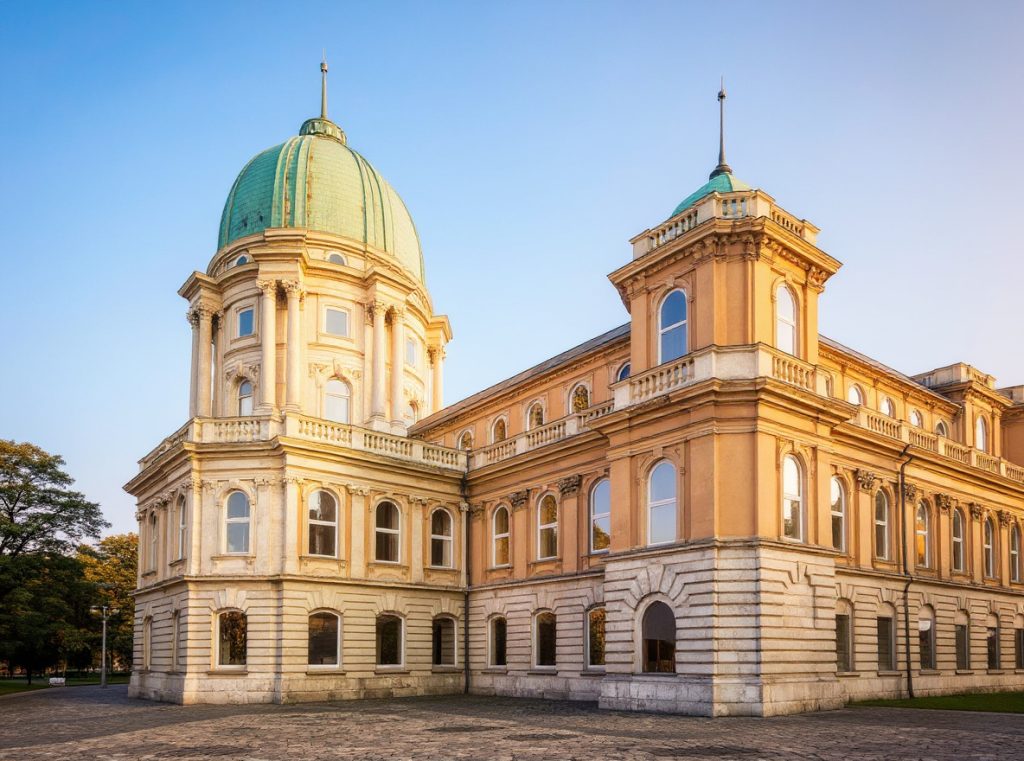
Crowning the limestone plateau of Castle Hill, Buda Castle rises above the Danube River as Hungary’s most significant royal residence. Hungarian kings used this castle and palace complex in Budapest for more than seven centuries. Builders first completed it in 1265, though the Baroque palace that occupies most of the site today took shape between 1749 and 1769. War and reconstruction have reshaped it many times since then. The complex earned UNESCO World Heritage status in 1987 as part of the Banks of the Danube and Castle Quarter.
Plan your visit to Buda Castle
Location of Buda Castle
The castle stands at Szent György tér 2 in Budapest’s 1014 district. It sits atop Castle Hill on the Buda side of the city. The site perches 70 metres above the Danube on Castle Hill and offers sweeping views across the river to Pest. Visitors can reach the complex via the Castle Hill Funicular, which links it to Clark Ádám Square and the Széchenyi Chain Bridge below. The funicular provides direct access from the riverbank to Szent György tér at the palace entrance. Bus line 16 also serves the hill from various points in the city. The cobbled streets of the surrounding Castle District fan out to the north, while the palace itself commands the southern tip of the plateau. From the terraces fronting the palace, the cityscape unfolds: the Parliament dome across the water, Margaret Island upstream, and Gellért Hill to the south. The location served a strategic purpose for centuries, and today it remains one of Europe’s most photographed urban panoramas.
History of Buda Castle
The devastating Mongol invasion of 1241–1242 prompted King Béla IV of Hungary to recognize the urgent need for more secure defence. Around 1265 he commissioned a fortified stronghold on the elevated plateau of Castle Hill. This first royal residence established a presence that would endure through the ages. Stephen, Duke of Slavonia, the younger brother of King Louis I of Hungary, built the oldest part of the present-day palace in the fourteenth century. Only the foundations remain of the castle keep, known as Stephen’s Tower, with the Gothic palace of King Louis I arranged around a narrow courtyard next to it.
The castle reached new splendour under King Matthias Corvinus during the fifteenth century. After the marriage of Matthias and Beatrice of Naples in 1476, Italian humanists, artists and craftsmen arrived at Buda. As a result, the Hungarian capital became the first centre of Renaissance north of the Alps. Under the rule of King Sigismund, builders enlarged and significantly fortified the castle because Sigismund chose Buda Castle as his residence. He intended to use it as a symbol of his prominence to other European rulers. Construction in Gothic style took place primarily between 1410 and 1420.
In 1529 the Ottoman army besieged Buda and the palace suffered badly. Then in 1541 Buda came under Turkish rule. The Ottomans used the palace as barracks, stables and munitions storage, otherwise leaving it unattended to decay. A Christian campaign recaptured the city in 1686, but the palace lay in ruins. In the decades after, the palace fell into such disrepair that workers demolished much of it in 1715. Architects then constructed a new Baroque-style palace. The palace suffered severe damage during the Siege of Budapest in World War II.
Current status
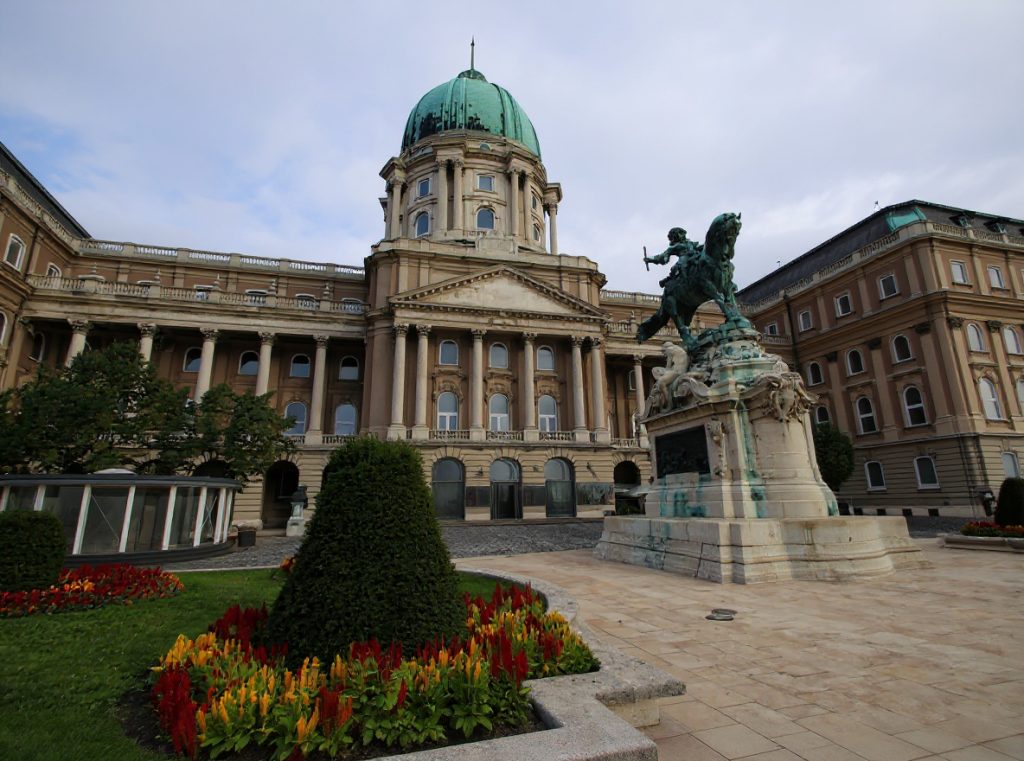
Buda Castle now houses the Hungarian National Gallery, the Budapest Historical Museum and the National Széchényi Library. The Hungarian National Gallery occupies the central wings and displays Hungarian art from the Middle Ages to the twentieth century. The Budapest History Museum operates the Castle Museum in Building E, with permanent exhibitions on medieval royal palace archaeology, Gothic sculptures from the royal palace, and the history of the palace from 1686 to the present. Visitors pay admission to enter the museums and special exhibition halls; the courtyards and terraces remain open to the public without charge.
The palace administration oversees ongoing restoration projects, including work on St Stephen’s Hall and the medieval vaults beneath the complex. Guided tours explore the underground labyrinth, where wartime bunkers and centuries-old cellars reveal hidden layers of history. Today the Castle District has become a sanctuary for religion, politics, sciences, culture and arts. It hosts treasures such as Matthias Church, the Hungarian National Gallery, the National Széchényi Library and the Budapest History Museum. The castle grounds host cultural events, concerts and exhibitions throughout the year, drawing scholars, artists and travellers from across the globe.
As evening light washes the honey-coloured stone and the dome glows above the Danube, Buda Castle still presides over the Hungarian capital. It endures as a monument to royal ambition, Renaissance brilliance, Ottoman conquest, Habsburg grandeur and modern revival—each era leaving its mark on this extraordinary hill.
Castles near Buda Castle
Frequently asked questions
Is Buda Castle free to visit?
The courtyards, ramparts and terraces of Buda Castle are free and open 24/7. The museums inside (Hungarian National Gallery, Budapest History Museum, St Stephen's Hall) charge separate admission fees ranging from 3,800 to 5,800 Ft.
Do I need to book tickets for Buda Castle in advance?
Advance booking is not required for the Hungarian National Gallery or Budapest History Museum. St Stephen's Hall requires timed-entry booking as only 20 visitors are admitted per session.
What is the best way to reach Buda Castle by public transport?
Bus 16 runs from Deák Ferenc tér through the Castle District and stops at Dísz tér. Alternatively, the Budavári Sikló funicular runs daily from Clark Ádám tér near the Chain Bridge (separate ticket, not included in public transport passes).
What are the opening hours of Buda Castle?
The outdoor areas (courtyards and ramparts) are open 24 hours a day. The Hungarian National Gallery and Budapest History Museum are open Tuesday to Sunday 10:00–18:00, closed Mondays.
Can I visit Buda Castle with the Budapest Card?
Yes, the Budapest Card provides free entry to the Hungarian National Gallery and Budapest History Museum permanent exhibitions. It also includes unlimited public transport, so you can use bus 16 to reach the castle at no extra cost.
Featured listings