
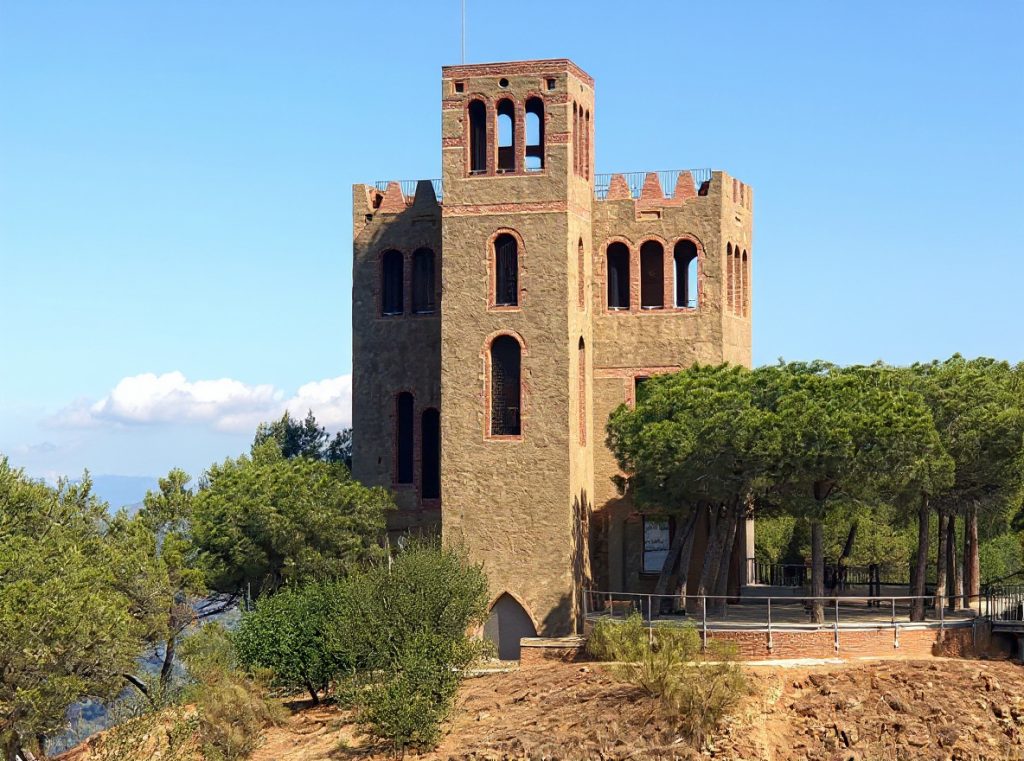
Crowning one of the easternmost ridges of the Collserola range, Castell de Torre Baró commands sweeping views across Barcelona’s northern districts. This four-storey structure radiates medieval charm, yet its history tells a more complex story. The castle now serves as an environmental education centre, while its elevated position makes it one of the city’s finest viewpoints.
Plan your visit to Castell de Torre Baró
Tue–Thu 10:00–13:00
Fri 10:00–13:00, 5:00–20:00
Sat 10:00–20:00
Location of Castell de Torre Baró
The castle sits atop Collserola hills in the Nou Barris district. It rises between the Torre Baró and Les Roquetes neighbourhoods. Visitors reach the site via Carretera Alta de les Roquetes, which winds through residential areas before climbing into the natural park. Bus 182 from Plaça Virrei Amat (metro L5) stops right by the castle. On foot, the nearest metro station is Trinitat Nova (L3, L4, L11), about 25 minutes away. The location offers expansive views over Nou Barris, Horta, Sant Andreu and Sant Martí. Beyond these districts, the Besòs River valley and coastal towns stretch toward the horizon.
History of Castell de Torre Baró
The name Torre Baró derives from an earlier mansion that stood near today’s metro station. Baron Bernat de Planós owned that original tower until 1714, when Bourbon troops destroyed it during the War of Spanish Succession. A second tower rose on the site in 1797, though authorities demolished it in 1968 to extend Avinguda Meridiana. The Sivatte family purchased the Torre Baró lands in the late 19th century, including the mountains of Les Roquetes.
Builders raised the current castle around 1904, though it appeared on the neighbourhood standard by 1930. Some sources suggest Manuel Sivatte i Llopart built the structure as a retreat where his sick daughter could benefit from the mountain climate. Others claim developers designed it as a hotel for a planned urban development project. The enterprise collapsed before completion. Workers abandoned the building before they finished construction, so it remained empty for decades.
The Spanish Civil War brought military use to the castle. During the 1970s, civic movements adopted the derelict structure as a gathering place. Years of neglect pushed the building toward ruin. Barcelona City Council intervened in 1989, restoring the castle and declaring it a historical heritage site. Architects built a magnificent viewpoint around the structure. A comprehensive refurbishment followed in 2014, when architect Jordi Farrando added modern interventions while respecting both the 1904 construction and the 1980s restoration work.
Current status
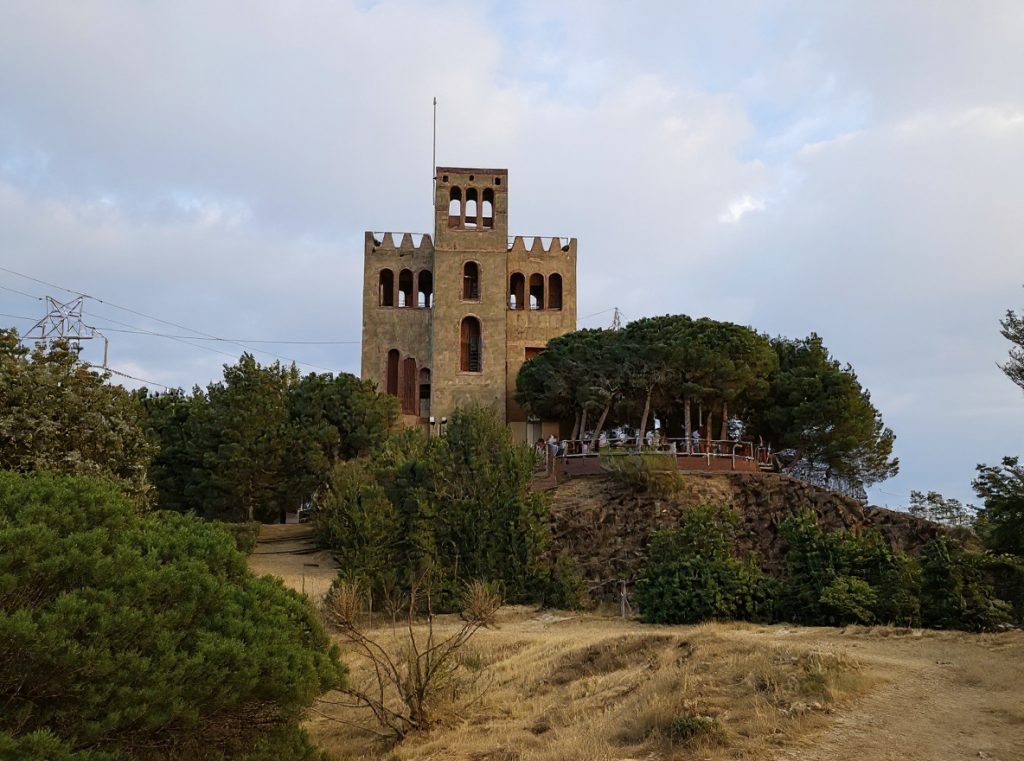
Barcelona City Council now manages the castle through the Parc Natural de la Serra de Collserola. The building functions as an environmental information and education centre for the natural park. The ground floor houses educational exhibitions about local history and ecology. Guided tours lead visitors through the tower’s levels, explaining its unusual past and the successive restoration efforts. The centre organises environmental workshops for all ages, plus itineraries exploring the surrounding Collserola landscape.
The castle welcomes visitors free of charge. A spiral staircase from the 1980s provides access to upper viewing platforms. The lower floors feature security measures and enclosures, while higher levels remain open to the sky. Black varnished iron elements from the 2014 intervention contrast with the original masonry walls and hand-exposed brick arches. The structure blends three distinct historical layers into one coherent whole.
From the upper terraces, the urban fabric of working-class Barcelona unfolds below. The castle reveals the city’s growth through the second half of the 20th century. Stone walls rise against the Mediterranean sky, while pine forests cloak the surrounding slopes. The unfinished building that developers abandoned over a century ago now anchors the neighbourhood’s identity and guards its collective memory.
Castles near Castell de Torre Baró
Frequently asked questions
Is Castell de Torre Baró a real medieval castle?
Despite its medieval appearance, the castle was built in the early 20th century as part of a hotel development that was never completed. It was restored in 1989 and is now a Barcelona City Council heritage site and environmental education centre for Collserola Natural Park.
What can I see at Castell de Torre Baró?
The castle features a 360-degree viewpoint with panoramic views over Barcelona and its surroundings, information point for Collserola Natural Park, a small historical exhibition, and an environmental education classroom. Guided tours explain the building's history and the Collserola area.
How difficult is it to reach Castell de Torre Baró?
The castle sits atop the Collserola hills in the Nou Barris district. Bus 182 stops directly at the castle (stop Castell de Torre Baró), or you can take the metro to Trinitat Nova (L3, L4, L11) and walk about 25 minutes uphill.
Does Castell de Torre Baró charge admission?
Entry to the castle and viewpoint is free. It operates as a public municipal facility managed by Barcelona City Council. Group visits require advance booking for a minimum of 8 people.
What are the opening hours of Castell de Torre Baró?
The castle opens Tuesday to Thursday 10:00–13:00, Friday 10:00–13:00 and 17:00–20:00, and Saturday 10:00–20:00. It is closed on Mondays. Hours may vary for special events and workshops held regularly at the castle.
Featured listings