<?xml version="1.0" encoding="UTF-8"?><rss version="2.0"
	xmlns:content="http://purl.org/rss/1.0/modules/content/"
	xmlns:wfw="http://wellformedweb.org/CommentAPI/"
	xmlns:dc="http://purl.org/dc/elements/1.1/"
	xmlns:atom="http://www.w3.org/2005/Atom"
	xmlns:sy="http://purl.org/rss/1.0/modules/syndication/"
	xmlns:slash="http://purl.org/rss/1.0/modules/slash/"
	>

<channel>
	<title>middle ages Archives - Europe&#039;s Castles</title>
	<atom:link href="https://europescastles.com/tag/middle-ages/feed/" rel="self" type="application/rss+xml" />
	<link>https://europescastles.com/tag/middle-ages/</link>
	<description>Explore the timeless majesty of Europe&#039;s castles</description>
	<lastBuildDate>Sun, 22 Dec 2024 18:14:20 +0000</lastBuildDate>
	<language>en-US</language>
	<sy:updatePeriod>
	hourly	</sy:updatePeriod>
	<sy:updateFrequency>
	1	</sy:updateFrequency>
	<generator>https://wordpress.org/?v=6.9.4</generator>

<image>
	<url>https://europescastles.com/wp-content/uploads/2024/05/cropped-favicon-32x32.png</url>
	<title>middle ages Archives - Europe&#039;s Castles</title>
	<link>https://europescastles.com/tag/middle-ages/</link>
	<width>32</width>
	<height>32</height>
</image> 
	<item>
		<title>Twelve famous women of the Middle Ages</title>
		<link>https://europescastles.com/famous-persons/twelve-famous-women-of-the-middle-ages/</link>
					<comments>https://europescastles.com/famous-persons/twelve-famous-women-of-the-middle-ages/#respond</comments>
		
		<dc:creator><![CDATA[europescastles]]></dc:creator>
		<pubDate>Sat, 21 Sep 2024 05:13:23 +0000</pubDate>
				<category><![CDATA[Famous persons]]></category>
		<category><![CDATA[History]]></category>
		<category><![CDATA[famous]]></category>
		<category><![CDATA[middle ages]]></category>
		<category><![CDATA[woman]]></category>
		<guid isPermaLink="false">https://europescastles.com/?p=9913</guid>

					<description><![CDATA[<p>The Middle Ages produced many extraordinary women whose contributions to politics, culture, religion, and warfare continue to resonate in European history. Often connected to castles—either as military strategists, rulers, or cultural influencers—these women shaped medieval society. This article explores Twelve Famous Women of the Middle Ages, their legacies, and the castles that played a part [&#8230;]</p>
<p>The post <a href="https://europescastles.com/famous-persons/twelve-famous-women-of-the-middle-ages/">Twelve famous women of the Middle Ages</a> appeared first on <a href="https://europescastles.com">Europe&#039;s Castles</a>.</p>
]]></description>
										<content:encoded><![CDATA[<p>The Middle Ages produced many extraordinary women whose contributions to politics, culture, religion, and warfare continue to resonate in European history. Often connected to castles—either as military strategists, rulers, or cultural influencers—these women shaped medieval society. This article explores Twelve Famous Women of the Middle Ages, their legacies, and the castles that played a part in their stories.</p>
<h2>Empress Theodora of Byzantium (c. 500 – 548): Power behind the Byzantine Throne</h2>
<p>Empress Theodora, born around 500 and deceased in 548, remains one of the most significant female figures in Byzantine history. As the wife of Emperor Justinian I, Theodora played an essential role in political decision-making and legal reforms. While her influence was most prominent in the Eastern Roman Empire, her legacy indirectly influenced governance across Europe, including the structure of castles in the West.</p>
<p><img fetchpriority="high" decoding="async" class="alignnone wp-image-9914 size-full" src="https://europescastles.com/wp-content/uploads/2024/09/Empress-Theodora-of-Byzantium.jpeg" alt="Empress Theodora of Byzantium" width="609" height="348" srcset="https://europescastles.com/wp-content/uploads/2024/09/Empress-Theodora-of-Byzantium.jpeg 609w, https://europescastles.com/wp-content/uploads/2024/09/Empress-Theodora-of-Byzantium-300x171.jpeg 300w" sizes="(max-width: 609px) 100vw, 609px" /></p>
<p><strong>Blachernae Palace</strong> in Constantinople (modern-day Istanbul, Turkey) was one of the major residences of the Byzantine Emperors. Although not a castle in the Western European sense, Blachernae had significant fortifications typical of medieval strongholds.</p>
<p>&nbsp;</p>
<h2>Hilda of Whitby (614 – 680): A pivotal religious figure</h2>
<p>Hilda of Whitby was born in 614 and passed away in 680. As the abbess of the important monastery at Whitby, she became a powerful religious leader. Although not directly linked to castles, her abbey&#8217;s fortified location was similar to many medieval fortresses, designed to protect its inhabitants and their precious knowledge.</p>
<p><img decoding="async" class="alignnone size-full wp-image-9915" src="https://europescastles.com/wp-content/uploads/2024/09/Hilda-of-Whitby.jpg" alt="Hilda of Whitby" width="840" height="460" srcset="https://europescastles.com/wp-content/uploads/2024/09/Hilda-of-Whitby.jpg 840w, https://europescastles.com/wp-content/uploads/2024/09/Hilda-of-Whitby-300x164.jpg 300w, https://europescastles.com/wp-content/uploads/2024/09/Hilda-of-Whitby-768x421.jpg 768w" sizes="(max-width: 840px) 100vw, 840px" /></p>
<p><strong><a href="https://europescastles.com/castle/whitby-abbey/">Whitby Abbey</a></strong>, while not a military castle, stood on a strategic cliff overlooking the North Sea in Northumbria (modern-day England). This fortified religious site was critical during a time of religious and political turmoil.</p>
<p>&nbsp;</p>
<h2>Aethelflaed, Lady of the Mercians (c. 870 – 918): Defender of Mercia’s castles</h2>
<p>Aethelflaed, born around 870 and died in 918, was the daughter of Alfred the Great and the ruler of Mercia. As a military strategist, she is well known for defending and building fortifications to protect her lands from Viking invasions.</p>
<p><img decoding="async" class="alignnone size-full wp-image-9916" src="https://europescastles.com/wp-content/uploads/2024/09/Aethelflaed.webp" alt="Aethelflaed" width="620" height="412" srcset="https://europescastles.com/wp-content/uploads/2024/09/Aethelflaed.webp 620w, https://europescastles.com/wp-content/uploads/2024/09/Aethelflaed-300x199.webp 300w, https://europescastles.com/wp-content/uploads/2024/09/Aethelflaed-360x240.webp 360w" sizes="(max-width: 620px) 100vw, 620px" /></p>
<p><strong><a href="https://europescastles.com/castle/tamworth-castle/">Tamworth Castle</a></strong>, located in Mercia (modern-day Staffordshire, England), was one of the central fortresses during her reign. Aethelflaed was instrumental in the fortification of this castle and many others across her kingdom.</p>
<p>&nbsp;</p>
<h2>Matilda of Tuscany (1046 – 1115): A Strategic castle builder</h2>
<p>Born in 1046 and deceased in 1115, Matilda of Tuscany was a powerful noblewoman who controlled a vast swathe of northern Italy. Her involvement in the Investiture Controversy between the pope and the Holy Roman Emperor marked her as one of the most important political figures of her time.</p>
<p><img loading="lazy" decoding="async" class="alignnone wp-image-9919 size-full" src="https://europescastles.com/wp-content/uploads/2024/09/Matilda-of-Tuscany-1.jpeg" alt="Matilda of Tuscany" width="800" height="450" srcset="https://europescastles.com/wp-content/uploads/2024/09/Matilda-of-Tuscany-1.jpeg 800w, https://europescastles.com/wp-content/uploads/2024/09/Matilda-of-Tuscany-1-300x169.jpeg 300w, https://europescastles.com/wp-content/uploads/2024/09/Matilda-of-Tuscany-1-768x432.jpeg 768w" sizes="(max-width: 800px) 100vw, 800px" /></p>
<p>Canossa Castle, in northern Italy, was one of Matilda&#8217;s key strongholds. This castle became famous when Pope Gregory VII sought refuge there in 1077, during the conflict with Emperor Henry IV.</p>
<p>&nbsp;</p>
<h2>Hildegard of Bingen (1098 – 1179): A spiritual leader in a Fortress-Like monastery</h2>
<p>Hildegard of Bingen, born in 1098 and passed away in 1179, was a Benedictine abbess, writer, composer, and mystic. Her intellectual and spiritual contributions made her one of the most influential religious figures of the Middle Ages.</p>
<p><img loading="lazy" decoding="async" class="alignnone size-full wp-image-9920" src="https://europescastles.com/wp-content/uploads/2024/09/Hildegard-of-Bingen.webp" alt="Hildegard of Bingen" width="790" height="480" srcset="https://europescastles.com/wp-content/uploads/2024/09/Hildegard-of-Bingen.webp 790w, https://europescastles.com/wp-content/uploads/2024/09/Hildegard-of-Bingen-300x182.webp 300w, https://europescastles.com/wp-content/uploads/2024/09/Hildegard-of-Bingen-768x467.webp 768w" sizes="(max-width: 790px) 100vw, 790px" /></p>
<p>Eibingen Abbey, near Rüdesheim in Germany, served as her religious home and can be seen as a spiritual fortress. The abbey operated much like a medieval castle, with its fortified structure protecting not only its inhabitants but also the knowledge stored within.</p>
<p>&nbsp;</p>
<h2>Eleanor of Aquitaine (1122 – 1204): A Queen who shaped castles across Europe</h2>
<p>Eleanor of Aquitaine, born in 1122 and died in 1204, was the queen of both France and England. Her life was filled with political intrigue, and she held great influence over the construction and refurbishment of many castles during her time.</p>
<p><img loading="lazy" decoding="async" class="alignnone size-full wp-image-9921" src="https://europescastles.com/wp-content/uploads/2024/09/Eleanor-of-Aquitaine.jpg" alt="Eleanor of Aquitaine" width="686" height="385" srcset="https://europescastles.com/wp-content/uploads/2024/09/Eleanor-of-Aquitaine.jpg 686w, https://europescastles.com/wp-content/uploads/2024/09/Eleanor-of-Aquitaine-300x168.jpg 300w" sizes="(max-width: 686px) 100vw, 686px" /></p>
<p>Château de Chinon in France was one of the many castles Eleanor was connected to during her reign. As the seat of Plantagenet power, Chinon Castle was crucial to the Angevin Empire, which Eleanor helped control.</p>
<p>&nbsp;</p>
<h2>Marie de France (late 12th century): A Literary voice from the courts</h2>
<p>Marie de France, active in the late 12th century, was one of the earliest female poets. She lived in courtly environments where literature and art flourished, and her Lais became popular across the noble classes who resided in castles.</p>
<p><img loading="lazy" decoding="async" class="alignnone size-full wp-image-9922" src="https://europescastles.com/wp-content/uploads/2024/09/Marie-de-France.jpg" alt="Marie de France" width="1200" height="630" srcset="https://europescastles.com/wp-content/uploads/2024/09/Marie-de-France.jpg 1200w, https://europescastles.com/wp-content/uploads/2024/09/Marie-de-France-300x158.jpg 300w, https://europescastles.com/wp-content/uploads/2024/09/Marie-de-France-1024x538.jpg 1024w, https://europescastles.com/wp-content/uploads/2024/09/Marie-de-France-768x403.jpg 768w" sizes="(max-width: 1200px) 100vw, 1200px" /></p>
<p><strong><a href="https://europescastles.com/castle/dover-castle/">Dover Castle</a></strong> in England, while not directly tied to Marie, represents the type of courtly environment where literature thrived. This castle housed many nobles and provided the setting for the flourishing of medieval culture, including the works of writers like Marie de France.</p>
<p>&nbsp;</p>
<h2>Christine de Pizan (1364 – c. 1430): A castle of ideas and feminism</h2>
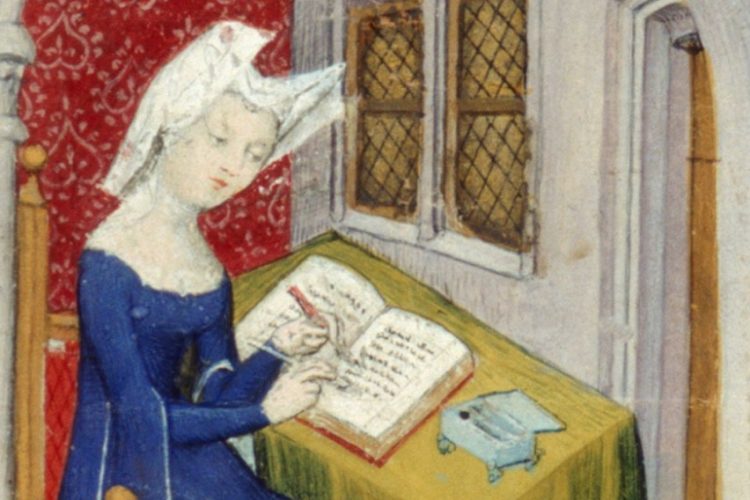
<p>Christine de Pizan, born in 1364 and deceased around 1430, was one of the first women to earn a living through her writing. She advocated for women&#8217;s rights and defended their intellectual and moral abilities in her works, particularly The Book of the City of Ladies.</p>
<p><img loading="lazy" decoding="async" class="alignnone size-full wp-image-9923" src="https://europescastles.com/wp-content/uploads/2024/09/Christine-de-Pizan.jpg" alt="Christine de Pizan" width="852" height="601" srcset="https://europescastles.com/wp-content/uploads/2024/09/Christine-de-Pizan.jpg 852w, https://europescastles.com/wp-content/uploads/2024/09/Christine-de-Pizan-300x212.jpg 300w, https://europescastles.com/wp-content/uploads/2024/09/Christine-de-Pizan-768x542.jpg 768w" sizes="(max-width: 852px) 100vw, 852px" /></p>
<p>Louvre Castle in Paris, originally a medieval fortress, served as the setting for much of Christine’s work. She lived in the French court during this time. Although today known as a museum, the Louvre was a residence of kings and a center of intellectual activity during Christine&#8217;s life.</p>
<p>&nbsp;</p>
<h2>Joan of Arc (1412 – 1431): The warrior who defended castles</h2>
<p>Joan of Arc, born in 1412 and executed in 1431, remains one of the most iconic figures in French history. Her military campaigns, particularly during the Hundred Years&#8217; War, were crucial in recapturing castles and fortresses from English control.</p>
<p><img loading="lazy" decoding="async" class="alignnone size-full wp-image-9924" src="https://europescastles.com/wp-content/uploads/2024/09/Joan-of-Arc.jpg" alt="Joan of Arc" width="720" height="405" srcset="https://europescastles.com/wp-content/uploads/2024/09/Joan-of-Arc.jpg 720w, https://europescastles.com/wp-content/uploads/2024/09/Joan-of-Arc-300x169.jpg 300w" sizes="(max-width: 720px) 100vw, 720px" /></p>
<p>Château de Chinon is again significant here. It was at this castle that Joan met with Charles VII, persuading him to let her lead his army. This castle played a pivotal role in Joan’s story and in the history of France.</p>
<p>&nbsp;</p>
<h2>Julian of Norwich (1342 – after 1416): A visionary from the shadows of castles</h2>
<p>Julian of Norwich, born in 1342 and deceased sometime after 1416, was a mystic and theologian whose spiritual writings influenced religious thought throughout medieval Europe. While not directly associated with castles, her visions were read by many nobles and clergy who lived within them.</p>
<p><img loading="lazy" decoding="async" class="alignnone size-full wp-image-9925" src="https://europescastles.com/wp-content/uploads/2024/09/Julian-of-Norwich.jpg" alt="Julian of Norwich" width="920" height="656" srcset="https://europescastles.com/wp-content/uploads/2024/09/Julian-of-Norwich.jpg 920w, https://europescastles.com/wp-content/uploads/2024/09/Julian-of-Norwich-300x214.jpg 300w, https://europescastles.com/wp-content/uploads/2024/09/Julian-of-Norwich-768x548.jpg 768w" sizes="(max-width: 920px) 100vw, 920px" /></p>
<p>Norwich Castle, located in Julian’s home city, symbolizes the close relationship between religious mysticism and the power structures of the Middle Ages. The castle dominated the cityscape, providing both military defense and a center of governance.</p>
<p>&nbsp;</p>
<h2>Margery Kempe (c. 1373 – after 1438): A spiritual pilgrim in the world of castles</h2>
<p>Margery Kempe, born around 1373 and alive after 1438, was another mystic. She chronicled her spiritual journeys in <em>The Book of Margery Kempe</em>, considered one of the earliest autobiographies in English. Her religious fervor brought her into contact with the noble classes and clergy, many of whom resided in castles.</p>
<p><img loading="lazy" decoding="async" class="alignnone size-full wp-image-9926" src="https://europescastles.com/wp-content/uploads/2024/09/Margery-Kempe.webp" alt="Margery Kempe" width="768" height="586" srcset="https://europescastles.com/wp-content/uploads/2024/09/Margery-Kempe.webp 768w, https://europescastles.com/wp-content/uploads/2024/09/Margery-Kempe-300x229.webp 300w" sizes="(max-width: 768px) 100vw, 768px" /></p>
<p>King’s Lynn Castle in Norfolk, England, where Margery lived, was an important medieval stronghold. It stood as a backdrop to her life as she navigated the religious and social landscapes of the time.</p>
<h2>Castles as witnesses to female power</h2>
<p>They twelve famous women of the Middle Agesnot only shaped the history of their time. They also left their marks on the castles and fortresses that dominated the medieval landscape. From Empress Theodora’s reign in Byzantium to Joan of Arc’s defense of French fortresses, each woman contributed in unique ways to the evolution of Europe’s castles. These structures, whether military strongholds, religious sanctuaries, or centers of courtly life, bear witness to the complex and multifaceted roles women played during the medieval period. Their stories remain intertwined with the architectural heritage of Europe&#8217;s castles, inspiring both scholars and visitors to this day.</p>
<p>The post <a href="https://europescastles.com/famous-persons/twelve-famous-women-of-the-middle-ages/">Twelve famous women of the Middle Ages</a> appeared first on <a href="https://europescastles.com">Europe&#039;s Castles</a>.</p>
]]></content:encoded>
					
					<wfw:commentRss>https://europescastles.com/famous-persons/twelve-famous-women-of-the-middle-ages/feed/</wfw:commentRss>
			<slash:comments>0</slash:comments>
		
		
			</item>
	</channel>
</rss>