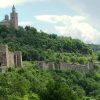

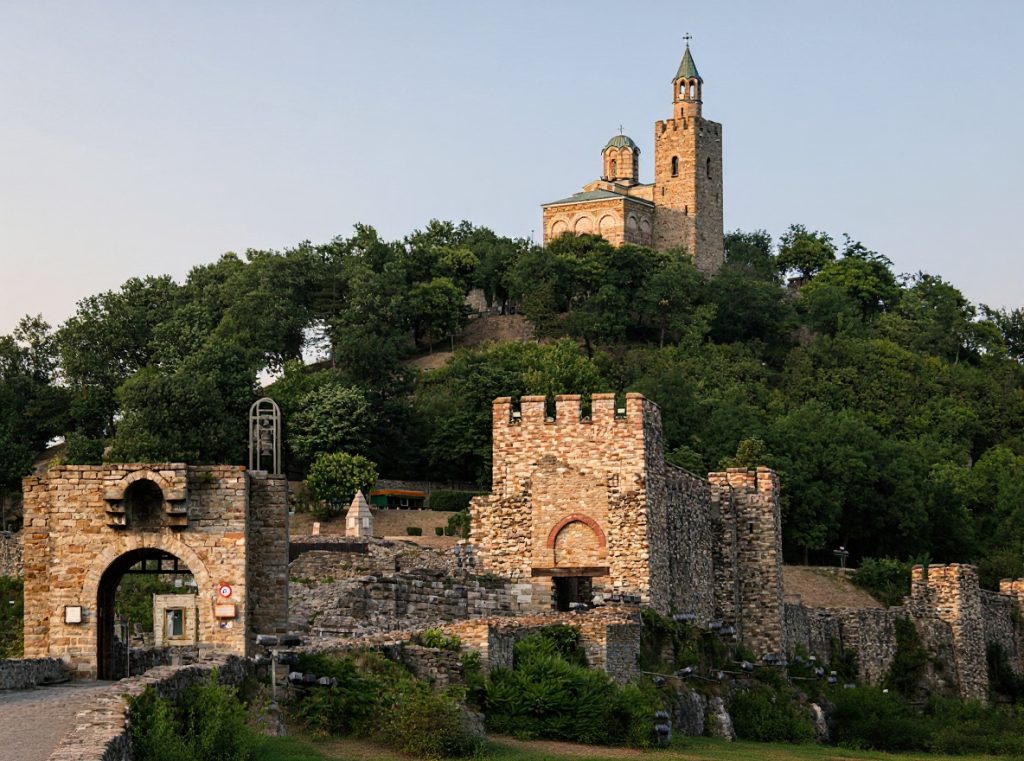
Crowning a rocky hill above the winding Yantra River, Tsarevets Fortress served as the political and spiritual heart of the Second Bulgarian Empire for over two centuries. Byzantine builders constructed a city on this strategic site near the end of the 5th century. Bulgarians began their stronghold in the 12th century. Brothers Asen and Peter led a rebellion against the Byzantine Empire in 1185 and established the fortress. Just one year later, it became the capital of the newly formed state. After the establishment of the Second Bulgarian Empire with its capital in Veliko Tarnovo, the fortress became the most important one in Bulgaria. Contemporary observers often compared it with Rome and Constantinople in magnificence.
Location of Tsarevets Fortress
The fortress sits on a hill with the same name in Veliko Tarnovo in northern Bulgaria. Tsarevets rises 206 metres above sea level. The river’s sharp twists form high hills with rocky cliffs, and the river surrounds the hill on three sides. Veliko Tarnovo lies in north central Bulgaria, roughly 240 kilometres east of Sofia. Visitors can reach the city by bus from Sofia in approximately three hours. The fortress occupies a prominent hill in Veliko Tarnovo. A pleasant walk from the city center takes about 15 to 20 minutes. Several city buses run to the square at the base of Tsarevets Hill. The site commands sweeping views over the surrounding hills and the old artisan quarter below.
History of Tsarevets Fortress
The earliest evidence of human presence on the hill dates from the 2nd millennium BC. People settled it in the 4th century. Byzantine builders then constructed a city, tentatively identified with Zikideva, near the end of the 5th century. The Slavs and Bulgars rebuilt and fortified the fortress between the 8th and 10th centuries. The Byzantines fortified it again in the early 12th century. Construction of the fortress began in the mid-12th century, and it saw its peak during the reign of the Bulgarian tsars. It served as the Second Bulgarian Empire’s primary fortress and strongest bulwark between 1185 and 1393. The royal and patriarchal palaces occupied the site.
During this golden age, Tsarevets functioned as more than simply a military stronghold. Excavations show that Tsarevets, although a fortress wall surrounded it, was a real medieval town. The palace stood in the centre, while churches, numerous residential and commercial buildings, reservoirs and battle towers filled the complex. Kings Petar, Asen, Kaloyan and Ivan Asen the Second lived there. The Bulgarian Patriarchate occupied an area of about 30 decares and formed an independent fortress. It had the form of an irregular polygon, and fortress walls, gates and towers surrounded it. The fortress walls reached impressive dimensions. The fortress wall along the rock ridge of Tsarevets measured 2.4 metres thick. In some places it reached 3.6 metres, with battlements and towers.
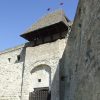
In 1393, Ottoman forces besieged the stronghold for three months before finally conquering it. They burnt it down on 17 July. This marked the fall of the Bulgarian Empire. Three entrances allowed entry to the fortress. The main one occupied the westernmost part of the hill, built on a narrow rock massif.
Current status
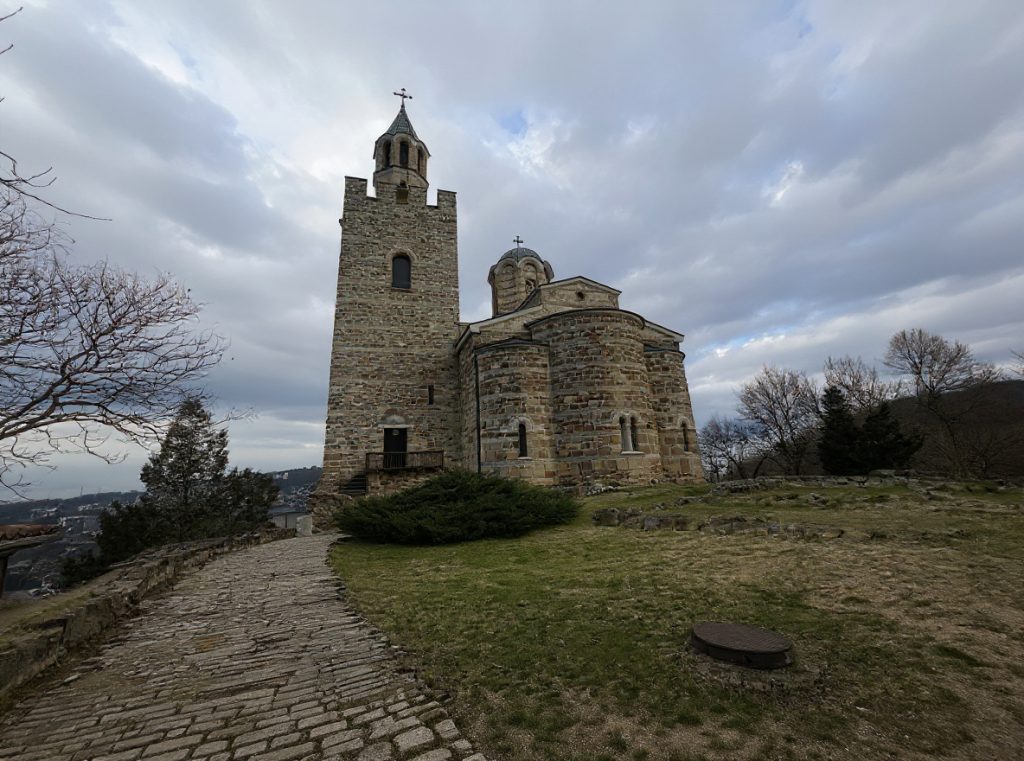
The restoration of the fortress Tsarevets began in 1930. Workers completed it in 1981 in honour of the 1300 anniversary of the establishment of the Bulgarian state. Architect Alexander Rashenov designed the first gate, which workers rebuilt without the tower from 1932 to 1934. Systematic excavations began after 1946, particularly in 1958 to 1959. These focused on the fortress walls, royal palace and patriarchal complex. The Bulgarian Academy of Sciences’ Archaeological Institute initiated comprehensive research efforts in 1974. The Regional Museum of History in Veliko Tarnovo now runs the site. Visitors can arrange guided tours in English, French, German and Russian through the museum.
Tourists flock to this popular attraction. The fortress opens for visits all year round with working hours 8 am to 7 pm from April till October. From November till March, it opens 9 am to 5 pm. The entry fee for Tsarevets Fortress typically costs around 10 BGN for adults. Visitors can explore the ruins of the royal palace and walk along the restored ramparts. They can also visit the reconstructed Patriarchal Cathedral at the summit. A spectacular sound and coloured light show dramatises the history of the fortress. This show takes place at night on national holidays and on the holiday of Veliko Tarnovo itself on March 22.
Today Tsarevets ranks as one of Bulgaria’s most significant cultural landmarks. The fortress walls rise dramatically from the cliffs, framing the reconstructed church at the peak. From the battlements, the Yantra River gleams far below. It loops around the wooded hills where medieval Tarnovo once spread. The site draws history enthusiasts and visitors alike. They all come to walk where Bulgarian tsars once ruled an empire that rivalled Byzantium itself.
Featured listings