
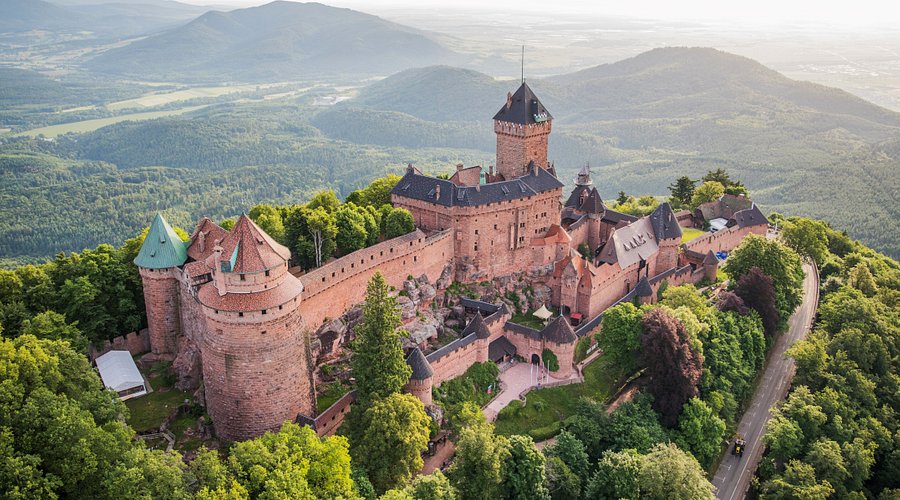
The Château du Haut-Koenigsbourg is one of Europe’s most captivating medieval castles. It is renowned for its picturesque setting and remarkable restoration. Perched high atop the Vosges mountains in the Alsace region of France, this castle offers an unparalleled glimpse into medieval life. Its architecture adds to its allure. Through centuries of transformation, destruction, and restoration, the château has remained a fascinating site. It draws those interested in history, culture, and architectural beauty.
Plan your visit to Château du Haut-Koenigsbourg
Tue–Sun 09:30–17:00July–August 09:00–19:00; January–March 09:30–12:00 & 13:00–17:00. Open at 10:30 on Mondays.
Location of Château du Haut-Koenigsbourg
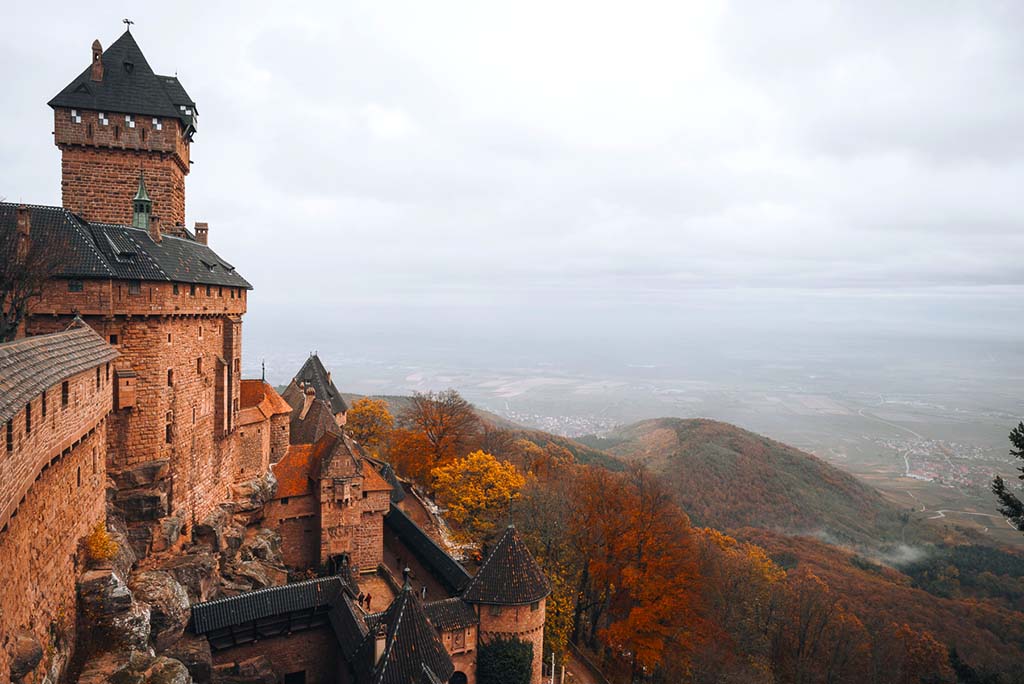
The Château du Haut-Koenigsbourg stands in Orschwiller, a small commune in northeastern France. It is located in the Bas-Rhin department. Its strategic position at an elevation of nearly 800 meters above sea level allows for commanding views. These views include the surrounding Alsatian plain, the Black Forest in Germany, and, on clear days, the Alps. This prime location made the castle a vital stronghold for its medieval rulers. It was used to control key trade routes between northern and southern Europe.
The castle’s location is easily accessible today. Its proximity to Strasbourg and Colmar makes it a popular destination for travelers. Those exploring the Alsace region are particularly drawn to it. The surrounding forests and vineyards add to the castle’s enchanting atmosphere. These features provide visitors with a serene and picturesque backdrop.
History of Château du Haut-Koenigsbourg
The history of Château du Haut-Koenigsbourg dates back to the 12th century. It was constructed by the Hohenstaufen family to oversee wine and wheat trade routes. Initially known as “Staufenberg,” the castle became a focal point of territorial disputes throughout the Middle Ages. It passed through the hands of several noble families and experienced numerous conflicts. The Thirty Years’ War was one such event. It led to its near-total destruction in 1633 by Swedish forces.
For two centuries, the castle remained in ruins. It became overgrown with vegetation. It stood as a symbol of lost grandeur. In 1899, Emperor Wilhelm II of Germany decided to undertake an ambitious restoration project. This effort was part of a broader initiative to reinforce German cultural pride in Alsace. At that time, Alsace was under German control. The restoration was led by architect Bodo Ebhardt. It aimed to reconstruct the castle as it might have appeared in the 15th century. The work was meticulous. The restoration team completed the project in 1908, using historical texts, archaeological findings, and artistic interpretations to recreate the fortress.
The castle’s history took another turn following the end of World War I. France regained control of Alsace during this period. Authorities designated the castle as a national monument and opened it to the public as a cultural and historical site. Since then, the château has become a testament to the complex and intertwined histories of France and Germany.
Current status
Today, Château du Haut-Koenigsbourg stands as one of France’s most visited castles. It attracts hundreds of thousands of visitors annually. Its restoration has been maintained over the years. Guests can experience a remarkably authentic representation of a medieval fortress. Visitors can explore its fortified walls, drawbridge, living quarters, towers, and intricate halls. Among the highlights is the weapons room. This room displays an extensive collection of medieval weaponry and armor.
The castle also hosts educational events, guided tours, and exhibitions. These provide insight into medieval warfare, daily life, and the castle’s storied history. The surrounding gardens and panoramic viewpoints further enhance the visitor experience. These offer breathtaking vistas of the Alsace region.
Managed by the French government as a historic monument, Château du Haut-Koenigsbourg is a prime example of cultural preservation. It is also a symbol of historical storytelling. Its importance extends beyond its architectural and historical value. It serves as a symbol of the enduring connections between France and Germany.
Castles near Château du Haut-Koenigsbourg
Frequently asked questions
Is Château du Haut-Koenigsbourg wheelchair accessible?
The tour route includes 300 steps of different heights, making it challenging for visitors with reduced mobility. Pushchairs are not permitted inside the monument and must be stored in a basement area.
Can I buy tickets at Château du Haut-Koenigsbourg on the day?
Yes, tickets can be purchased on-site by cash, cheque, or card. However, online booking at tickets.haut-koenigsbourg.fr is recommended during peak periods to save time, as queues can be long.
What is the history of Château du Haut-Koenigsbourg?
Built in the 12th century by the Hohenstaufen family, the castle changed hands between the Habsburgs and other rulers before being destroyed in the Thirty Years' War. It was restored 1900–1908 by German Emperor Wilhelm II, who commissioned architect Bodo Ebhardt to recreate a medieval fortress.
Are guided tours available at Château du Haut-Koenigsbourg?
Yes, guided tours in French, German, and English are offered for an additional €2 supplement (€14 total). Audio guides are available for €4 extra, and a self-guided visit is included with standard admission.
Is there parking at Château du Haut-Koenigsbourg?
Yes, there are 150 free parking spaces near the monument. The car park is approximately 10–15 minutes' walk uphill from the castle entrance at the top of the site.
Featured listings