
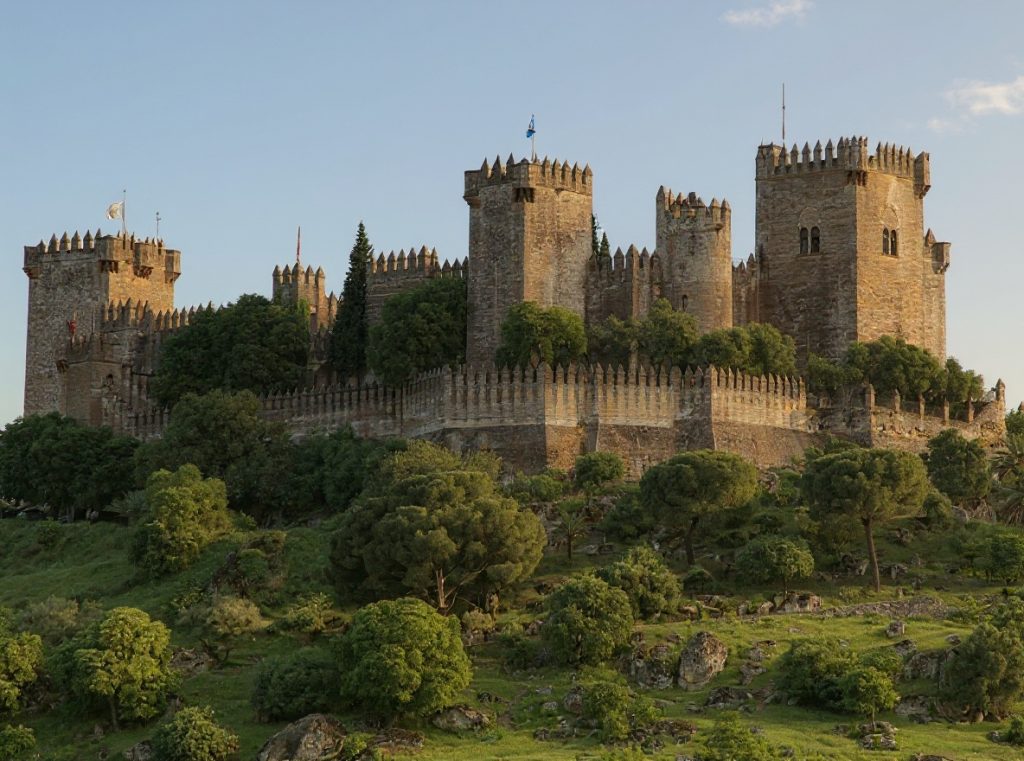
Rising above the Guadalquivir valley on a 252-metre hill, Castillo de Almodóvar del Río commands the landscape of Córdoba province with its nine towers and formidable walls. Builders raised this fortress of Arab origin around 740 in the village of Almodóvar del Río. It played a fundamental role in defence because of its strategic location. Traces of multiple cultures, including Muslim and Christian, have left their mark on the architectural style of this unique building. Arabs knew the castle as Hisnu-l-mudawar or “the round castle”. It has witnessed thirteen centuries of sieges, royal intrigue and cultural transformation.
Plan your visit to Castillo de Almodóvar
Sat–Sun 11:00–20:00Oct–Mar: Mon–Fri 11:00–14:30, 16:00–19:00, weekends 11:00–19:00; Jun–Jul: Mon–Fri 9:00–15:30, weekends 11:00–20:00
Location of Castillo de Almodóvar del Río
The castle sits 22 kilometres from Córdoba in the municipality of Almodóvar del Río, in the Guadalquivir lowland region. It occupies 5,628 square metres on a hilltop 252 metres high. Visitors travelling from Córdoba take the A-431 towards Palma del Río, then the Carretera de la Estación, which leads to the town. The fortress stands 15 miles from Córdoba, on the left bank of the Guadalquivir. The castle rises almost vertically from the river. The modern AVE high-speed railway threads through the narrow gap between hill and water. This position once allowed control of river traffic when small boats navigated the Guadalquivir. It also provided surveillance of the surrounding plains. Today the hilltop offers sweeping views across the Córdoba countryside, olive groves and white villages scattered below.
History of Castillo de Almodóvar del Río
A Roman fort previously occupied this site, yet the current structure dates from Arab Umayyad origin, in the year 760. In 756 this fortress became the estate of the Moorish Prince Al’delMalik Ben Qatan. From 758 onwards it passed into the hands of the Emirate of Córdoba in the reign of Abderraman I. In the ninth century, people knew Almodóvar del Río as Almudawar Al-Adna. During the tenth century it linked closely to the Caliphate of Córdoba before becoming part of the Taifa of Carmona. In the eleventh and twelfth centuries, it passed to the Taifa of Seville, and finally the Almohad Empire. The Moorish King Abed Mohammed de Baeza died at the gates of the castle in 1226. That same year the fort fell into Christian hands when Fernando III ‘The Saint’ took it.
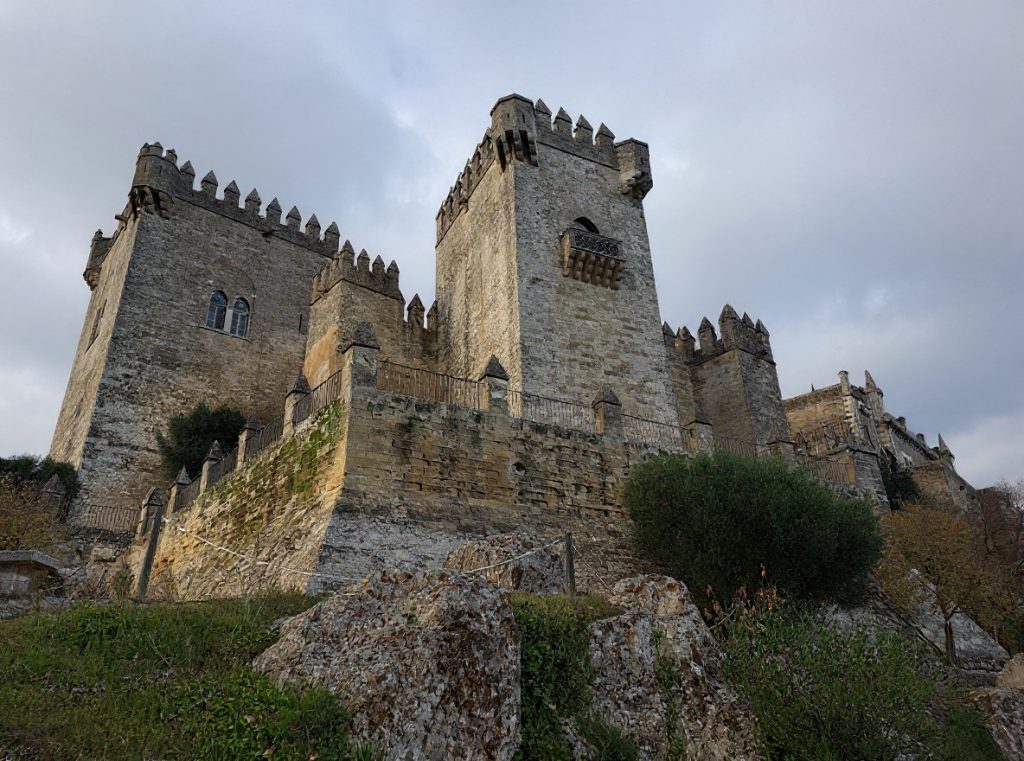
The Castilian Kings Pedro I of Castile and Enrique II of Trastamara initiated successive extensions to the castle. Alfonso XI ‘The Just’ and Pedro I ‘The Cruel’ also got involved in these extensions. It served as royal residence of Pedro I and Enrique II in the fourteenth century. Because enemies had never taken the castle by force, Pedro I used it as a treasure store. Its walls served as a prison for Doña Juana de Lara (wife of Infante D. Tello, half-brother of King Pedro I). Guards also kept the treasures of Castilla here, while its dungeons witnessed the agony of illustrious prisoners such as the 1st Duke of Benavente. The current image results from different construction periods in the tenth, twelfth, thirteenth and especially the fourteenth centuries. Workers built its most important Gothic-Mudéjar style towers during this final period.
Current status
Since 2001, the XI Marquis of La Motilla, Miguel Ángel de Solís y Martínez Campos, has owned Castillo de Almodóvar del Río. The castle welcomes visitors year-round with several tour options. Guests can explore at their own pace with the help of a map and explanatory panels. Staff provide panels in two languages (Spanish and English) along with video guides. Its interior features a display of medieval armour and weapons. Projections show the castle’s history and its owners, and a collection of sword replicas includes King Arthur’s Excalibur. The fortress features nine towers, each offering different views and architectural details. Visitors discover the beauty of its walls and towers. These include the square tower, the round tower and the Homage tower. They also see the weapons courtyard and the mystery of its underground dungeons, passages and other underground elements.
The castle gained fresh fame when it appeared in popular culture. HBO filmed part of the seventh season of Game of Thrones at the castle. The production depicted House Tyrell’s home Highgarden and also parts of Casterly Rock, the ancestral home of House Lannister. The Medieval Historical Reenactment Days faithfully recreate life between 1350 and 1360. They focus on the struggles between Pedro I and Enrique II for Almodóvar Castle. Visitors can enjoy activities such as falconry, battles, dances and assaults on the castle. Characters from the period transport them back to the fourteenth century. A moat garden surrounds the fortress with zones of Oriental, high mountain, Mediterranean, tropical and floral vegetation. Paths lead to the castle’s viewpoint. From those ramparts, the Guadalquivir winds through fertile plains where olive trees shimmer silver-green.
Castles near Castillo de Almodóvar
Frequently asked questions
Was Castillo de Almodóvar used in Game of Thrones?
Yes, the castle served as Highgarden, the seat of House Tyrell, in Season 7 of Game of Thrones. The dungeons also appeared as part of Casterly Rock, and visitors can see stills and costumes from the filming throughout the castle.
How long does it take to visit Castillo de Almodóvar?
Allow 1.5 to 2 hours for a self-guided visit. The tour includes towers, dungeons, courtyards, and Game of Thrones exhibits with explanatory panels in Spanish and English.
Do I need to book tickets in advance for Castillo de Almodóvar?
Advance booking is not required but is available online. Tickets can be purchased at the castle ticket office, which closes one hour before the castle closes.
What are the opening hours of Castillo de Almodóvar?
Hours vary seasonally: October to March weekdays 11:00–14:30 and 16:00–19:00, weekends 11:00–19:00; June to mid-August weekdays 9:00–15:30, weekends 11:00–20:00. Check the official website for other months.
How do I get to Castillo de Almodóvar from Córdoba?
Take bus M-250 from Córdoba bus station to Almodóvar del Río (30–38 minutes, departing every 4 hours). By car it's a 25-minute drive (29 km) via the A-431 with parking available at the castle.
Official website

Featured listings