
Carved into a limestone plateau high above the Provençal plains, Château des Baux-de-Provence commands the rocky spur of Les Baux with a presence both ancient and unyielding. The fortress rises from the pale stone of the Alpilles massif as though the mountain itself sculpted it. For nearly a millennium this stronghold sheltered one of the most powerful dynasties in southern France. Today its towers, ramparts and troglodyte halls recall medieval ambition and the conflicts that shaped Provence.
Plan your visit to Château des Baux-de-Provence
Location of Château des Baux-de-Provence
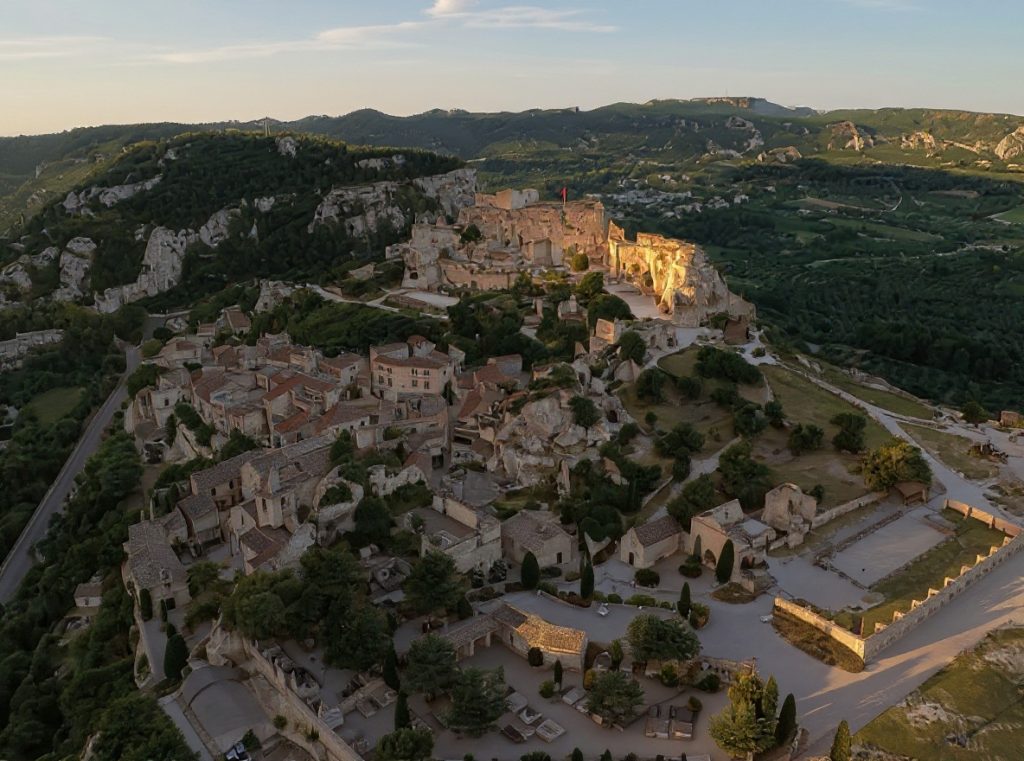
The château sits in Les Baux-de-Provence, a village perched on the last foothills of the Alpilles in the Bouches-du-Rhône. The site lies between Arles and Avignon, roughly one hour from Marseille and Aix-en-Provence. From the A7 motorway, exit 24 leads south through olive groves and vineyards to the clifftop settlement. Visitors must pay for parking near the village entrance. Cobbled streets then climb steeply from there to the castle gate. Regional buses serve Les Baux in summer months along line 707, connecting Avignon and Arles. The nearest train stations stand at Arles, Tarascon and Avignon TGV. A five-minute walk through the medieval village brings visitors to the château entrance on Rue du Trencat. The fortress covers five hectares and occupies a rocky spur seven hundred metres long. Deep ravines flank it on either side.
History of Château des Baux-de-Provence
Texts from the second half of the tenth century mention a castrum at Les Baux. Early occupation served primarily military purposes. The House of Baux claimed descent from Balthazar, one of the Magi, and placed a sixteen-pointed star on their coat of arms. Around 1030 Hugues first adopted the surname “des Baux.” The dynasty grew powerful through the Middle Ages and controlled seventy-nine towns and strongholds across Provence and neighbouring counties. Troubadours sang courtly songs in the castle halls, while poets and philosophers gathered at the Baux court. The twelfth century brought the Baussenque Wars, three bitter conflicts between 1144 and 1162 over succession to the County of Provence. Lords Hugues III and Barral I launched major building campaigns and replaced earlier fortifications with a keep. They exploited the natural rock so it served as a support for other structures.
By the thirteenth century, three thousand inhabitants lived in the village below. The fortress withstood assaults through the following decades. Several lords coveted this stronghold because its height allowed observation as far as the Mediterranean on clear days. In 1426 Princess Alix died without an heir. The lordship passed to the comtal estates and then to the royal domain. The barons of the Counts of Provence took control, and the town enjoyed a brief golden age. Builders partly rebuilt residential buildings, raised new ramparts, and erected fine private mansions. In 1486 Provence joined the Kingdom of France. Family feuds and wars of religion brought decline during the sixteenth century. Protestant rebellions prompted King Louis XIII to restore order. In 1631 his minister Cardinal Richelieu besieged the town. After its fall in 1633, royal troops demolished the ramparts with gunpowder.
Current status
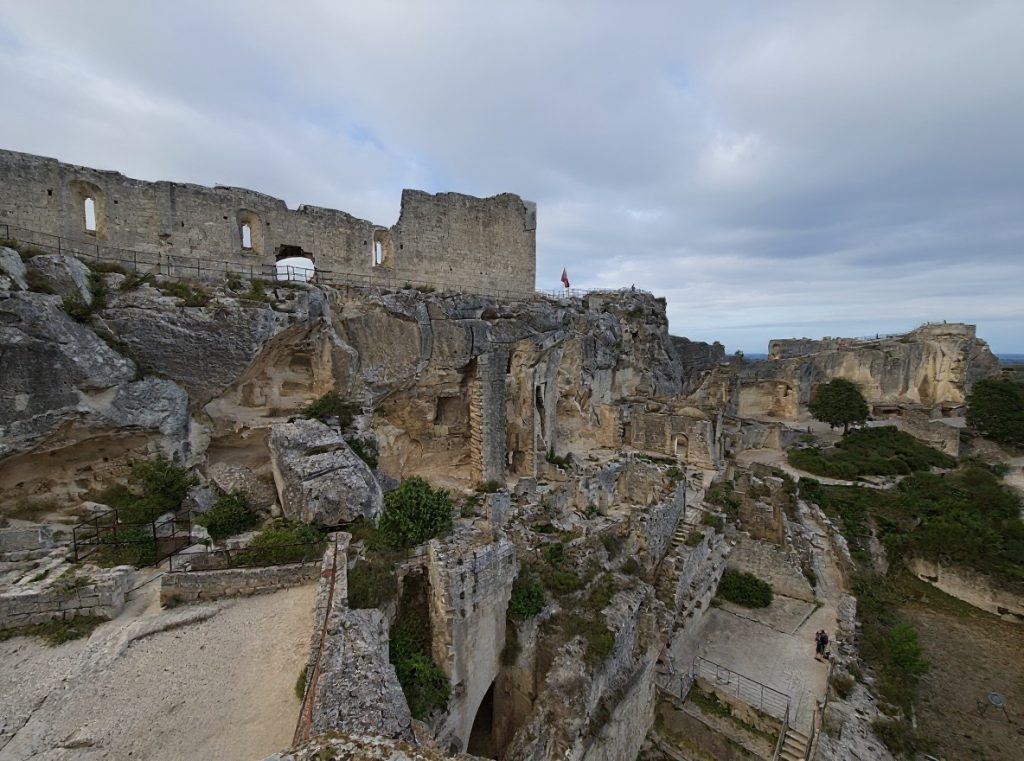
The French state classifies the entire site as a Historic Monument. The château opens to visitors every day of the year, though hours vary by season. Entrance costs ten euros for adults, seven euros for children aged seven to seventeen. Audio guides in seven languages accompany visitors through the ruins. Explanatory panels and orientation tables mark key points along the circuit. Demonstrations of medieval siege engines—trebuchet, bricole and couillard—take place regularly. A replica trebuchet sixteen metres tall stands among the ruins. Workshops teach archaeology, calligraphy and medieval seal-making. Families with children receive free activity booklets filled with puzzles about castle history. An escape game invites teams to solve mysteries surrounding Alix, the last princess. Seasonal events animate the fortress, so the Médiévales des Baux run from late March through August. They feature falconry, knightly combat and artisan demonstrations.
Culturespaces manages the site and organises the cultural programme. Many remnants testify to the castle’s past importance: the keep built in the thirteenth century, the Saracen and Paravelle towers, and chapels carved in Romanesque and Flamboyant Gothic styles. The site also preserves the Quiqueran Hospital from the sixteenth century, an oven house, cisterns, a dovecote and troglodyte dwellings. Workers cut the dwellings directly from the limestone. Whole sections of wall emerge from the bedrock as if the fortress had always been part of the mountain. From the ramparts, views extend across the Camargue wetlands, the vineyards and olive groves of the valley, and the white ridges of the Alpilles. The village of Les Baux clings to the slopes below with Renaissance houses and narrow lanes. Officials designated it one of the Most Beautiful Villages in France.
Castles near Château des Baux-de-Provence
Frequently asked questions
Is Château des Baux-de-Provence open all year?
Yes, the château is open every day of the year except 25 December. Opening hours vary by season, with shorter hours in winter (10:00–17:00) and extended hours in summer (09:00–19:30 in July and August).
How much does it cost to visit Château des Baux-de-Provence?
Standard admission is €10 for adults, €9 for seniors (65+), €7 for ages 7–17, and free for children under 7. A combined pass with the nearby Carrières des Lumières is available for €21.
Can I visit Château des Baux-de-Provence by public transport?
Yes, ZOU bus line 707 connects Avignon bus station to Les Baux-de-Provence twice daily, taking about 1 hour. The château is a 5-minute walk from the village entrance.
What can I see at Château des Baux-de-Provence?
The 5-hectare medieval fortress includes castle ruins carved into the rock, defensive towers, reconstructed siege weapons, and a panoramic viewpoint over Provence stretching from Aix to Arles. Free audio guides are available in 10 languages.
Is Château des Baux-de-Provence suitable for visitors with mobility issues?
The château has steep rocky terrain with uneven surfaces. However, two Quadrix wheelchairs are available for visitors with reduced mobility (subject to availability). International disability cards provide free entrance.
Featured listings