
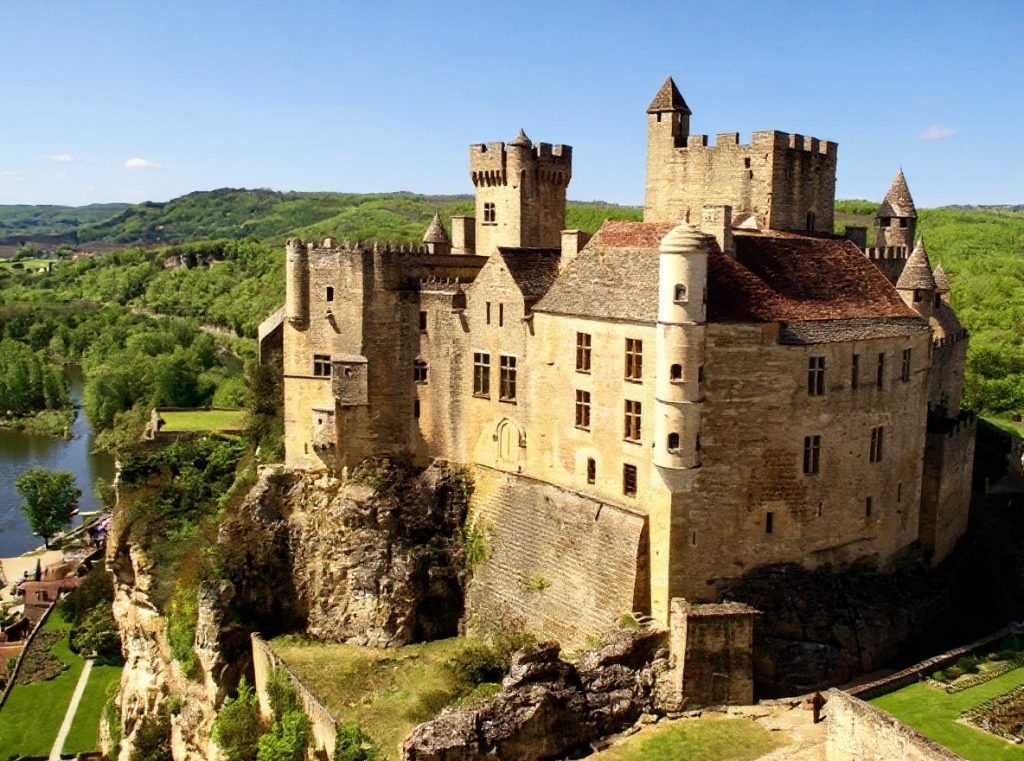
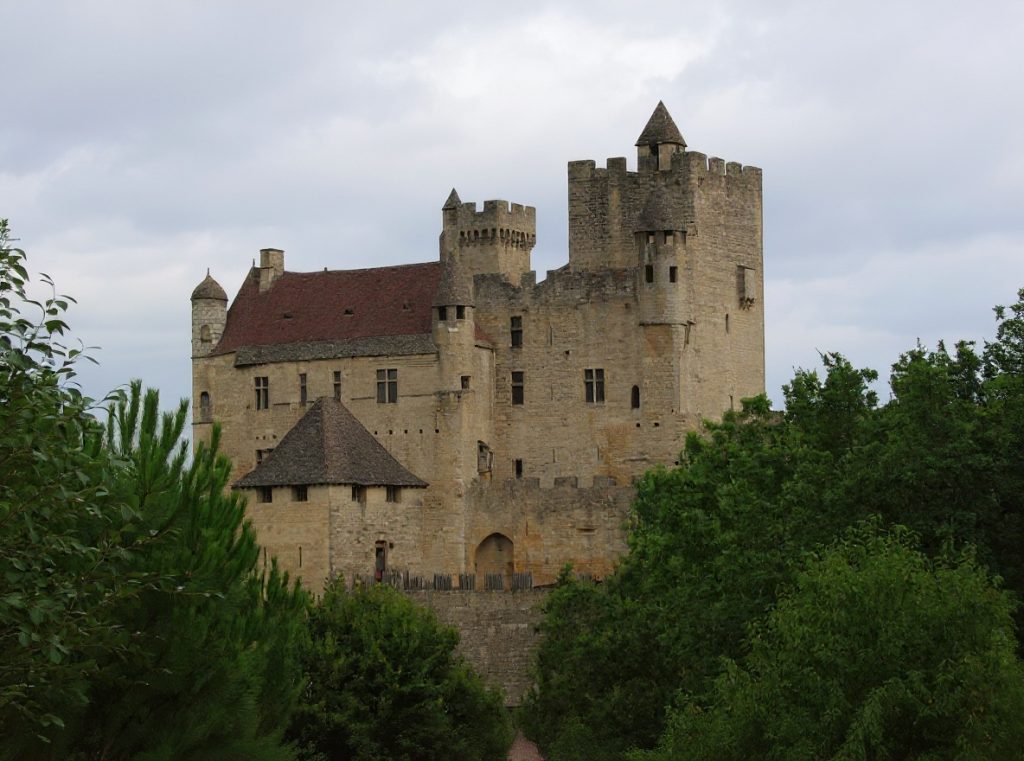
Perched atop a vertiginous limestone cliff, Château de Beynac commands the Dordogne Valley with an austere magnificence forged over nine centuries. This formidable medieval fortress rises 150 metres above the meandering river, its weathered ramparts and square keep standing as one of the most authentic testimonies to feudal military architecture in France. The château dominates the village of Beynac-et-Cazenac, officially designated among Les Plus Beaux Villages de France, and its imposing silhouette has witnessed the footsteps of legendary figures including Richard the Lionheart and Simon de Montfort. Moreover, its exceptional preservation allows visitors to experience the raw power and strategic genius of medieval defensive design.
Plan your visit to Château de Beynac
Location of Château de Beynac
Château de Beynac sits in the commune of Beynac-et-Cazenac in the Dordogne département of southwestern France’s Nouvelle-Aquitaine region. The fortress occupies a rocky promontory overlooking the north bank of the Dordogne River, approximately ten kilometres from Sarlat-la-Canéda. Visitors can access the castle via multiple routes. Parking facilities lie at the village base, requiring a scenic fifteen-minute climb through cobblestone medieval streets. Alternatively, motorists can drive to parking areas near the summit at 2520 Route du Château, placing them within one minute’s walk of the entrance. The sheer cliff facing the river provides natural protection from the south, while the fortress gazes directly across the water toward Château de Castelnaud, its historic English rival during the Hundred Years’ War.
History of Château de Beynac
The barons of Beynac constructed the castle in the 12th century, establishing it as one of the four great baronies of Périgord. The original structure featured a massive square Romanesque keep with thick walls and minimal openings, designed primarily for observation and control of river traffic below. Each vessel navigating the Dordogne paid passage tolls to the Lord of Beynac, generating considerable economic power. In 1194, Adhémar de Beynac died without direct heirs. Richard the Lionheart, King of England and Duke of Aquitaine through his mother Eleanor, claimed the fortress and gifted it to his trusted knight Mercadier. However, this transfer proved brief. Mercadier fell to assassination in Bordeaux in 1200, and the castle reverted to the Beynac family under Pons de Beynac. During the 13th century, Simon de Montfort captured Beynac during his crusade against the Cathars. The fortress gained strategic prominence during the Hundred Years’ War, when French forces held Beynac while English troops occupied Castelnaud across the river. The Dordogne itself marked the tense frontier between the two kingdoms. Throughout the 14th and 15th centuries, builders expanded the castle with additional residences, the States’ Hall where the four Périgord barons convened, and elaborate defensive systems including double crenellated walls, double moats, and a barbican. The 17th century brought further embellishments, including painted wooden panelling and a Renaissance staircase. The Beynac male line ended in 1753 with Pierre, the last marquis. His daughter Marie-Claude married into the Beaumont du Repaire family in 1761, and when she died childless in 1811, eight centuries of Beynac lineage concluded.
Current status
Lucien Grosso purchased the abandoned fortress in 1962 and initiated comprehensive restoration work that continues today under his successors. The French Ministry of Culture listed Château de Beynac as a monument historique in 1944, recognizing its exceptional historical and architectural significance. Today, private owners maintain and operate the castle, welcoming visitors year-round with varying seasonal hours. Guests explore the fortress at their own pace using mobile audio guides available in multiple languages. The tour encompasses the original keep, the guard room adjoining it, the magnificent Salle des États du Périgord with its Renaissance fireplace, and a small oratory adorned entirely with 15th-century frescoes depicting a Pietà and the Last Supper. Sumptuous tapestries portraying hunting scenes hang in several chambers, while 17th-century apartments retain their painted woodwork and beamed ceilings. The terrace of the spur offers breathtaking panoramic vistas across the valley. The castle’s authenticity has attracted filmmakers; Luc Besson’s Joan of Arc, Ridley Scott’s The Last Duel, and Les Visiteurs filmed here. Adults pay €11.50 for admission, while children under ten enter free. The château stands as an enduring monument to feudal power, its stones still echoing with the conflicts and grandeur of medieval France.
Castles near Château de Beynac
Frequently asked questions
How long does a visit to Château de Beynac take?
A typical visit takes 1 to 1.5 hours. The self-guided tour covers the 12th-century keep, guard room, Salle des États, and the terrace of the spur with views over the Dordogne valley.
Do I need to book tickets in advance for Château de Beynac?
No, reservations are not required. You can purchase tickets at the entrance or book online through the official website for convenience.
Is Château de Beynac suitable for children?
Yes, children under 11 enter free. The medieval fortress with its towers, rooms, and panoramic views appeals to families, though be aware of steep climbs and stairs.
What are the opening hours for Château de Beynac?
The castle is open daily year-round. Hours vary seasonally: 10:00–18:00 (Feb–Apr), 10:00–19:00 (Apr–Jul), and 09:00–22:00 in July–August with extended evening hours on certain days.
How do I get to Château de Beynac from Sarlat?
Regional buses run from Sarlat to Beynac-et-Cazenac (25 minutes, €3). By car, it's a 10-minute drive with paid parking (€3 for 2 hours) available near the castle entrance at the top of the village.
Official website

Featured listings