
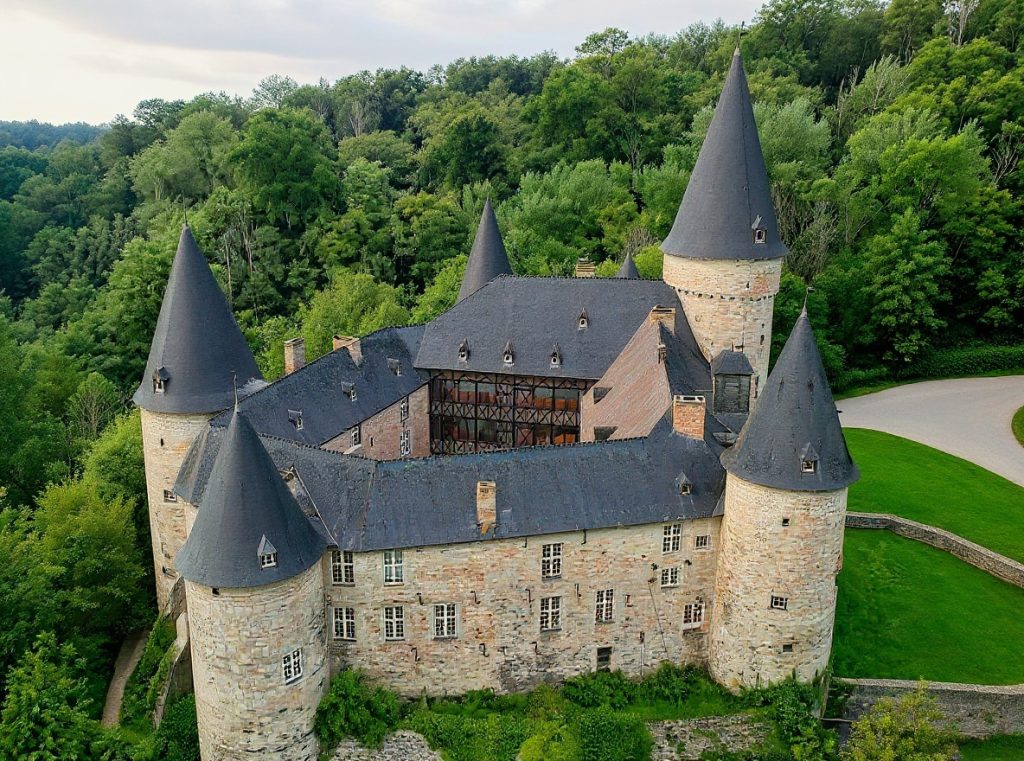
Rising from a rocky outcrop above the Lesse valley, Vêves Castle commands the landscape near the village of Celles with its six round towers and limestone walls. This remarkable fortress dates to the thirteenth century, though its roots stretch even deeper into Belgian history. The castle forms an irregular pentagon that follows the natural contours of the stone beneath it. Moreover, it stands as one of the finest examples of fifteenth-century military architecture in Wallonia. Authorities now classify it as exceptional heritage.
Plan your visit to Vêves Castle
Thu–Fri Closed
Sat–Sun 10:00–17:00Sat–Sun 10:00–17:00; daily 6 Jul–23 Aug; daily during Easter and autumn holidays (check website for exact dates)
Location of Vêves Castle
Vêves Castle sits in the province of Namur in Wallonia, just southwest of the picturesque village of Celles. The castle occupies a strategic hilltop position. This position once controlled the old road between Dinant and Rochefort. Today, visitors reach it easily by car from several Belgian cities. Namur lies thirty minutes away by car. Meanwhile, Brussels sits approximately one hour fifteen minutes distant. Free parking welcomes guests at the castle entrance.
The nearest train station serves Dinant, ten kilometers from the castle. From there, a taxi covers the remaining distance in about fifteen minutes. The surrounding region features rolling forested hills typical of the Ardennes. Additionally, a popular hiking trail connects Vêves with nearby Walzin Castle. It offers scenic views across the valley. The village of Celles itself charms visitors with traditional limestone houses and a beautiful Romanesque church.
History of Vêves Castle
According to tradition, Pepin of Herstal established the first fortification here in the late seventh century. Saint Hadelin’s presence and the hill’s commanding position attracted him to this spot. The initial structure burned in 1200. The Beaufort family then rebuilt it in 1230 after acquiring the fief through marriage. Wauthier de Beaufort wed Ode de Bretagne and became Lord of Celles. He added the Breton ermine to his ancestral coat of arms.
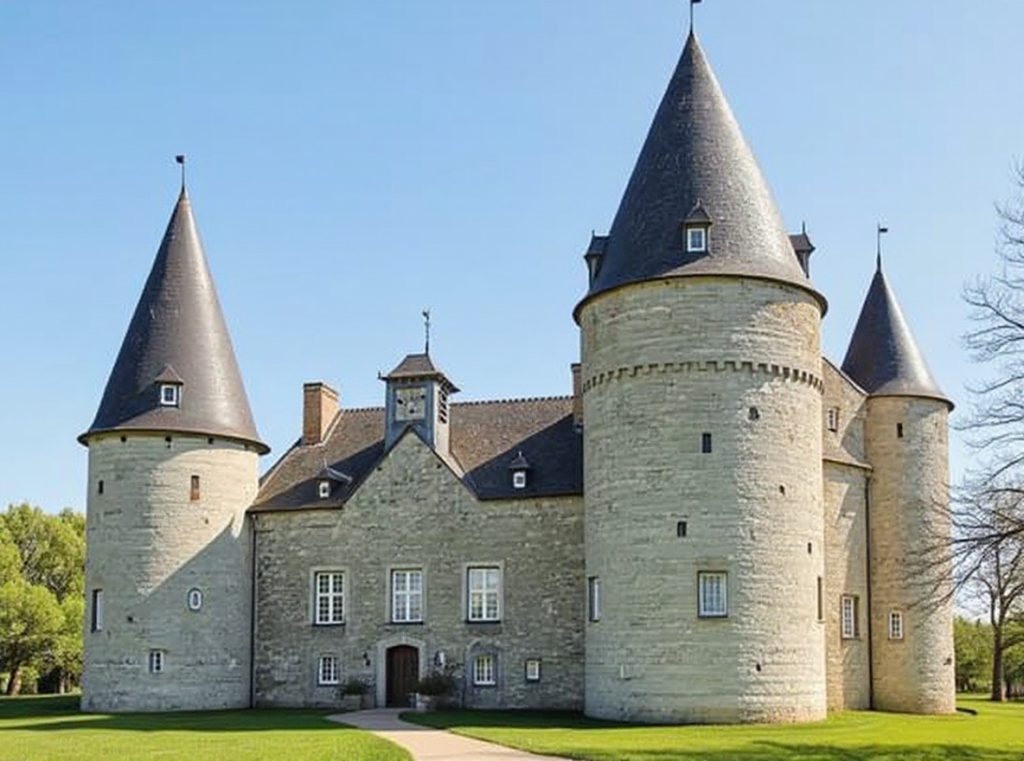
Fire destroyed the castle again at the beginning of the fifteenth century. The Beaufort family reconstructed it around 1410, creating the present pentagonal layout with its six distinctive towers. One tower, the great keep, rises thirty-six meters. It features walls three meters thick at its base. The castle served as a military fortress throughout the Middle Ages. Notably, Gérard de Beaufort distinguished himself at the Battle of the Golden Spur in 1302. Louis de Beaufort participated in the 1466 siege of Dinant. However, the castle burned once more during that conflict.
The Renaissance brought complete transformation to the buildings. Defensive battlements gave way to pointed slate roofs. Arrow slits widened into windows as residential needs replaced military function. Under Louis XV, craftsmen added refined interior elements including wood paneling, alcoves, and decorative windows. A charming half-timbered gallery from the sixteenth century connects the medieval residential wing to a Renaissance addition. Meanwhile, another courtyard wall received a red brick façade in the Louis XV style. This created striking architectural contrast.
Through marriage, the family name became Liedekerke Beaufort during the eighteenth century. Members played important roles in French, Belgian, and Dutch politics. Eventually, Count Hadelin de Liedekerke Beaufort donated the castle to a foundation in the twentieth century. He wanted to ensure its preservation.
Current status
The foundation established by the Liedekerke Beaufort family runs Vêves Castle today. Count Hadelin de Liedekerke Beaufort chairs the foundation. It maintains this family and historical heritage. The castle opens regularly to the public from late March through early November. During summer months from early July to late August, it welcomes visitors daily. Otherwise, it opens on weekends and public holidays. The ticket office closes at 5 PM. However, visitors may enter up to thirty minutes afterward.
Guided tours in French, Dutch, English, and Spanish lead guests through richly furnished rooms. Visitors explore dining halls, bedrooms, medieval kitchens, and a chapel. The chapel features decoration with refined simplicity. The armory displays original swords and armor alongside a sandstone floor mosaic. The mosaic bears family coats of arms. Eighteenth-century furniture fills the chambers. This includes Louis XV armchairs, marquetry writing desks, antique clocks, and porcelain tableware. The blue salon particularly impresses with its Louis XV styling.
Family-friendly activities distinguish Vêves from many heritage sites. Children receive knight or princess costumes as part of admission. A treasure hunt sends young visitors searching for the legendary Holy Grail. They search throughout the castle’s chambers and staircases. Furthermore, special guided family tours include knighthood ceremonies, medieval dance initiations, and crossbow tournaments. During holiday seasons, reenactments bring scenes of noble life and knight training to the courtyard. A small shop near the entrance offers local handicrafts, books, and souvenirs. These items relate to the castle and its era.
The castle stands proud against the Walloon sky. Its six towers catch light as they have for centuries. Gardens cascade in terraces at its feet. They offer magnificent views back toward the fortress. Stone bridges now replace the original drawbridges.
Castles near Vêves Castle
Frequently asked questions
Is Vêves Castle suitable for children?
Yes, Vêves Castle is very family-friendly. All children receive free knight or princess costumes to wear during their visit, and an optional treasure hunt is available for €2.75 per person.
How long does it take to visit Vêves Castle?
The self-guided interior tour takes about 45 minutes at a comfortable pace. Allow 1 to 1.5 hours in total to explore the castle and enjoy the exterior views.
Is Vêves Castle open year-round?
No, Vêves Castle is open seasonally. It operates on weekends and public holidays from late March to early November, with daily opening during summer (July–August) and school holidays.
Can I reach Vêves Castle by public transport?
There is no direct bus service. The nearest train station is Dinant (10 km away), from which you need to take a taxi (about 15 minutes) to reach the castle.
Does Vêves Castle have facilities for visitors?
Yes, the castle offers free parking, a gift shop and a seasonal cafeteria with views during fine weather in high season. The castle is not accessible to visitors with reduced mobility due to its elevated location.
Featured listings